Vibe Coding Techniques That Keep a Project from Falling Apart
In short
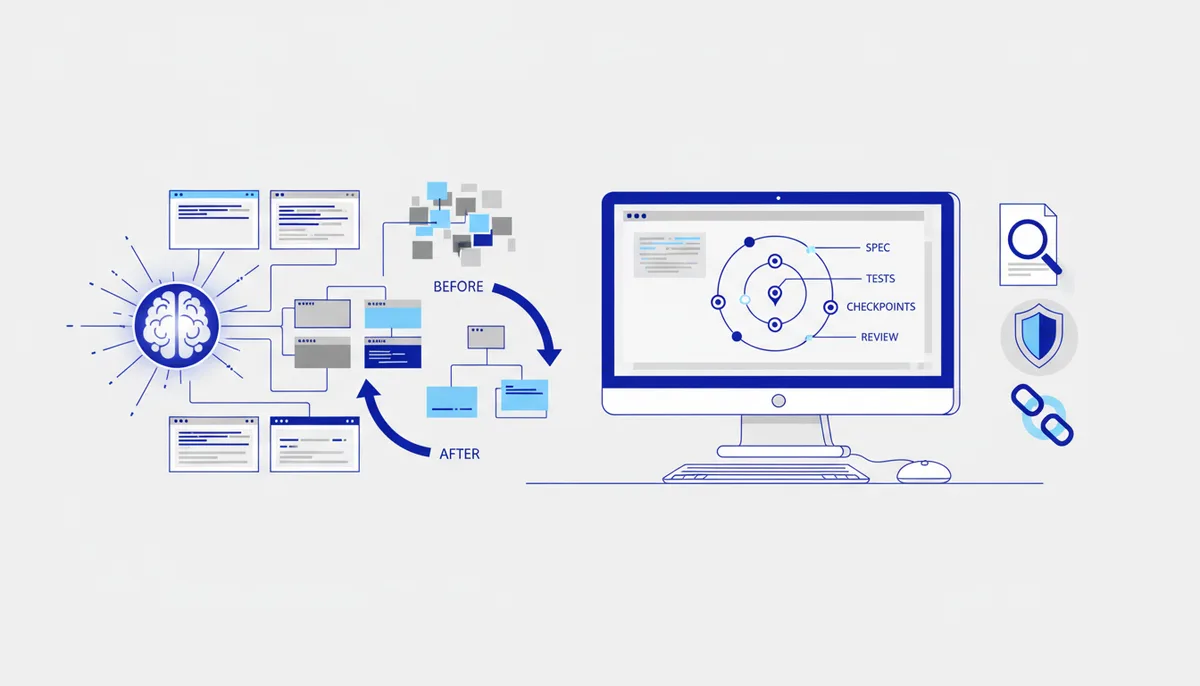
Vibe-coded projects fall apart not because the model is "dumb," but because the agent is allowed to write code without guardrails: no spec, no tests, no rollback points. Below are 10 techniques that turn "ramble into a chat, get mush back" into a managed process: spec before code, project rules, small iterations, tests up front, checkpoint commits, distrust of "done," independent review, secret hygiene, fresh context, and rolling back when the agent loops. Each technique comes with a before/after example and a link to dig deeper.
Why does a vibe-coded project fall apart?
Vibe coding is development where you describe the task in plain language and an AI agent writes the code (a full breakdown of the term is in what vibe coding is). The idea itself works, but the agent has a systematic bias: it optimizes for "working right now," not for "still alive in six months." Hence the familiar arc: two evenings where everything flies, and on the third the agent fixes one button while silently breaking three others — and by then you no longer remember which version worked.
An honest caveat up front: the techniques below don't make the agent infallible. They make mistakes cheap — visible sooner, faster to roll back, and unable to pile up into an unmaintainable lump.
What to do before the first line of code
1. Spec before code. A spec is a short document covering what you're building, what you're not building, and how you'll verify it's done. Not a 20-page requirements doc — 10–15 lines is enough. Before: "build an expense tracking app" — the agent invents half the product itself. After: "MVP: manual expense entry, 5 categories, a monthly totals screen; no auth, no sync; done = 3 scenarios from the list pass." How to phrase this so the agent gets it the first time is covered in how to brief an agent.
2. Project rules. A rules file (CLAUDE.md in Claude Code, rules in Cursor) is the project's permanent memory: stack, style, prohibitions, build commands. Before: every new chat starts with you re-explaining that this is TypeScript and which linter you use. After: the agent opens the project and already knows "strict mode, no any, migrations only through the script." Ready-made rule and system-prompt templates are in the prompts section of the arsenal.
3. Small iterations. One iteration, one verifiable change. Before: "build the whole admin panel" — you get 40 files and no idea which parts work. After: "build the users table, show me the result; we'll add filters next." The smaller the step, the more precisely you can see where things broke.
How to keep the agent in check while it works
4. Tests now, not later. In vibe coding, "later" means "never": without tests, every new feature can silently break the previous one, and you'll notice a week from now. Before: "we'll write the tests at the end." After: the agent only delivers a feature together with a test for it, and running the suite is a mandatory part of every iteration.
5. Checkpoint commits. A checkpoint commit is a save point, like in a game: a recorded working state you can return to with one command. Before: four hours of edits in one heap, nowhere to roll back to, easier to rewrite from scratch. After: a git commit after every working iteration — any failure costs 20 minutes at most, not the whole evening.
6. Don't trust "done" without proof. Agents regularly report success before verifying anything: "it all works" can mean "the code compiled." Before: the agent writes "Done!", you believe it and move on. After: you demand proof — command output, a green test run, a page that actually opens. In our Claude Code guide for beginners we show how to bake that check into the working loop.
How to verify results properly
7. Independent review. The author of the code is a poor judge of it, and that applies to agents even more than to people: an agent tends to defend its own solution. The fix is a separate session or a second agent, forbidden from writing code and allowed only to hunt for problems. The technique is covered in prisms and adversarial verify.
8. Secret hygiene. Before: an API key gets pasted into the code "just for a minute," the agent dutifully commits it to the repo, and the key leaks. After: secrets live in .env, the file is in .gitignore, and the project rules say it plainly: never paste keys into code, never print the contents of .env into the chat. A collection of practices is in the security section of the arsenal.
What to do when the agent gets stuck in a loop
9. Fresh context. A long chat degrades: obsolete decisions, cancelled plans and contradictions accumulate, and the agent starts leaning on garbage. Before: 200 messages in one session and the agent "fixing" something you cancelled an hour ago. After: a new chat plus a short summary of the current state — or simply a fresh session that leans on the spec and project rules instead of the conversation history.
10. Roll back when it loops. The three-attempt rule: if the agent has fixed the same spot three times, further coaxing is pointless — each iteration on polluted context lowers the odds. Before: "just try again" ten times in a row. After: roll back to the last checkpoint (git reset --hard), start a new session, and rephrase the task — usually narrower than the original.
Summary: which technique saves you from what
| Technique | Symptom without it | Minimum action |
|---|---|---|
| Spec before code | Agent builds the wrong product | 10–15 lines: what, what not, how to verify |
| Project rules | Every chat starts with explanations | CLAUDE.md / rules with stack and prohibitions |
| Small iterations | 40 files of incomprehensible code | One step, one verifiable change |
| Tests up front | New feature silently breaks the old one | Feature ships only with its test |
| Checkpoint commits | Nowhere to roll back to | Commit after every working iteration |
| Proof instead of "done" | "It works" = "it compiled" | Demand command output or a screenshot |
| Independent review | The author praises their own solution | A separate session purely for finding problems |
| Secret hygiene | Keys leak into the repository | .env + .gitignore + a rule against it |
| Fresh context | Agent leans on cancelled decisions | New chat + a state summary |
| Roll back on loops | Ten "try again"s in a row | Three-attempt rule, then reset |
Do I have to assemble all this by hand?
You can put it together yourself: this article plus the arsenal cards cover every technique. Honestly, setup will take a few evenings — and the hard part isn't configuring it once, it's keeping the discipline from crumbling a week later when you're in a hurry and "come on, it's a tiny thing."
We packaged these practices into the Quest engine for Claude Code and Cursor: spec workflow, project rules, checkpoints, independent review and secret hygiene are on by default — the agent follows them on its own, without reminders. As of July 2026 the engine costs 4,900 ₽ as a one-time purchase, with add-on modules at 1,900 ₽ each. If you're not ready to buy, the qvib knowledge base is free: over 550 arsenal cards and articles breaking down every one of these techniques.
FAQ
Where do I start if I'm a complete beginner?
Not with all ten techniques at once. Take three: spec before code, small iterations, and checkpoint commits — they head off most disasters. Add the rest as the project grows. A step-by-step route is in vibe coding: where to start.
Do these techniques work in both Claude Code and Cursor?
Yes, all ten are tool-independent: specs, iterations, tests and checkpoints are a process, not a feature of any particular editor. The only difference is the mechanics of project rules: CLAUDE.md in Claude Code, rules files in Cursor.
Won't these practices slow development down?
In the short term, yes — 10–20 minutes a day on specs and commits. Over a week they save hours: a single avoided evening of "why did everything break" debugging pays for a week of discipline. What speeds you up isn't typing faster, it's not having to go two steps back.
Do I need to know how to program to apply this?
No. None of the techniques require writing code by hand: a spec is text, a checkpoint is one command, the review is done by a second agent. Being able to read code helps, but two other things matter more: the ability to articulate what the result should be, and the habit of demanding proof that it is.