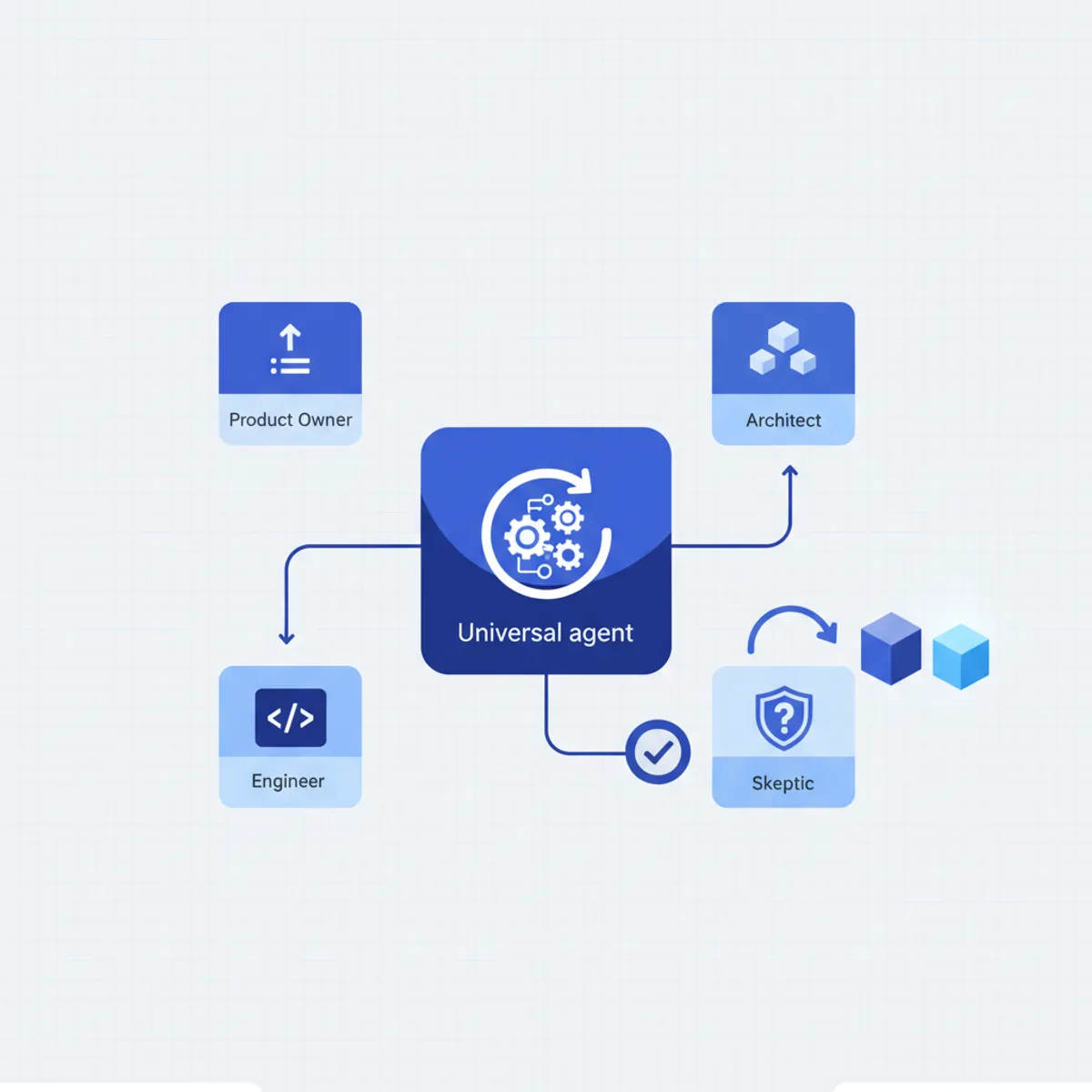
Agents and Roles: Why the Engine Uses a Team of Specialists
In short
You can ask a single all-purpose agent to "build the feature and check it." The problem is that it checks itself — and it almost always approves its own work. It's like an author acting as their own editor: the obvious mistakes stay invisible, because they were written with confidence.
Quest, our vibe coding engine, takes another route: it splits the work into specialist roles, each with its own temperament, its own area of responsibility and its own system prompt. The core principle: one does the work — ANOTHER checks it.
Who's on the base engine's team (Quest)
The base engine assembles a team of 8 roles (all of them ship in every package; which ones "switch on" for a given task is decided by the target model reading the routing text — there's no separate runtime router yet, that's roadmap):
- Product owner — digs out the real intent and value, holds scope firmly (anything extra → backlog).
- Analyst — writes requirements in EARS form, covering the happy path, edge cases and errors.
- Architect — reads the existing code and dependency map BEFORE any edits, follows reuse-first, holds the invariants.
- Designer — the concept and every UI state, accessibility, distinctive typography (not the stock "purple gradient").
- Engineer — takes a step to green without breaking what's next door; TDD; verify after every step.
- Senior reviewer — concrete feedback in the form
file:line — what's wrong — how to fix it. - Security auditor — looks for ways to break it: injections, leaked secrets, holes in data isolation.
- Skeptical verifier — arrives AFTER the step with one job: prove the step broke something or is unfinished.
(Specialized roles for video, presentations and data live in the themed templates and modules that extend the engine — not in base Quest. Debugging, refactoring and release work is distributed across these eight roles — the engineer fixes and refactors, the reviewer and verifier check — rather than spawning a separate debugger or DevOps role.)
Why a team and not a single agent
Three reasons, all about reliability:
- Division of labor beats self-deception. The skeptical verifier treats the engineer's work with suspicion by default and runs the checks itself — it has no interest in being liked.
- Different angles of view. The security auditor asks "how do I break this," the designer asks "how does this feel to a person," the architect asks "what falls apart at scale." One agent physically can't hold all those lenses at equal strength at once.
- Veto power for the critical angles. Five invariant angles (security, tenant isolation, the paid gate, regressions, data integrity) carry a veto: a critical finding from any of them is a BLOCK, even if every other vote says go.
How it works in practice: input → what the engine does → result
Input:
"Add a CSV export of the client list, with a button in the dashboard."
What the team does:
- The product owner clarifies scope: only visible clients or all of them? Respecting the active filters? (recommends: with the current filters). Anything extra ("also Excel, and on a schedule") → backlog.
- The analyst writes the EARS requirement:
WHEN a user clicks "Export", THE SYSTEM SHALL return a CSV containing only the clients belonging to their organization+ edge cases: an empty list, thousands of rows, special characters in a name. - The architect checks whether an export service already exists to reuse instead of writing a new one (reuse-first).
- The engineer implements it, adding the organization filter to the query — otherwise someone else's clients get exported.
- The security auditor catches exactly that class of bug: "does the query really filter by organization_id? does sorting from user input open an SQL injection?"
- The skeptical verifier runs two independent "done" votes and launches the checks itself.
Result:
An export that returns only your own clients (not someone else's — the most expensive mistake in a multi-tenant product), behaves correctly on both an empty and an enormous list, and is proven so by verification.
Honestly
- All 8 roles ship in every package. "Smart routing — only the roles you need get activated" is done today by the target model reading text, not by a separate routing engine. A real router is roadmap.
- The full system texts of the roles arrive with the package. Before purchase you can see the team composition and each role's specialization; the full prompts open up after payment — and then the whole team sits in front of you in plain text: read it, tune it for your project.
- Roles are discipline in text, not magic. The value is that the team is already assembled, debugged and tuned for an Opus-class model on judgment-heavy tasks — weeks of work folded into a single install.