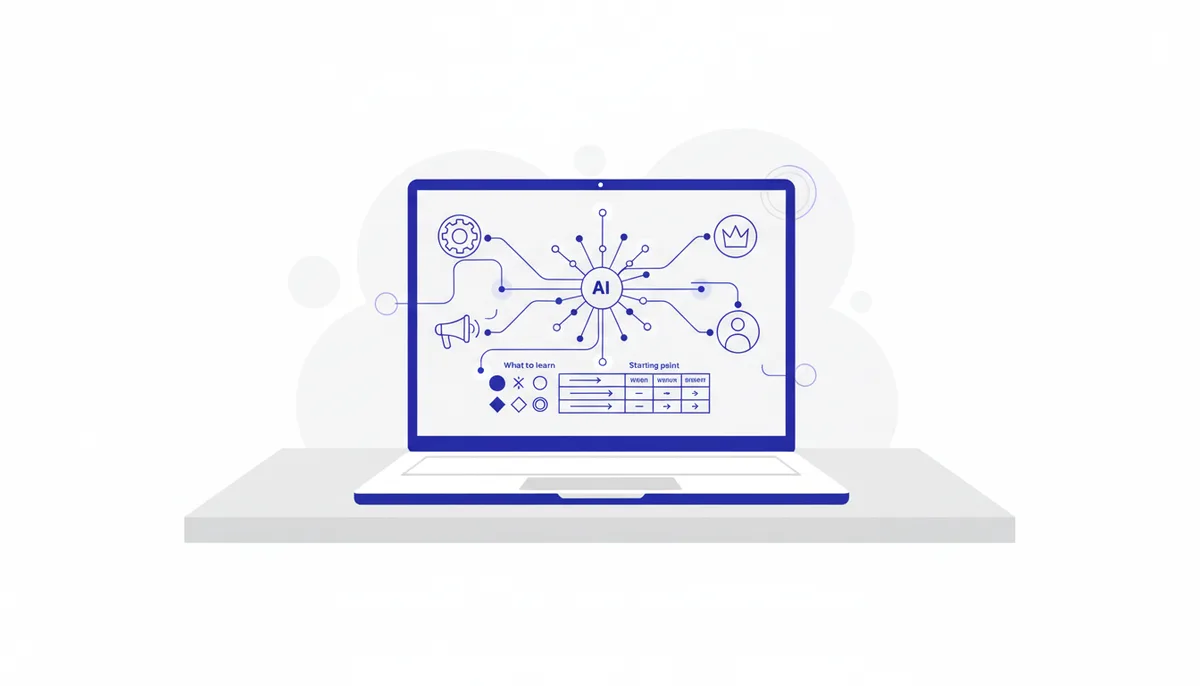
AI Skills in 2026: A Competency Map by Role
In short
An AI skill is not "being able to open ChatGPT" — it's the ability to plug a model into a specific work task and own the outcome. In 2026 the baseline is the same for everyone: a well-built prompt, fact-checking and data safety. Above that, skills split by role — a marketer needs content generation and audience analysis, a developer needs vibe coding and agents, a manager needs rollout and impact assessment, an analyst needs data work, HR needs team training and policy. Below is a "role → skills → where to start" map as a table, plus an honest 30-day route. On the Russian job market as of July 2026, the number of office vacancies mentioning AI skills grew roughly 47% year over year: AI literacy has become a hygiene minimum, not a bonus.
Why AI skills became the new literacy
A couple of years ago "I can use AI tools" was a nice extra on a résumé. As of July 2026 it's the entry ticket. Skill requirements in AI-adjacent professions are estimated to refresh markedly faster than in other fields (the figure quoted is around 66%), and the single most in-demand skill analysts point to is not a narrow technology but basic AI literacy — needed by technical and non-technical people alike.
An honest caveat: demand for "AI skills" is not demand for data scientists. Most roles don't need to train models. They need something else — to delegate routine work to a model, double-check it, and not dump sensitive data into a chat window. That takes weeks to learn, not years.
What counts as an AI skill: a short glossary
So the map reads the same for a marketer and a developer, let's agree on terms.
- Prompt engineering is the ability to frame a task for a model so you get the result you need on the first or second try: context, role, format, criteria. The foundation for everyone. A detailed breakdown is in the guide on how to write prompts.
- An AI agent is not just a chat but a system that carries out a multi-step task with access to tools (search, files, APIs) and minimal input from you.
- Vibe coding is building software by describing the task to a model in natural language rather than typing every line of code by hand (more here).
- AI literacy is understanding what a model can do, where it makes things up (hallucinations) and how to work with it safely.
The gap between "just using a chatbot" and prompting or agents is the gap between asking and delegating.
The competency map: role → skills → where to start
The table is a reference point, not a rigid standard. The baseline (prompting + fact-checking + data safety) is mandatory for every role; specialization stacks on top.
| Role | Key AI skills | First step |
|---|---|---|
| Any role (baseline) | Prompting, fact-checking, data safety | Practice prompts on your own tasks |
| Marketer | Content generation, audience and competitor analysis, A/B ideas | Run 3 of this week's tasks through AI |
| Developer | Vibe coding, AI code review, MCP and agents | Build your first project by vibe coding |
| Analyst | Data analysis, SQL/Python via AI, explaining findings | Work through one dataset with AI |
| Manager | Rolling AI into processes, measuring impact, AI agents | Find one process worth automating |
| HR | Screening, job-ad drafts, team training, AI policy | Write the rules for working with AI |
Read it like this: the "baseline" row is the foundation — without it the rest falls apart; specialization is what separates "I use a chatbot" from "I close the tasks my role owns".
Where AI pays off most for each role
Marketer. Drafts (posts, emails, landing pages), fast reads on audience and competitors, hypotheses for tests. The multiplier skill isn't generating — it's editing and selecting. As of July 2026 AI is mentioned in a noticeable share of marketing job ads, but the people who get valued are the ones accountable for results, not for volume generated.
Analyst. Demand for AI is among the highest here — the share of data-role vacancies mentioning AI is well above average. A model helps write and explain SQL/Python, clean data and phrase conclusions in plain language. Double-checking the math is critical: the model is confidently wrong.
Manager. The key skill isn't using AI but deploying it: spotting where AI genuinely shortens a cycle, quantifying the effect, and not breaking processes or data in the process. A separate topic is AI agents for business, which take over repetitive operations. The systematic approach is covered in how to roll out AI in a business.
HR. Screening applications, drafting job ads and offers, and above all organizing team training and internal rules: what may and may not be pasted into a chat.
Development and vibe coding: why it's a separate track
For developers AI is no longer an assistant but part of the process: industry surveys show most engineers use AI tools at work (as of July 2026 Stack Overflow's estimates reach ~84% of working scenarios). So the skill here runs deeper than "generate me a function":
- vibe coding paired with Claude Code or Cursor: describe the task → get working code → verify it;
- review and refactoring with AI;
- connecting MCP servers and assembling agents for your own project.
This is exactly the track qvib.pro is built for: the Quest vibe-coding engine for Claude Code and Cursor (4 900 ₽ plus 13 modules at 1 900 ₽ each) plus a knowledge base of 117 articles and 503 arsenal cards — prompts, MCP, skills, ready-made combos. If your role is technical or sits on the boundary (product, analytics with code), this is the fastest way to move from "I ask a chatbot" to "I build working tools". What the engine actually is: see the /engine/ page.
The route: where to start in 30 days
An honest plan with no magic. It works for any role; only the example tasks differ.
- Week 1 — the baseline. Learn prompting on real tasks using the guide on how to write prompts; build 5-7 personal templates.
- Week 2 — specialization. Take 2-3 typical tasks for your role from the table and run them through AI end to end.
- Week 3 — tools. Add whatever strengthens your role: agents and rollout (manager), data (analyst), vibe coding (developer), training (HR).
- Week 4 — a system. Write down what actually saves time and turn it into your personal playbook; for a team, into internal rules.
The entry point for structured learning is the /learn/ hub: materials by role and level. For teams there's a separate piece on training employees on AI.
FAQ
Do I need to know how to code to pick up AI skills?
No. The baseline — prompting, fact-checking and data safety — requires no code and is the same for every role. Code is only needed on the developer track, and that's precisely where vibe coding lowers the barrier.
Where should a beginner start?
With one real task from this week and the prompting guide. Don't study "AI in general" — study AI for a specific task your role owns. In a week you'll have a personal set of templates; after that, follow the route above.
Won't these skills be obsolete in a year?
The specific interfaces, yes — they'll change, and requirements refresh fast. But the baseline — framing a task, verifying the result and protecting data — carries across any model. That's why this map is built around skills, not around product names.
How do I train the whole team, not just myself?
Through shared rules and a single route: what may be pasted into a chat, which tasks we delegate to AI, where verification is mandatory. A practical breakdown is in the article on training employees on AI and on the /learn/ hub.