AI Video Dubbing: Translation and Voiceover in 2026
In short
AI video dubbing is the automatic translation and re-voicing of a clip into another language by a neural network: it transcribes the speech, translates the text, synthesizes a voice (often cloning the original timbre) and fits the lip movements to the new audio track. In 2026 this takes minutes, not days. The market leaders are HeyGen, ElevenLabs Dubbing and Rask AI, and YouTube has added free built-in auto-dubbing into Russian. Below: how the technology works, a comparison table of prices and languages (data as of July 2026), and what actually works legally from Russia.
What is AI dubbing and what is it made of?
Auto-dubbing is a chain of several steps, and understanding them helps you judge quality soberly.
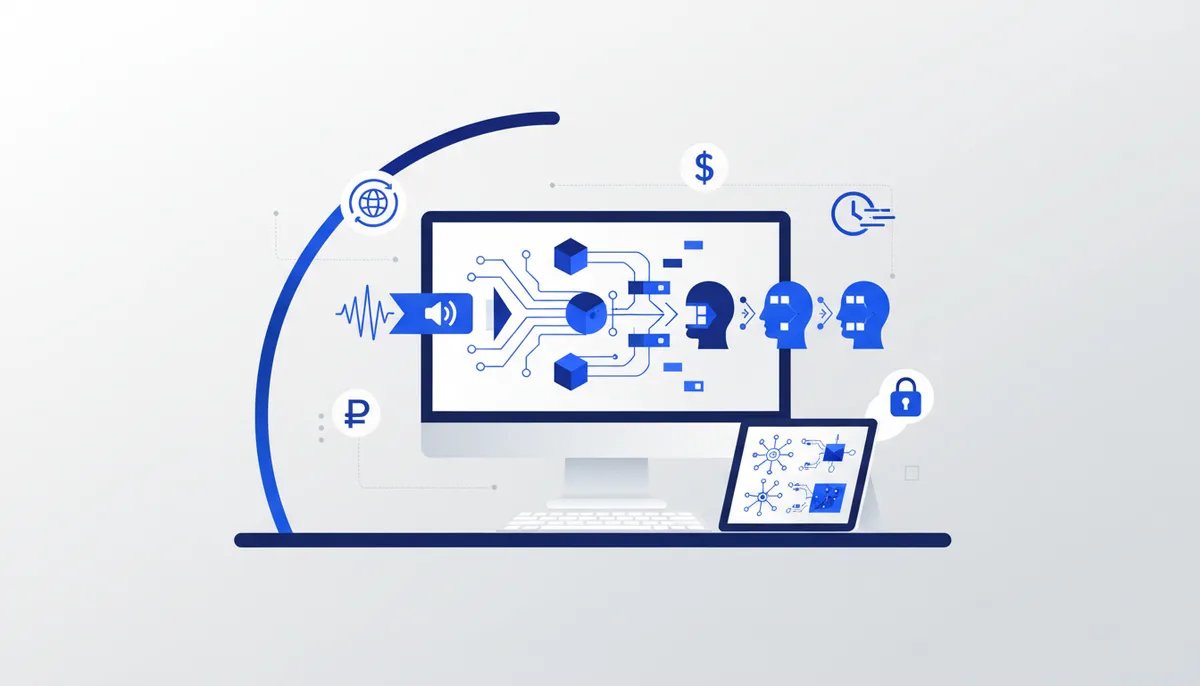
Speech recognition (ASR) turns audio into text with timecodes. Machine translation adapts that text into the target language. Speech synthesis (TTS) voices the translation with an artificial voice. Voice cloning creates a digital copy of the speaker's timbre from a short sample so the new track sounds like "their voice". Lip sync fits the on-screen articulation to the new audio track.
Not every service does all of it. Basic auto-dubbing stops at translation and synthesis; the advanced kind adds voice cloning and lip sync. We covered the voice side separately in the guide to AI tools for text-to-speech.
Which auto-dubbing services exist in 2026?
HeyGen Video Translate — its strength is lip sync. It supports 175+ languages, and automatically transcribes, translates, voices and re-animates the lips to match the new audio. There's a free tier: 3 videos a month, up to 3 minutes each.
ElevenLabs Dubbing — the benchmark for voice naturalness and cloning. It re-voices video into 29+ languages while preserving the speaker's character; it accepts a file upload or a link from YouTube, TikTok or X.
Rask AI — built for creators and channel localization. 135+ languages, voice cloning in 32 of them, automatic detection of multiple speakers with a distinct voice for each. Lip sync is on the higher tiers.
Kapwing — a video editor with dubbing built in (70+ languages), handy when you need editing and translation in one window.
Dubverse — strong on Indian languages (Hindi and 30+ others), useful for Asian markets.
YouTube's built-in auto-dubbing — Russian has been available since February 2026. Built on Google Gemini, it translates and voices the clip while preserving intonation; the creator enables it in the channel's advanced settings, and it's free.
Comparison: prices, languages and lip sync
The table is a reference point as of July 2026. Every service changes its pricing often, so always confirm the final price on the vendor's site.
| Service | Languages | Voice cloning | Lip sync | Starting price (July 2026) |
|---|---|---|---|---|
| HeyGen | 175+ | Yes | Yes | Free (3 videos/mo); paid from ~$29/mo |
| ElevenLabs Dubbing | 29+ | Yes | No (audio only) | from $5/mo; Pro voice cloning from $22/mo |
| Rask AI | 135+ | Yes (32 languages) | On the Creator Pro plan | 3-min trial; Creator ~$60/mo |
| Kapwing | 70+ | Partly | No | Pro ~$24/mo (up to 50 min of dubbing) |
| Dubverse | 30+ | Yes | No | Free up to 30 min/mo; Starter $19/mo |
| YouTube auto-dubbing | 27 (incl. Russian) | No | No | Free |
The conclusion is simple: if you need a talking head with accurate lips, take HeyGen; if you need the most lifelike voice and cloning, ElevenLabs; for mass channel localization, Rask; for free and fuss-free, YouTube's built-in dubbing.
How do you use auto-dubbing from Russia?
Honestly: most international services don't accept cards from Russian banks, and some of them (ElevenLabs, for instance) may not open from Russian IPs — that's the picture as of July 2026. HeyGen also processes payments only with foreign cards. In practice people solve this with a foreign card or an intermediary service that buys the subscription for your account for a fee (from 3% in HeyGen's case). We don't recommend any grey-market workarounds around blocks: that's a risk to your account and your data.
What works legally without payment gymnastics:
- YouTube's built-in auto-dubbing — free, right on the platform, with Russian support. For most creators that's enough.
- Russian AI reseller platforms — payable with a ruble card; check current reviews for which one to pick, because the lineup and prices shift fast.
We covered legal access from Russia in detail using video generation as the example, in the article on Kling AI in Russia.
How do you pick a service for your task?
Start from your scenario, not from the hype.
- A creator dubbing my own videos. Start with YouTube's free auto-dubbing; if you need voice cloning and accurate lip sync, go to HeyGen or Rask.
- A business localizing training videos and ads. ElevenLabs for the voice plus HeyGen for the picture; budget for minutes of voiceover.
- A constant content stream. HeyGen, ElevenLabs and Rask all have APIs — dubbing plugs into your pipeline and runs automatically.
That last case is where dubbing stops being a button and becomes part of production. Building that kind of automation (take in a clip, run it through translation and voiceover APIs, splice it into the edit) without deep programming is what vibe coding is for — the approach where you describe the task in words and an AI assistant in Claude Code or Cursor writes the code. A ready engine and a base of 117 articles and 503 cards on AI and automation live in the qvib hub, and you can assemble a working tool for your own pipeline with the Quest engine.
Dubbing is only one brick in a content pipeline. Next to it sit AI tools for video editing and generating clips from scratch: there's an overview of AI video generators in 2026 and a comparison of Sora, Kling and Veo.
FAQ
Which AI dubbing service is the best in 2026?
There's no single "best". HeyGen owns lip sync, ElevenLabs owns natural voice and cloning, Rask AI owns mass channel localization. For a free start, YouTube's built-in auto-dubbing is enough. The choice depends on what matters most: the picture, the voice, the volume or the price.
Can you do AI dubbing for free?
Yes. YouTube's auto-dubbing is free and supports Russian. HeyGen has a free allowance (3 videos up to 3 minutes), Dubverse gives up to 30 minutes a month. For regular work the free limits usually run out and you have to move to a paid plan.
How accurate are voice cloning and translation?
As of July 2026 voice cloning from the leaders sounds close to the original on short phrases; on long speech the intonation can slip. Translation is accurate for plain text, but terminology, jokes and wordplay are worth checking by hand — AI dubbing saves time, it doesn't remove the need for an editor.
Is lip sync always necessary?
No. If there's no person on screen (a screencast, slides, a review), audio dubbing is enough — it's cheaper and faster. Lip sync matters when the speaker is in close-up and the mismatch would be glaring.