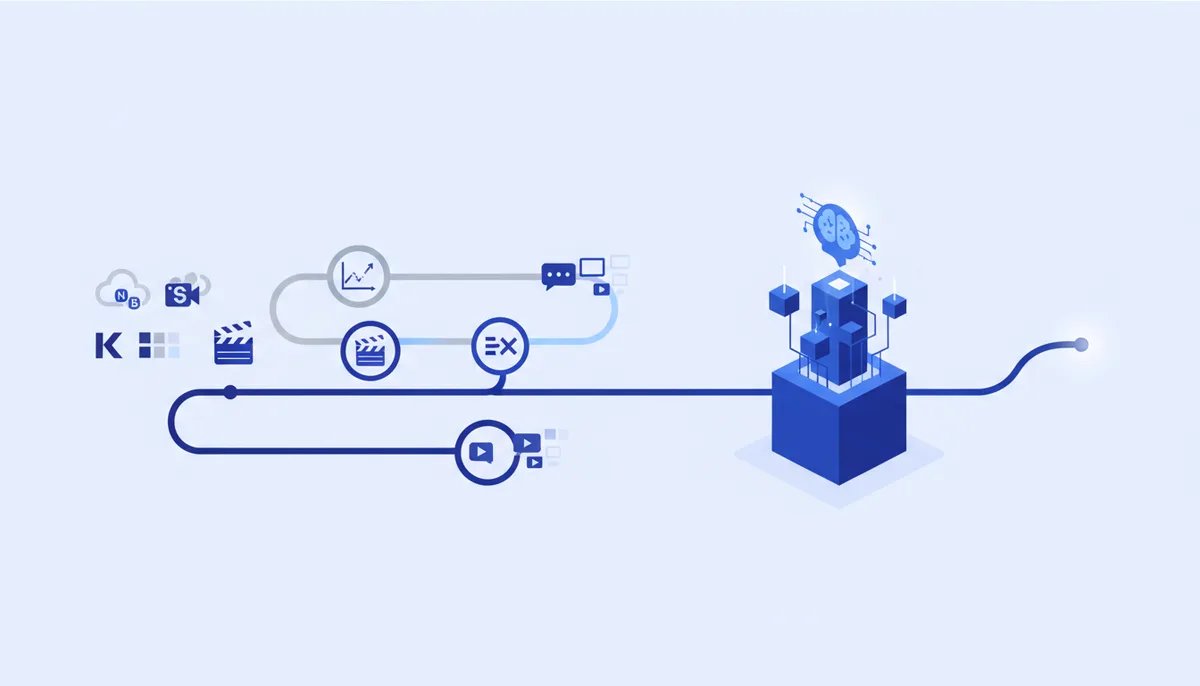
"A free alternative to a paid tool" is a headline that almost always oversimplifies: on some tasks the free model genuinely closes the question, on others the gap shows up right after the first result. Below is a comparison across three typical content-pipeline tasks — scripts, images, video — plus an honest answer about where the free option is not even in the running as a replacement.
How to read this comparison
For each task below there is a pair: a well-known paid tool and its free counterpart, with what you actually get and what you actually lose in the switch. No "unlimited" and no "3x better" — free services have limits of their own, and it is worth checking them on the official site before you build a workflow on top: terms and quotas change more often than articles about them get published.
Task 1 — video scripts
Claude takes a prompt and builds out structure, storytelling and brand voice, follows complex multi-step instructions and holds context across a long conversation. Paid access.
Kimi is a free model that handles a script draft: the structure is there, the hook is there, but the style and the fine work on brand voice take more manual editing than with the paid option.
Where it works: a quick draft to edit, test hook variants, one-off posts without an established brand style.
Where it does not: a series of videos with one recognizable voice, complex scripts with several plot turns, work through a chain of prompts where every step builds on the last.
Task 2 — image generation
Nano Banana gives you precise edits against a reference and control over details — what to change and what to leave untouched in the source image. Paid access.
Kolors is a free model that does a decent job on photorealistic scenes from scratch, but pinpoint edits to an existing image against a reference come out noticeably worse.
Where it works: generating new illustrations and backgrounds that are not tied to a specific source.
Where it does not: editing a specific photo or layout while preserving the composition, and work with brand elements that must stay identical between generations.
Task 3 — video generation
Seedance is a paid service with limits on clip length and the number of generations per month.
Kling AI is the free option, and it holds motion and scene coherence more reliably than most free alternatives — but it is still a service with limits of its own, worth checking on the site before you plan a content volume around it.
Where it works: short test clips, black backgrounds for a carousel, one-off visual experiments.
Where it does not: a regular video pipeline with a predictable monthly generation volume — here the stability of the limits matters more than the price.
Where a free counterpart is not even considered
For agentic tasks — working with code, Claude skills, MCP servers, automating multi-step processes — there are no direct free counterparts: this is not about "write some text" but about the model running a chain of actions itself, calling tools and holding the state of the task. Here a free model is not "worse" — it is simply not in this category.
How we do it
We do not pick one tool forever: a draft script or image is often done on the free option, while the final assembly, the code and the agentic steps go through Claude and Claude Code. A breakdown of exactly where that line runs, with concrete prompts and workflows, is part of the qvib.pro knowledge base: 500+ open cards, no code words and no DMs. The same pipeline behind those cards also runs the qvib engine for vibe coding.
Related links
- Claude skills: qvib.pro/arsenal/claude-skills
- Content prompts: qvib.pro/arsenal/prompts
- Vibe coding tools: qvib.pro/docs/vibe-coding-tools