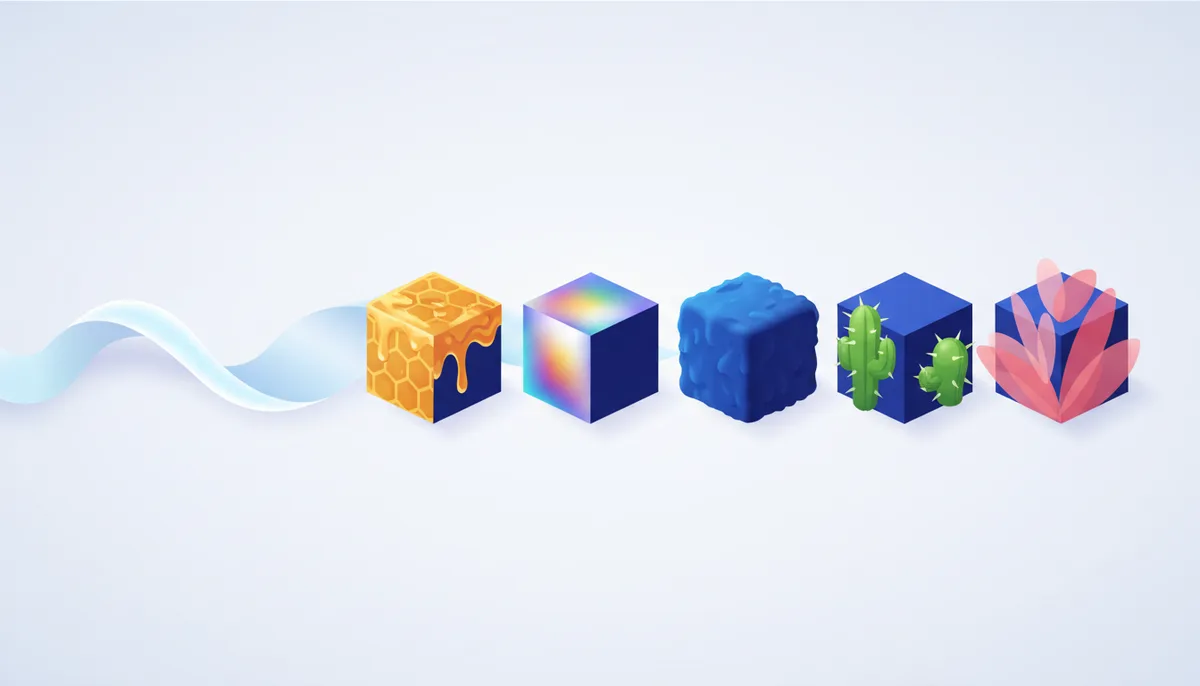
The cover decides whether anyone opens the carousel at all — and volumetric 3D typography reliably stands out in the feed right now against flat screenshots and stock photos. Below are five textures for 3D letter hooks: a working prompt for each and an honest note on which generation tool handles it more willingly.
Why a volumetric letter works as a hook
A letter is the most recognizable shape there is: the brain identifies it instantly, so an unusual texture on a familiar silhouette reads as "wow" in a fraction of a second, with no story and no caption. The technique transfers easily to any niche: only the word inside the prompt changes, the composition and the logic of the hook stay the same.
Prompt 1 — thick honey and caramel
A glossy liquid texture with drips and droplets — a surface that reads as "expensive" and appetizing at the same time. Dense gloss with clean highlights is usually easiest to get in Midjourney — the model is strong exactly at photorealistic product shots with liquids.
Volumetric 3D letters "[WORD]" made of thick honey or caramel,
glossy surface, dripping droplets and runs, the letters stand
on a podium stand, dark orange background, soft studio
light from the side, close-up, high detail, photorealism.
What to change for yourself: [WORD] is the hook headline, 1-2 words; the background color can be shifted toward your own palette as long as it stays in contrast with the golden-brown texture of the letters.
Prompt 2 — holographic metal
Rainbow shifts of pink/blue/yellow on the metal surface of a letter — a technique that looks almost like video even in a still because of the gradient. Metallic and iridescent effects often come out nicely in Nano Banana thanks to precise control of reflections against a reference.
Volumetric 3D letters "[WORD]", holographic metal
surface with rainbow iridescence (pink, blue, yellow),
chrome shine, letters on a dark blue background, directional
studio light, environment reflections, high detail.
What to change for yourself: if your niche is calmer, dial down the contrast of the iridescence and keep one or two shades instead of the whole rainbow.
Prompt 3 — soft quilted fabric
Quilted upholstery with seams turns the letter into a volumetric cushion — a warm, "cozy" contrast to the glossy and metallic textures above. Soft fabric surfaces come out decently in most modern image generators today, not just in one service.
Volumetric 3D letters "[WORD]" made of soft quilted fabric with seams
(like a cushion or an ottoman), pastel upholstery color, warm diffused
light, background matching the tone of the letter texture, light shadows between the stitches,
close-up.
What to change for yourself: the fabric color, to match your brand palette; for a more premium feel swap the pastel for a deep velvet shade.
Prompt 4 — spiky cactus
A letter fully covered in cactus spines, with a single flower on top for contrast — an unexpected material on a familiar shape, and that is the essence of a visual hook: the viewer does not immediately understand what they are looking at and stays on the frame longer than a second.
Volumetric 3D letters "[WORD]", fully covered in cactus
texture with needles/spines, one bright flower bud on top
of one letter, light sandy or yellow background, soft daylight,
botanical detail.
What to change for yourself: swap the cactus for another contrasting texture from your niche (moss, coral, sand) — the logic of the technique ("an unexpected natural material on a letter") stays intact.
Prompt 5 — fluffy petals
Letters fully covered in soft petals or feathers — a texture without a single sharp corner, a good alternative to gloss and metal if your audience and niche are softer and calmer in tone.
Volumetric 3D letters "[WORD]", fully covered in soft flower
petals or feathers in a lilac shade, fluffy volumetric
texture, gray-blue background, soft diffused light, no harsh
shadows, close-up.
What to change for yourself: the shade of the petals, to match the brand palette; for a bolder version swap the petals for fur or down in a more contrasting color.
Format rules that apply to all five
- One word (or a short phrase) per slide — not a paragraph: the letter has to read as an object, not as a line of text.
- The background is always in contrast with the letter texture and free of extra detail — the whole scene works for a single object.
- The light is directional studio light, not flat fill: that is what gives the sense of volume and an "expensive" image.
- Keep the
[WORD]placeholder in the prompt — that way the same prompt gets reused for any hook without rebuilding it from scratch.
Our sixth hook: a crystal in the brand color
The five textures above are the shared repertoire of the technique. We added a sixth one for ourselves: a volumetric crystal in our signature ultramarine instead of a letter. One recognizable material across all covers works as the brand's visual signature — the reader recognizes a qvib post before they have read the headline, the same way a logo works.
How we do it
The prompts above and the breakdown of cover formats are part of the qvib.pro knowledge base: 500+ open cards on neural networks, prompts and vibe coding, with no code words and no DMs. This article itself and the carousel that goes with it were assembled by the same pipeline that powers the qvib engine — a tool that builds sites and content from a text request, not just generates images.
Related links
- Prompts for 3D typography: qvib.pro/arsenal/prompts/3d-typography-hooks
- Prompts for image generation: qvib.pro/arsenal/prompts/image-generation
- Carousel cover formats: qvib.pro/arsenal/carousel-hook-formats