When to use it
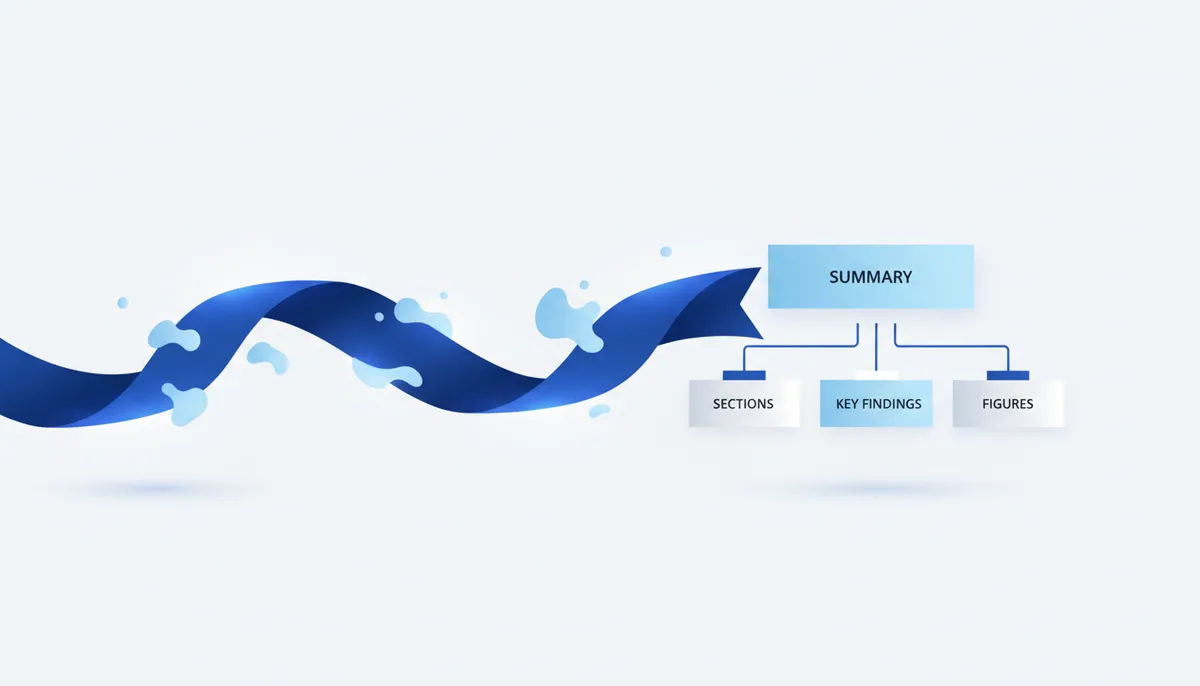
When you need to grasp a long document quickly — a report, a white paper, a book chapter, a manual, a study — without missing anything important or ending up with filler. The role is an analyst-editor. Output: the gist in a couple of sentences → a summary by section/topic → key takeaways, numbers and recommendations from the text → what remains unclear. Strictly from the document's content, with no guessing.
The prompt (copy and paste)
You are an analyst-editor who produces precise structured summaries. Work ONLY from the text of the document, adding nothing of your own and inventing nothing.
DOCUMENT: "<PASTE THE TEXT>".
WHAT IT IS AND WHY I AM READING IT: "<document type and my goal — what I want to get out of it>". WHO THE SUMMARY IS FOR: <myself / my manager / the team>.

Produce the summary in layers (general to detailed):
1. TL;DR — the gist of the whole document in 2-3 sentences.
2. By STRUCTURE — walk through the document's sections/chapters/logical blocks; for each: the block heading plus 2-4 of its main points. Preserve the original's logic and order.
3. Key takeaways, facts and NUMBERS — the most important ones as a list (take exact data/conclusions from the text faithfully, do not round by eye).
4. If present — the recommendations/conclusions/decisions the document proposes.
5. Open questions / what to pay attention to given MY goal.

Rules: do not add "common knowledge" of your own; if the document asserts something contentious or unsupported, flag it rather than repeating it as fact. If the text is too long and you only see part of it, say honestly that the summary covers only the part available.
A filled-in example
Document: a 40-page company annual report. Goal: understand its financial position and strategy in order to decide about working together. For: myself.
What the AI should produce: TL;DR — the company grew revenue but margin fell, and it is betting on a new segment; by structure — blocks for "Financials" (revenue +X%, profit -Y%, reasons), "Market and strategy" (entering segment Z), "Risks" (dependence on 2 clients), "Plans"; key numbers listed verbatim from the report; management's recommendations and plans; open questions given the goal — "margin has fallen two years running — is that sustainable", "how realistic are the plans for segment Z". Contentious claims are flagged. If only part of it fit, there is a caveat.
Variations
- Level of detail. "Give me three versions: one line / one paragraph / one page" — for different needs.
- Action-oriented. "Just the conclusions and what I should do about them" — for reports and studies with a practical goal.
- Very long document. "Summarise it in parts: each chapter separately first, then merge into an overall summary" (map-reduce for text that does not fit at once).
Pro tips
- "Work ONLY from the text" is the core of the prompt: otherwise the model will fill in "what is typical for documents like this" and you will mistake that for the content. For reports and studies this is critical — the substance must come from the document, not from the model's memory.
- The hierarchy (TL;DR → by section → details) gives you both a quick overview and a way to dive into the block you need. Tying it to YOUR goal (point 5) is what separates a useful summary from a neutral retelling — always say why you are reading.
- A very long document may not fit the context window — in which case the AI quietly summarises only the beginning. Slice it by chapter (map-reduce) or use a model with a larger window, and verify the key numbers against the original: a retelling distorts them easily.