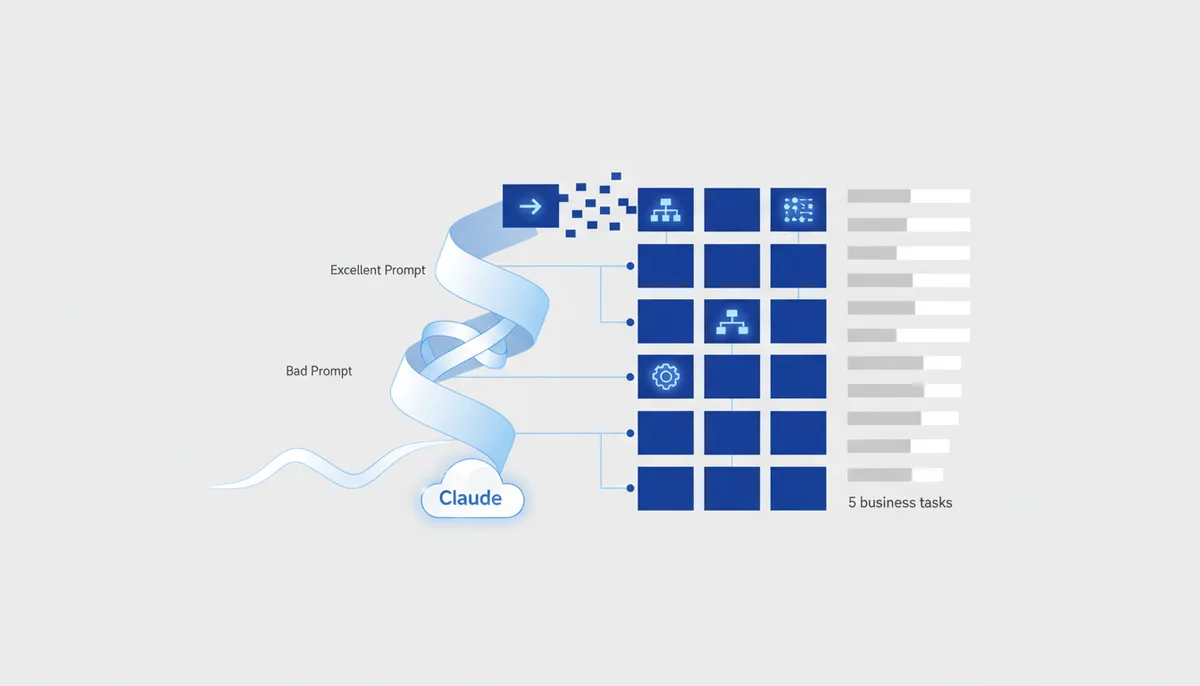
The difference between a bad prompt and a great one isn't the word count, it's the structure. A bad prompt is a question with no context. A good one adds specifics. A great one adds a role, context, a definition of a good result and a request to reason step by step. Below are five business tasks that make it obvious what exactly gets added at each level.
What a great prompt is made of
In every example below, the great prompt consistently contains: an expert role, concrete inputs (product, audience, budget — the things the bad prompt leaves out or states vaguely), an explicit criterion for what counts as a good result, and a request to reason step by step. That last part isn't decoration — step-by-step reasoning lowers the chance the model offers the first thing that comes to mind instead of something thought through.
Example 1 — SaaS ideas
The bad prompt ("give me SaaS ideas") names neither the niche, nor the audience, nor what makes an idea good. The good one adds a niche ("in marketing") but still doesn't say who exactly it's for or what counts as a strong idea.
You are a founder researching profitable SaaS ideas.
Niche: marketing. Customers: agencies and creators.
Generate ideas that solve their real problems.
Prioritise high demand and high margin.
I need commercially viable concepts,
not just interesting tools. Reason
step by step.
Example 2 — competitor analysis
The bad prompt ("analyse my competitors") doesn't say along which axes to compare. The good one adds "strengths and weaknesses" but sets no market context and no goal for the analysis.
You are a founder analysing competitors in your own
market. Company: [your company]. Competitors:
[competitor 1], [competitor 2]. Break down their
positioning, pricing and marketing.
Name their main advantage and their main weakness.
I'm not interested in surface-level observations — I want
to understand where there's an open niche in the market. Reason
step by step.
Example 3 — automation with AI
The bad prompt ("how do I use AI in my business") is a question with no boundaries and no specific answer. The good one narrows it to marketing tasks but doesn't state a timeframe or team size, which leaves the recommendations abstract.
You are a founder automating part of the business
with AI. Type of business: [type]. Team size:
[size]. Find the tasks that eat the team's time
and can be automated. Suggest
only what can realistically be implemented in 30 days.
I don't need futuristic ideas — I need
practical automations for a small team.
Think step by step.
Example 4 — marketing strategy
The bad prompt ("give me a marketing plan") with no product returns a generic textbook template. The good one names the product but doesn't cap the budget or set priorities, so the plan covers every channel at once instead of concrete first steps.
You are a founder building a marketing strategy
for a startup. Product: [product]. Audience:
[audience]. Budget: [budget]. Design a strategy
for acquiring the first 1000 customers, focusing
on the highest-leverage channels. I don't
need a full-funnel plan — I need the most
practical steps given limited time and budget.
Reason step by step.
Example 5 — a LinkedIn post
The bad prompt ("write a post about niching down") sets the topic but not the author or the audience. The good one adds length and a practicality requirement, but still doesn't define the hook or the author's point of view.
You are a founder writing on LinkedIn about startup
strategy for an audience of early-stage
founders. Explain why niching down early accelerates
growth, and give practical advice. Write directly and usefully,
drawing on experience rather than motivational slogans.
Length — up to 2900 characters. Reason step by step.
How to apply this structure yourself
Take your usual short request to Claude and add four elements in order: an expert role for your task, concrete inputs instead of generalities, an explicit result criterion ("what counts as a good answer") and a request to reason step by step. If one of the four is missing, the prompt stays at the "good" level rather than "great" — and in practice you notice the difference in the model's very first answer.
How we do it
The full breakdown of this structure and all five examples in their entirety are collected in the qvib.pro knowledge base — openly, with no "DM me for the link". We build instructions for the qvib engine on the same principle — role, context, criterion, step-by-step — so it generates code and sites from a defined request structure rather than by guessing intent.
Related links
- The "Prompt structure" section: qvib.pro/arsenal/claude/
- The "Prompts for business" section: qvib.pro/arsenal/prompts/
- How the qvib engine works: qvib.pro/