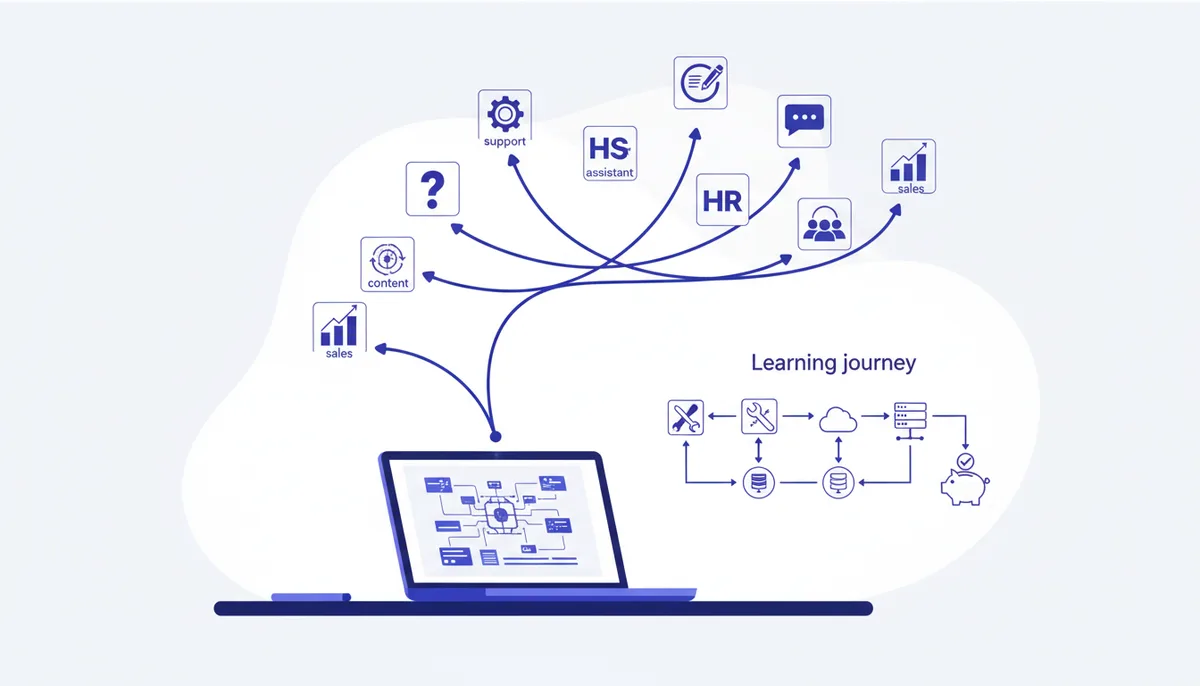
The AI Employee for Business: 10 Recipes for 2026
In short
An AI employee is an AI agent tuned to one specific work role: not a "universal assistant" but a support operator, an executive assistant or a resume screener with clear instructions and access to the data it needs. In 2026 such an "employee" handles 70-80% of standard requests and frees up 2-3 hours a day of routine work for specialists. Below are 10 practical recipes: what each role does, which tool to build it with, and what it costs (prices and services as of July 2026). Plus an honest look at the limits: AI is strong on repeatable tasks and weak where accountability, empathy and non-standard decisions are required.
What an AI employee is and how it differs from a chatbot
A chatbot follows a script: "press 1 to check your balance". An AI employee, or AI agent, is a program built on a language model that understands context, chooses its own action and drives the task to a result: it reads the correspondence, finds the answer in a knowledge base, creates a task in the CRM.
The practical difference is simple: a bot answers with a template, an agent works out what's actually going on. Automation vendors estimate that a modern AI agent handles 70-80% of standard requests without a human (as of July 2026) — previous-generation chatbots couldn't do that.
An important point: an AI employee is not "a replacement for a department". It's a tool that takes routine off real people so they can work on the hard parts. We break down the logic of such agents in detail in the article on AI agents for business.
10 AI employee recipes for business
Below are the roles that get automated most often. For each one: what it does, what to build it with, and what it saves. Tools and prices are as of July 2026 — double-check before you launch.
| Role | What it does | What to build it with (July 2026) | What it saves |
|---|---|---|---|
| Support operator | Answers standard questions 24/7, collects requests | Bot on GigaChat/YandexGPT, Intercom | First line: up to 70-80% of requests |
| Executive assistant | Transcribes meetings, writes minutes, creates tasks | mymeet.ai, Alice Pro | ~2-3 hours a day on note-taking |
| Content editor | Drafts posts, articles, SEO copy | SMMplanner AI, YandexGPT | Hours of copywriting on standard content |
| Data analyst | Prepares reports, writes SQL, finds anomalies | Claude, ChatGPT, GigaChat | ~3 hours a day of technical routine |
| HR screener | Parses resumes, runs pre-screening | Garmony, AI HR PRO, Naimee AI | 500 resumes in minutes instead of days |
| Sales SDR | Qualifies leads, handles first-touch correspondence | Sales AI agents, bots inside the CRM | Manual processing of inbound |
| Legal assistant | Reviews contracts, prepares templates | GigaChat (context up to 1M tokens) | First-pass review of long documents |
| Internal helpdesk | Answers employees on policies and IT | Bot on your own knowledge base | Load on HR and the IT department |
| Marketing researcher | Gathers data on competitors and the market | ChatGPT, AI search assistants | Days of manual information gathering |
| Document processing operator | Extracts data from invoices, acts and waybills | Document processing AI agents | Manual entry into accounting systems |
Screening means the first-pass filtering of candidates against formal criteria; this is where AI delivers the fastest effect. Two roles in the table — support operator and HR screener — work with the personal data of customers and applicants, so they come with separate requirements (see the section on limits below). Sales is easier to handle separately, with the funnel in mind: AI in sales.
Which tools are legally available from Russia?
You can build an AI employee without circumventing any blocks — Russian models work directly:
- GigaChat (Sber) — works in Russia with no VPN and no foreign account, has a free tier with limits, and API plans for legal entities have been in place since 1 February 2026; context of up to 1M tokens and multimodality are claimed (as of July 2026).
- YandexGPT — through the Yandex Cloud API, with a Lite / Pro / 5 Pro line-up; the flagship 5.1 Pro costs about 40 kopecks per 1,000 tokens (as of July 2026) and is trained predominantly on Russian data.
- Alice Pro (Yandex) — access without a VPN, first 100 requests an hour free.
- Russian HR and support services — Garmony (AI screening from 10,000₽/month), Huntflow AI (from 15,000₽/month), AI HR PRO (about 900₽ per 500 resumes); prices as of July 2026.
- mymeet.ai — Russian speech transcription, connects to Zoom, Google Meet and Yandex Telemost.
Claude and ChatGPT are used from Russia too, but payment goes through intermediaries: Claude Pro costs about $20/month, which when paid from Russia works out at roughly 1,900-2,500₽ depending on the method (as of July 2026). Arrange access legally, without circumventing restrictions. Integrators estimate that a basic staff of 3-4 AI employees, including API, hosting and support, costs 20,000-60,000₽/month (as of July 2026).
How much it saves and where the limits are
The savings are real: AI frees analysts up to 3 hours a day of technical routine, and according to HR surveys 46% of companies already use AI for resume evaluation and 65% report improved hiring efficiency (as of July 2026). But an AI employee has hard limits, and pretending otherwise is a route to disappointment:
- Accountability. The AI isn't responsible for the decision — you are. Legal, financial and medical conclusions are always checked by a human.
- Hallucinations. A model can confidently invent a fact. For support and legal tasks, a knowledge base and an output check are mandatory.
- Personal data. Resumes and customer correspondence fall under 152-FZ (Russia's personal data law). Before feeding them to AI, sort out consent and storage: AI and 152-FZ.
- Empathy and escalation. A conflict, an unusual case, a VIP client — hand it to a human immediately.
The working rule is simple: AI takes volume and routine, the human takes accountability and exceptions.
How to roll out an AI employee in 3 steps
- Pick the single role with the biggest flow of routine — most often that's the first line of support or document processing.
- Write the prompt instructions and assemble the knowledge base: roughly 80% of the agent's quality depends on exactly this. How to phrase it is in the complete guide to prompts.
- Launch it on a subset of tasks, measure the effect (time saved, % of requests closed), and only then scale.
Don't try to automate everything at once — that's the main mistake. A step-by-step breakdown of the rollout is in the guide on how to bring AI into a business. And don't skip training employees to work with AI: an agent is useless if the team doesn't know how to use it and doesn't trust it.
When a subscription isn't enough and you need your own engine
Off-the-shelf services cover the standard roles from the table. But subscriptions have a ceiling: per-user fees, someone else's servers, limited logic, and no way to embed the agent deeply into your product or internal processes.
When an AI employee has to work with your data, by your logic, and without a lifetime per-seat fee, people build it themselves. This is where vibe coding comes in: you describe the task in words, and Claude Code or Cursor write the agent's code. The Quest engine by qvib gives that build a structure, while the knowledge base and the /learn/ hub give you 117 articles and 503 cards with ready-made prompts, MCP servers and roles so you don't start from zero. This is the next level of maturity: not renting someone else's AI employee, but building your own for a specific business.
FAQ
Will an AI employee replace live employees?
No. As of July 2026 it covers routine — standard requests, drafts, document parsing — but accountability, empathy and non-standard decisions stay with people. More often the team doesn't shrink; it stops drowning in routine and takes on more volume.
How much does it cost to launch a first AI employee?
Integrators estimate that a basic staff of 3-4 roles costs 20,000-60,000₽/month including API, hosting and support (as of July 2026). A single simple role on a Russian model like GigaChat or YandexGPT can be launched for less, starting on the free limits.
Which tools work from Russia without a VPN?
Legally and without workarounds — Sber's GigaChat, YandexGPT and Alice Pro (first 100 requests an hour free), plus Russian HR and support services. Claude and ChatGPT are reachable, but payment goes through intermediaries (as of July 2026).
Is it safe to give AI customers' personal data?
Only with an eye on 152-FZ: you need consent, clear storage rules and, where possible, Russian servers. Running resumes and customer correspondence through external models without that is a legal risk.
Which role should I start with?
The one with the most repetitive work and the clearest result — usually the first line of support or document processing. One role, a measurable effect, then scaling to adjacent processes.