AI in Sales: Use Cases and Adoption in 2026
In short
AI in sales is a set of models and services that take over the sales team's routine: finding and qualifying leads, transcribing and scoring calls, writing scripts and follow-ups, suggesting the next step on a deal. In 2026 this is no longer an experiment: industry surveys put daily AI use at up to 60% of B2B sellers, and up to 80% of a rep's standard tasks — intake, first-pass qualification, FAQ, booking meetings — can realistically be automated.
Three use cases pay off fastest: lead scoring (which filters out 40–60% of off-target enquiries), call speech analytics, and follow-up generation. You can get started in a week on off-the-shelf SaaS or on a stack of GigaChat/YandexGPT (Russian large language models from Sber and Yandex) plus your own automation. The main risk is customer data and 152-FZ, Russia's personal data law: before pushing conversations and contacts into someone else's cloud, check where they're stored. Below: use cases with the economics, prices as of July 2026, and an honest answer on what to rent and what's cheaper to build yourself.
What AI does in a sales team
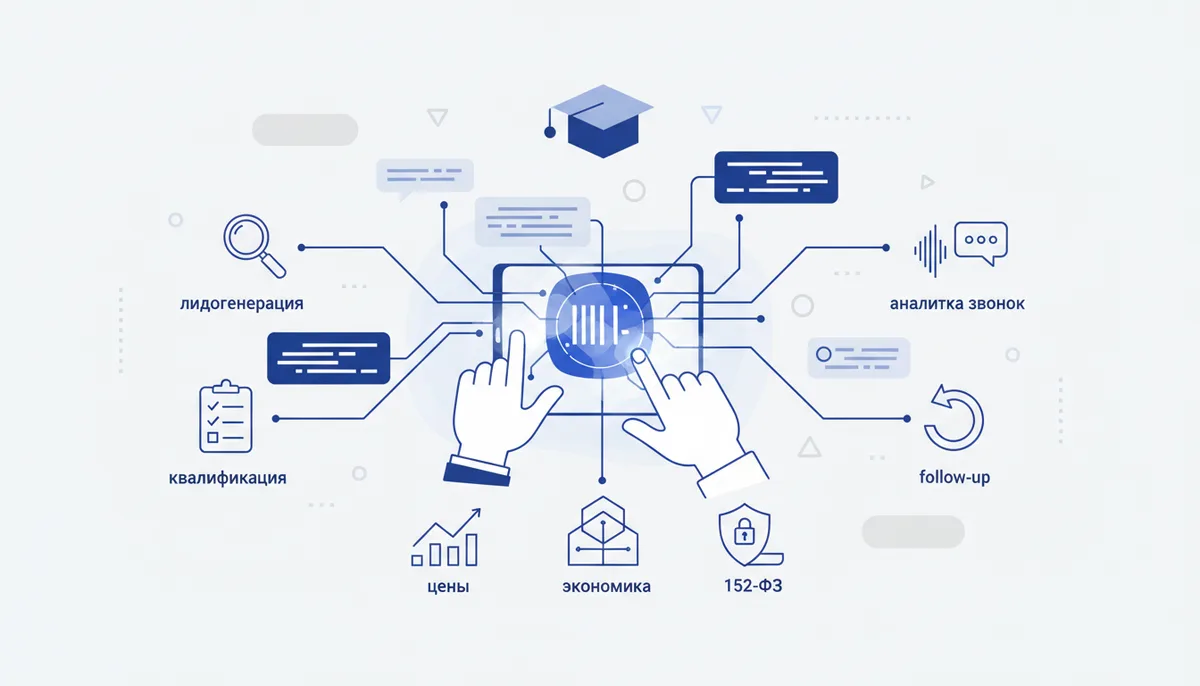
A sales team is a conveyor: traffic → lead → qualification → negotiation → deal → repeat business. AI slots into almost every joint and removes manual work.
- Lead generation. Models parse open sources, find companies matching ICP (ideal customer profile) criteria, enrich records and drop warm contacts into the CRM.
- Qualification and scoring. Lead scoring is rating an enquiry against criteria (budget, role, urgency, ICP fit) before a rep spends time on it. AI filters out off-target enquiries and passes on only the good ones — with context attached.
- Scripts and objection handling. A rep spends up to 60% of their time preparing: the call script, answers to standard objections, the proposal. AI drafts these in minutes.
- Speech analytics. Speech analytics is the automatic transcription and analysis of conversations: topics, emotions, objections, reasons for rejection, script adherence. Instead of spot-checking 5% of calls, a manager sees 100%.
- Follow-up. Follow-up is the series of nudges after first contact. AI writes personalised emails and reminders tailored to the specific deal and correspondence history.
- Analytics and forecasting. Close probability, LTV, seasonality — so you can prioritise deals and stop losing stalled ones.
These are classic AI agent tasks — how agents work is covered in the guide on AI agents for business.
Use cases and economics: where to start
Not everything rolls out at the same speed or pays off as obviously. Here's a comparison by difficulty and effect (estimates from industry surveys and vendor claims as of July 2026; verify against your own numbers).
| Use case | What it does | Time to deploy | Claimed effect |
|---|---|---|---|
| Lead scoring | Filters out off-target enquiries by ICP | 1–2 weeks | −40–60% junk leads, up to +27% conversion |
| Speech analytics | Analyses 100% of calls | ~2 weeks | Quality control, higher average deal size |
| AI follow-up | Writes nudge emails | Days | Fewer lost deals |
| Scripts and objections | Drafts in minutes | Days | Up to −60% prep time |
| Voice qualification bot | First contact and filtering | 2–4 weeks | 24/7 enquiry handling |
| Deal forecasting | Pipeline prioritisation | 3–6 weeks | More accurate planning |
By industry estimates, the cost of a qualified lead under manual handling is 500–1,500 ₽; with AI qualification it drops to 80–250 ₽. That's the core economics: you aren't so much "selling more" as you are no longer paying reps to sort through junk.
Ready-made sales playbooks, prompts and checklists live in Arsenal → Business — 46 cards with concrete wording — while the prompt library covers scripts and objection responses.
What it costs and what it runs on
Three cost layers; all figures are ballpark, as of July 2026.
Off-the-shelf speech analytics SaaS. Entry-level cloud services (up to ~1,000 minutes) start at 3,000–15,000 ₽/month. Some platforms have a free tier (around 40 minutes of analysis a day, for example), with paid plans from ~49,000 ₽/month. On-premise deployment for a large team starts at 200,000 ₽ plus transcription charges, and enterprise self-hosting runs into the millions. For an SMB handling 500–3,000 calls a month, cloud usually pays for itself in one or two months.
The underlying model. Russia's GigaChat (Sber) and YandexGPT (Yandex) operate officially inside Russia, accept Russian cards and have free basic tiers; the API is on Sber's developer portal and, for Yandex, through Yandex Cloud. For a sales team that's a decisive plus: the data stays inside the Russian perimeter. ChatGPT (Free / Plus at $20 a month / Pro / Go) is generally stronger at complex reasoning, but doesn't accept Russian cards directly — you can pay legally through aggregator services or with a foreign card, and the final amount from Russia is usually above list price. Access is covered in detail in ChatGPT in Russia: how to use it.
Your own automation. Stacks built on n8n, a Telegram bot with AI for intake and qualification, a script that pulls transcripts and files the analysis into your CRM. This is cheaper than subscriptions and, crucially, keeps the data with you.
What you can realistically deploy in a week
Don't start with "an AI that replaces the department." Start with one bottleneck:
- Days 1–2. Pick one pain point: junk leads, unreviewed calls or failed follow-up. Describe the current process and the metric you want to move.
- Days 3–4. Take an off-the-shelf service for that pain point or build a prototype on GigaChat/YandexGPT. For follow-ups and scripts, a good prompt is enough — how to brief a model is covered in how to frame a task so the agent understands.
- Days 5–7. Run it on last week's real data, compare it with the manual result, record the effect. Only then scale.
The full sequence is in the AI adoption checklist for business.
Risks: 152-FZ and customer data
This is where the grown-up part begins. Call recordings, names, phone numbers and customer correspondence are personal data, and their processing is governed by 152-FZ (Russia's personal data protection law). When you send a conversation to a cloud model, you're transferring personal data to a third party — and you are responsible for it, not the service.
The minimum you need to do:
- check where the data is physically stored and processed (the Russian perimeter is safer);
- obtain consent for processing and for recording conversations;
- anonymise data wherever the model doesn't need real names;
- write the rules into a policy.
The detailed treatment is in AI and 152-FZ: personal data and an AI usage policy for companies. This isn't a formality: data risk is the single most common reason B2B rollouts stall, and it's exactly why in-house tools built on Russian models often beat foreign SaaS.
Rent or build?
The honest answer: both.
- Rent something ready-made when the task is standard and the service already does it better than you would — speech analytics, voice outreach, scoring out of the box.
- Build your own when the tool has to fit your process exactly and the data must not leave your walls: a qualifier tuned to your ICP, a proposal generator that knows your price list, an integration with your CRM.
The second route no longer requires a development team. Vibe coding is assembling working tools in natural language through an AI assistant (Claude Code, Cursor). The Quest engine provides a ready framework and rules so that an internal tool like this can be built by the sales team itself rather than a programmer; the learning tracks in the learning hub take you from zero, and the logic of applying AI in sales and other processes is covered in the guide on vibe coding for business.
FAQ
Will AI replace sales reps?
No. As of July 2026 AI takes the routine — qualification, call analysis, email drafts — but negotiation, complex deals and relationships stay with people. What changes is the shape of the job: less time on junk, more on live deals.
Which use case should I start with?
The cheapest and most measurable one. Usually that's lead scoring or follow-up: fast effect, clear metric, minimal data risk. Add speech analytics and voice bots as a second step.
Can Russian models handle sales, or do I need ChatGPT?
For scripts, emails, qualification and call analysis in Russian, GigaChat and YandexGPT cover most tasks in 2026 — and keep the data inside Russia. ChatGPT is brought in for complex reasoning, bearing in mind payment from Russia and personal data risk.
What does it cost to get started?
You can start almost free — on the free tiers of Russian models and a single use case. Paid speech analytics SaaS starts at a few thousand roubles a month; a serious rollout runs into the hundreds of thousands. Do the maths on lead economics, not on the vendor's price tag.
Is this legal?
Yes, if you comply with 152-FZ: consent to process personal data, transparent storage, a written policy. Using AI in sales isn't prohibited in itself — what's risky is careless handling of customer data.