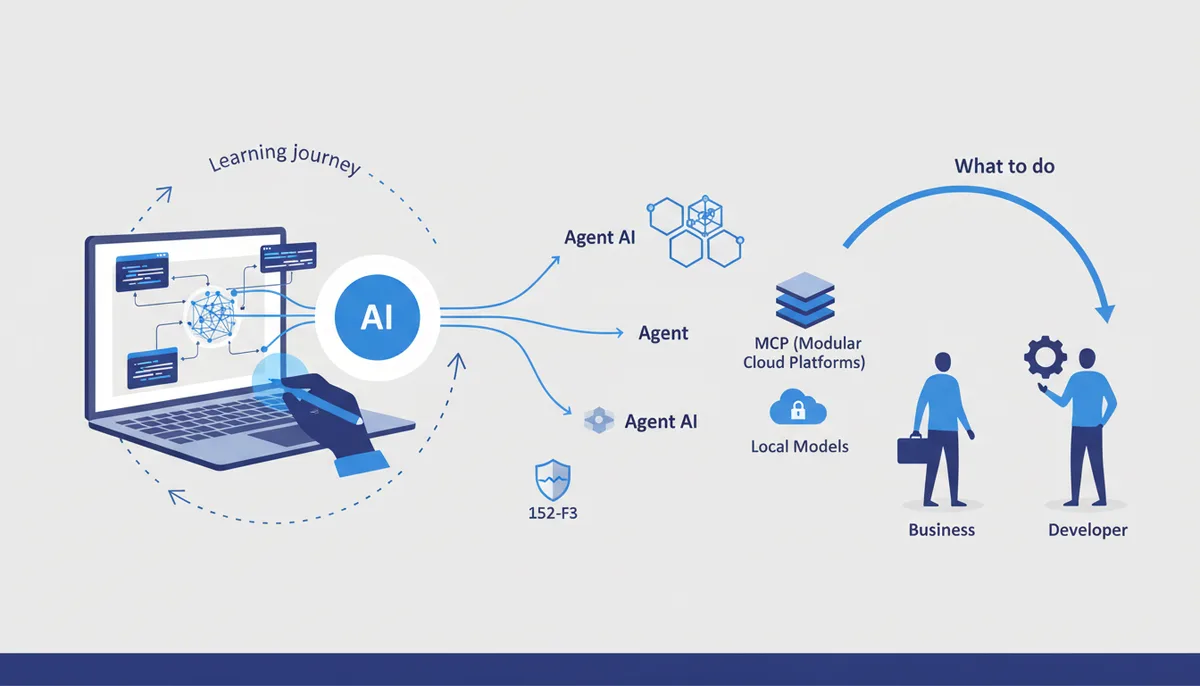
AI Trends 2026: What Matters for Business and Developers
In short
The big shift of 2026: AI stopped being a "smart conversationalist" and became a doer — it plans steps, calls tools and carries a task through to a result. For business that means new processes; for developers, a new way to write code. Six trends already in play:
- Agentic AI — the model doesn't just answer, it acts step by step.
- The MCP ecosystem — a shared protocol through which AI connects to data and services.
- Local models — open models that run on your own hardware without the cloud.
- Multimodality — working with video, audio, documents and charts, not just text.
- AI agents in production — from flashy demos to reliability and cost control.
- Regulation — tighter rules under Russia's 152-FZ personal data law and the launch of AI Act enforcement in the EU.
Below is what all of this means and what to do about it. We keep fresh cards on tools and approaches in Arsenal → Trends.
What is agentic AI and why is it trend number one?
Agentic AI is a model that doesn't stop at a chat reply but plans steps on its own, calls external tools and carries the task to a result. The difference is like the one between "give me a recipe" and "plan a week of meals and order the groceries."
The numbers confirm the scale. Gartner estimates that by 2026 roughly 40% of enterprise applications will include specialized AI agents, and the agentic AI market grew from $7.6bn in 2025 to about $10.8bn in 2026 (data as of July 2026). But there's a sobering gap: around 79% of companies say they've deployed agents, while only about 11% actually keep them running in production.
Why? Demos and production are different things. The main barriers in 2026 are answer quality, governance and cost. Analysts call this "the hard-hat phase": the market got its fill of impressive videos and moved on to the boring but important work — reliability, monitoring and ROI.
The practical takeaway for business: start with narrow, well-specified tasks (document processing, support, routine operations), not with a "universal agent for everything." A detailed breakdown is in the article on AI agents for business.
Why did everyone suddenly need the MCP protocol?
MCP (Model Context Protocol) is an open standard through which an AI model connects to external data, tools and services in one uniform way. Where every integration used to be written by hand, MCP is "USB-C for AI": one port instead of a dozen adapters.
In a year the protocol became the de facto standard. MCP SDKs are downloaded around 97 million times a month, and the official registry lists some 9,600 servers (as of July 2026). OpenAI, Google DeepMind and Microsoft backed it, and in December 2025 Anthropic handed MCP to the Agentic AI Foundation under the Linux Foundation — meaning the standard became vendor-neutral. Gartner forecasts that by the end of 2026, 75% of API gateway vendors will add MCP support.
Why it matters: MCP turns scattered AI experiments into a system you can assemble. One server for your CRM works in Claude and in other clients alike. What to do: list the internal systems it makes sense to give AI access to, and look at the servers that already exist. A starting point is our roundup, MCP servers: what they are.
Where the models themselves are heading: local and multimodal
Two parallel trends concern the models themselves.
A local model is an open-weight model you run on your own hardware rather than through someone else's cloud. In 2026 the open families — Qwen, DeepSeek, GLM, Llama, Gemma — came within reach of what's genuinely good enough for real work, and tools like Ollama and LM Studio let you spin a model up with a single command. The main upside is privacy: data never leaves your machine, there are no logs on someone else's side and no rate limits. That also removes part of the 152-FZ question (see below).
Multimodality is one model's ability to work with several data types at once: text, images, audio and video. In 2026 the frontier moved from "understand a picture" to parsing video, long documents with OCR, audio and charts. Voice responses got below 200 ms of latency — conversation finally feels alive.
The practical takeaway: for sensitive data, look toward local models; for complex tasks involving documents and media, toward multimodal cloud models.
152-FZ and the AI Act: what's changing in regulation?
Regulation is the trend that's easy to miss until it sends you a fine.
In Russia, the amendments to 152-FZ (the federal personal data law) that took effect on 30 May 2025 came into full force in 2026. The key points: tighter requirements for collecting, storing and protecting personal data, and higher turnover-based fines — up to 3% of annual revenue (as of July 2026). Experts warn of new waves of inspections by Roskomnadzor (the Russian communications regulator). If you're feeding customer data to AI, this is squarely your risk zone — more in the article on AI and 152-FZ.
In the EU, the AI Act's supervisory and enforcement mechanisms for general-purpose AI (GPAI) model providers went live on 2 August 2026. Even if you're not in the EU, this sets a frame other markets will follow.
What to do: keep a register of which data goes into which models; prefer local models or anonymization for personal data; record who gave an agent access and why.
6 AI trends of 2026: summary table
| Trend | What it is | Why it matters | What to do |
|---|---|---|---|
| Agentic AI | The model acts, not just answers | Changes processes and roles | Start with narrow tasks |
| MCP ecosystem | A single protocol for AI access to services | Became the de facto standard | Connect your key systems |
| Local models | Open-weight models on your own hardware | Privacy and independence | Test on Ollama/LM Studio |
| Multimodality | Text, video, audio, documents in one model | New media-driven scenarios | Pilot on real data |
| AI agents in production | The move from demo to reliability | This is where money and time are lost | Monitoring, quality evaluation |
| Regulation | 152-FZ, AI Act | Fines and inspections | Data register, anonymization |
What should developers and businesses actually do?
The common denominator of all six trends is that AI is becoming part of the workflow rather than a toy in a separate tab. For a developer, that means vibe coding.
Vibe coding is an approach where you describe the task in plain language and an AI agent writes and edits the code right in your editor. The 2026 tools are Claude Code (included in the Claude Pro subscription, ~$20/month, and Max, $100–200/month) and Cursor (Free, Pro $20, Pro+ $60, Ultra $200/month) — prices as of July 2026. Independent tests note that Claude Code burns roughly 5.5 times fewer tokens on the same task, which affects the final bill. A step-by-step explanation is in the article what vibe coding is.
The catch is that "just open Cursor" isn't enough. Agentic AI, MCP and skills deliver when there's a system behind them: the right prompts, connected servers, repeatable scenarios. That's exactly what the Quest engine by qvib assembles: a configured environment for Claude Code and Cursor, a base of 117 articles and 503 arsenal cards, ready-made MCP servers, skills and combos. The base engine costs 4 900 ₽, individual modules 1 900 ₽ each. See what's inside on the engine page, and for rolling AI into your processes, read how to bring AI into a business.
FAQ
Which AI trend of 2026 is the most important?
For most teams, agentic AI, because it changes the processes themselves rather than just their speed. But it pays off in combination with MCP (access to data) and production discipline: monitoring, quality evaluation and cost control.
Should a business switch to local models?
Not everyone and not for everything. Local models are justified where data privacy and 152-FZ requirements matter, or where you need predictable offline operation. For complex multimodal tasks, frontier cloud models are still stronger — a hybrid setup makes sense.
What is MCP in plain terms?
It's a single "port" through which AI connects to your services and data. Instead of a dozen homegrown integrations, one standard that different AI clients understand, so one server works across several of them.
Where should a developer start in 2026?
With practice: learn vibe coding in Claude Code or Cursor, connect a couple of MCP servers and build 2–3 repeatable scenarios. You can take a ready-made knowledge base and a configured engine from qvib instead of assembling everything from scratch.