ChatGPT in Russia in 2026: How to Use It Legally
In short
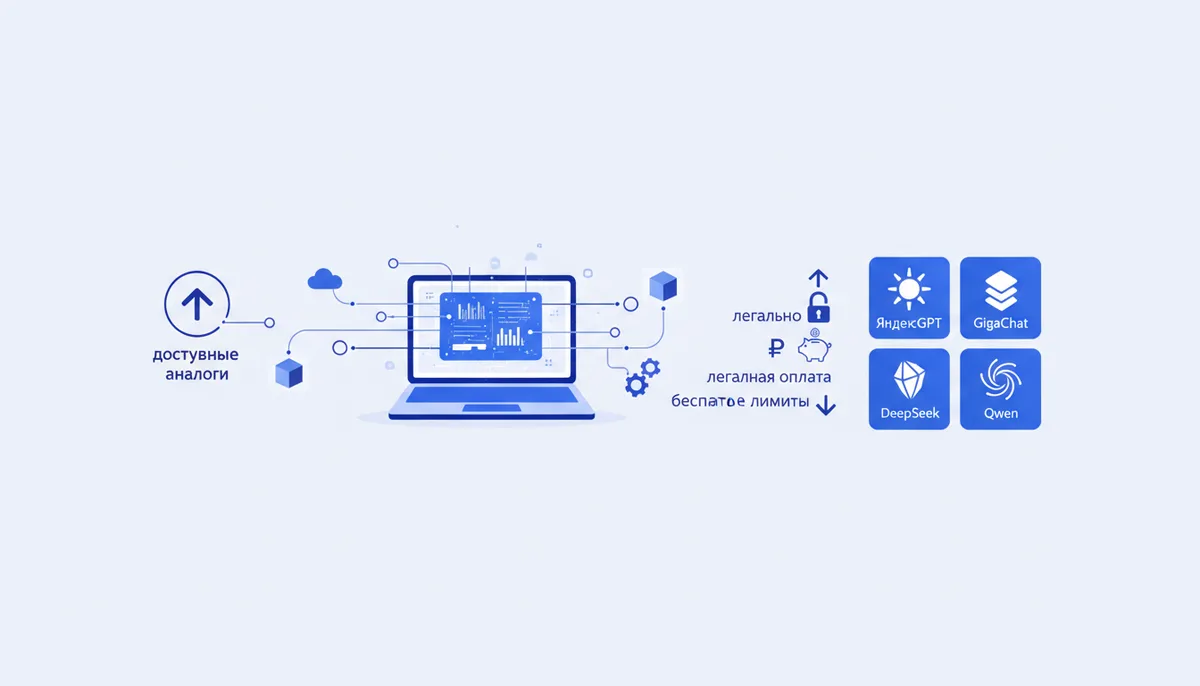
ChatGPT is a chatbot built on OpenAI's language models and the best-known AI service in the world. In Russia in 2026 you can use it, but with caveats: OpenAI does not officially support the region, Russian cards are not accepted for the subscription, and the site's availability is unstable. The legal options are the free tier (when the site opens at all), ruble-denominated AI aggregators with access to GPT, and the alternatives that are available: Alisa AI, GigaChat, DeepSeek and Qwen cover most everyday tasks for free.
What's happening with ChatGPT in Russia in 2026?
Fundamentally the status hasn't changed since 2022: OpenAI does not include Russia in its list of supported countries. In practice that looks like this:
- Site and app. chatgpt.com opens unreliably from Russia: it works with some providers and not others. There is no official app in Russian app stores.
- Registration. If the site opens, you can create an account — by email or with a Google account.
- Payment is the main barrier. OpenAI processes payments through Stripe, which automatically declines Russian bank cards by BIN code — the first six digits of the card number, which identify the issuing bank's country. The payment fails at the card verification stage.
An important caveat: using ChatGPT is not prohibited by Russian law. The restrictions come from the service itself and from payment infrastructure, not from legislation. In this article we deliberately do not cover ways to bypass network restrictions — the focus is only on what works directly and legally.
How much does ChatGPT give you for free?
The free tier is access to the current GPT-5 model with hard limits. As of mid-2026, free users get roughly 10 messages every 5 hours on the main model; once the limit is used up, the chat switches to a stripped-down mini version until the window resets. Image generation, file uploads and deep analysis modes are also curtailed.
Paid plans (as of July 2026): Plus at $20/month; a cheaper Go plan with expanded limits has also appeared. OpenAI changes its plan lineup and limits regularly — check the current terms before paying.
The honest conclusion: for "ask a couple of questions a day", the free tier is enough — if the site opens for you at all. For systematic daily work you need either a subscription or an alternative.
How can you pay for ChatGPT legally from Russia?
There aren't many workable options, and each has its price:
- A card from a foreign bank. If you legally hold an account in another country (studies, work, residence permit), payment goes through normally. The cleanest route, but relevant to a minority.
- AI aggregators. An aggregator is a service that buys API access to models under its own legal entity and resells it as a ruble subscription. There are dozens of these on the Russian market; a single window usually offers GPT, Claude, Gemini and open models. Pros: pay with a ruble card, no OpenAI account needed. Cons: a markup over API pricing, not always the branded features (voice mode, projects, memory), and you depend on a third party.
- Subscription payment intermediaries. Services and individuals who set up Plus on your account for a fee. It works, but you hand account access to strangers, pay a noticeable markup and carry the risk of the account being blocked.
- For companies — API resellers. Firms that legally supply corporate API access with a contract and proper accounting documents.
A practical rule: if the goal is "use a strong model occasionally", an aggregator is almost always cheaper and safer than buying a subscription through an intermediary.
Which ChatGPT alternatives are available in Russia?
Prices and limits are as of July 2026; every service in the table works without workarounds.
| Service | Access from Russia | Free tier | Paid (July 2026) | Strengths |
|---|---|---|---|---|
| ChatGPT (GPT-5) | unstable; payment only by foreign methods | ~10 messages / 5 h | Plus $20/month | versatility, voice, ecosystem |
| Alisa AI (YandexGPT 5) | direct | yes, basic tasks | "Alisa Pro" add-on on top of Yandex Plus (Plus from 399 ₽/month) | best Russian language, Yandex ecosystem |
| GigaChat (Sber) | direct | yes | subscription; API from 0.2 ₽ per 1k tokens | Russian language, documents, business integrations |
| DeepSeek | direct, occasional outages | yes, no card needed | cheap API | logic, math, code |
| Qwen (Alibaba) | direct | yes, the chat is free | — | code, long context, multilingual |
| AI aggregators | direct | rarely | ruble subscription | GPT, Claude, Gemini in one window |
Beyond the table there are dozens more working free services — a full breakdown with limits and honest caveats is in our guide Free AI tools in 2026.
What to pick for which task
- Russian-language texts, emails, posts, résumés. Alisa AI or GigaChat: Russian is native to them rather than translated, and both are free for basic tasks.
- Logic, math, data analysis. DeepSeek — its reasoning mode is one of the strongest among free models.
- Long documents and code in a chat. Qwen: a large context window and decent Russian starting from the third model generation.
- You specifically need GPT — the familiar interface, specific features, established workflows. Then use an aggregator with ruble payment: it's legal and cheaper than intermediaries.
- Maximum for free. Combine services by task — we keep the current tools and their limits updated in the tools section of the arsenal.
What if your goal is to build a site or a product?
If you were looking for ChatGPT to write code — a site, a bot, an automation — let's be honest: a chat window, whoever's it is, is a weak tool for that. Code doesn't need to be "generated" but run, checked and fixed, and in a chat that cycle collapses into copy-paste.
For those tasks there's vibe coding — an approach where you describe the outcome in words and an AI agent writes, runs and fixes the code in your project itself. We explain what it is in the basics article, and if you want to go straight to practice there's a Claude Code guide for beginners and a step-by-step walkthrough of how to build a site with AI. Access and payment for agentic tools are solved the same way as for ChatGPT — through API keys and aggregators.
The beginner's main problem in agentic development isn't access but chaos: an agent without rules rewrites too much and loses context. That's what we build the Quest engine for — a ready-made set of roles, processes and checks on top of Claude Code and Cursor (4 900 ₽ one-time as of July 2026) that turns "chatting with an AI about code" into a manageable process. Free prompting techniques are in the prompts section of the arsenal.
FAQ
Is it legal to use ChatGPT in Russia?
Yes. Russian law does not prohibit using ChatGPT, free or by subscription. The restrictions come from OpenAI (the region isn't supported) and from payment systems (Russian cards aren't accepted), not from the law.
Can I pay for ChatGPT with a Russian card directly?
No. OpenAI's payment processing declines Russian bank cards automatically by BIN code. The legal workarounds are a foreign bank card, ruble aggregators, or corporate resellers for companies.
Which available option comes closest to ChatGPT in quality?
For reasoning, math and code — DeepSeek and Qwen: independent benchmarks put them in the same league as the flagships. For Russian-language quality — Alisa AI and GigaChat. And GPT and Claude themselves are reachable through aggregators if the task really requires them.
Is there an "official ChatGPT in Russian"?
No. OpenAI has never released a Russian version and does not support the region. Sites advertising an "official Russian ChatGPT" are either aggregators (legal, but not OpenAI) or scams. Before paying, check which legal entity you're dealing with and what exactly you're buying.
Will ChatGPT return to Russia officially?
There are no public announcements (as of July 2026). It's wiser to plan around what exists: free limits, aggregators and strong available alternatives — enough today for most tasks.