AI Telegram Bot: A Step-by-Step Guide for 2026
In short
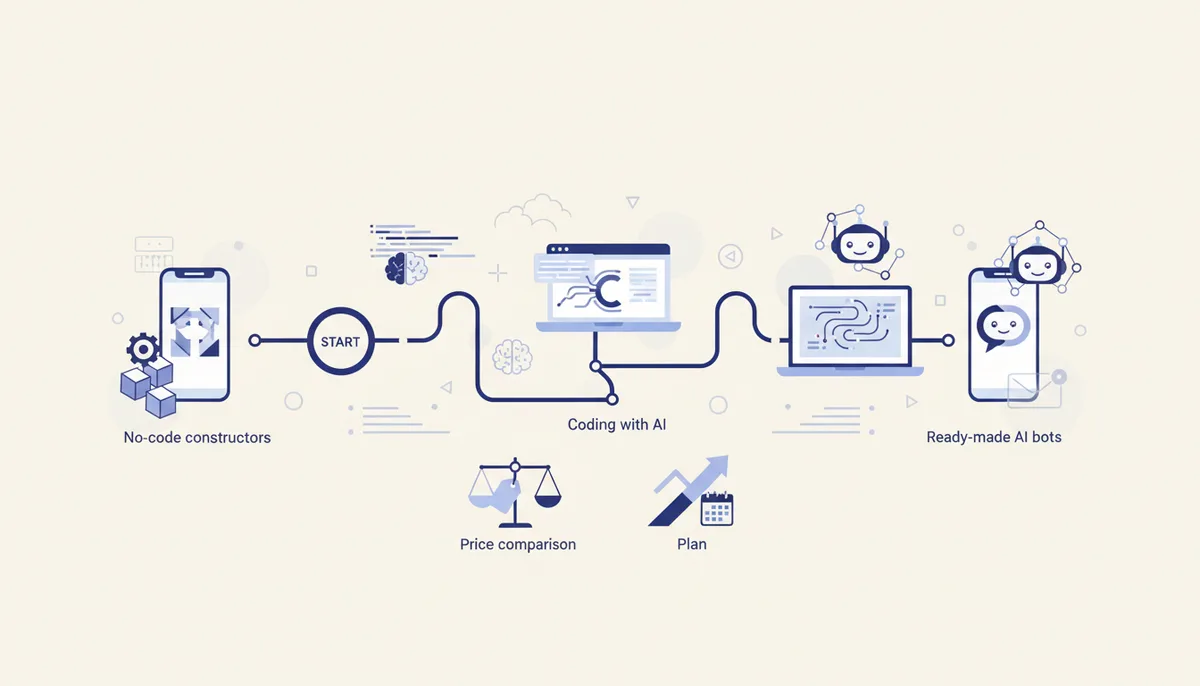
A Telegram bot with AI is a bot that answers people through a language model (Claude, GPT, GigaChat) connected over an API, instead of following a rigid tree of buttons. In 2026 there are three working routes: a no-code builder (SaleBot from 990 ₽/month, BotHelp from 1,290 ₽/month, prices as of July 2026), your own bot that Claude Code writes in one evening (the code is free, you pay for a VPS and API tokens), and ready-made AI bots on subscription from about 300 ₽/month. Builders are chosen for broadcasts and marketing funnels, your own code for a product with non-standard logic, and a ready-made bot when you just need access to a neural network rather than a service of your own. Below is a comparison table and a step-by-step plan for each route.
How an AI bot differs from an ordinary one
A classic Telegram bot is a tree of prepared answers: press a button, get some text. It's predictable, but it breaks on the first question that's "off script". A bot with AI forwards the user's message to a language model and returns the generated answer, so it understands free-form phrasing, holds the context of a conversation and can draw on your knowledge base.
In practice such bots cover four jobs: first-line support (handling most standard questions), lead qualification (the bot asks the follow-up questions itself and hands a warm contact to a manager), free-form request intake, and internal assistants for the team. If what you need is specifically the business side, look at the breakdown of AI agents for business — a Telegram bot there is just one of the interfaces.
Which route to choose: a comparison
| Route | Difficulty | Price (as of July 2026) | Flexibility |
|---|---|---|---|
| Builder (SaleBot, BotHelp) | Low: visual editor, no code | SaleBot from 990 ₽/month, BotHelp from 1,290 ₽/month per 1,000 subscribers | Medium: within the platform's blocks |
| Your own code via Claude Code | Medium: one evening and a willingness to dig in | Code free; VPS from ~300 ₽/month + API per token | Maximum: any logic and integrations |
| Ready-made AI bot on subscription | Zero: subscribe and use | From ~300 ₽/month | Minimal: it's someone else's product |
The rule for choosing is simple. If you need broadcasts, funnels and subscriber segmentation — a builder. If you need your own product, integration with your database or unusual logic — your own code. If you just want to use AI models inside Telegram — a ready-made bot, and don't overcomplicate it.
Route 1: no-code builders — SaleBot and BotHelp
A chatbot builder is a visual editor where the scenario is assembled from blocks: message, condition, delay, AI request. No programming needed, but you do need to think the scenario through carefully.
SaleBot has a free tier limited to 50 messages a day — enough to build and validate a prototype. Paid plans start at 990 ₽/month, "full automation" is 1,799 ₽/month; extra messengers and operator seats are billed separately (prices as of July 2026). BotHelp has been billed by the number of active subscribers since March 2026: from 1,290 ₽/month for 1,000 contacts, with AI agents backed by a knowledge base, broadcasts and CRM integrations included; there's a 14-day free trial.
Honest downsides: the logic lives inside the platform and can't be exported, the price grows along with your subscriber base, and the "AI block" is configurable only within the bounds the builder anticipated. For marketing scenarios that's enough; for a product it's cramped.
Route 2: how Claude Code writes a bot in one evening
This route is for people who want to own their bot outright. The code will be written by an AI agent; your job is to state the task and check the result. If Claude Code isn't set up yet, start with the beginner's guide.
Step 1. A token from BotFather. Open @BotFather in Telegram, send /newbot, set a name and a username (it must end in bot). You'll get a token in the form 123456:ABC-… — that's the key that controls your bot, so keep it like a password.
Step 2. The stack. Two proven options: Python + aiogram 3 or TypeScript + grammY. Both frameworks are mature, with large communities and plenty of public examples. For a beginner the difference barely matters — the agent writes the code, not you.
Step 3. The task for the agent. A prompt along these lines: "Write a Telegram bot in Python with aiogram 3: long polling, a /start command, forward all other messages to the Claude API with a system prompt for a shop consultant, store conversation history in SQLite, read tokens from .env." The more specific the constraints, the fewer iterations — more on that in how to state a task so the agent understands it.
Step 4. Running locally. Long polling needs no domain, no HTTPS and no public IP: run python bot.py and the bot already replies, even from your home computer.
Step 5. The neural network. You'll need a model API key; there's a separate guide on payment and access to the Claude API from Russia. Keep keys in .env and never commit them to git.
Step 6. Deployment. An inexpensive VPS (from ~300 ₽/month as of July 2026), Docker or a systemd unit with auto-restart. Ask Claude Code to write the Dockerfile and the deployment instructions too — that's its job.
A realistic estimate: your first bot takes 3–4 hours, the second one an hour. The whole path from idea to production with an AI agent is covered in how to build an app with AI.
Route 3: ready-made AI bots — when you don't need to build anything
A ready-made AI bot is someone else's service inside Telegram selling subscription access to neural networks: Syntx AI and dozens of similar bots aggregate GPT, Claude and image generators in one chat. Subscriptions as of July 2026 start at roughly 300 ₽/month, paid by Russian card, SBP (Russia's instant payment system) or Telegram Stars.
One thing to be clear about: this is not "your bot". You don't control the logic, you don't accumulate a subscriber base, and you can't wire it into your own processes. But for personal access to AI models without a foreign card, it's the shortest path.
Common mistakes when building an AI bot
- The token in the code. A bot token or API key committed to a public repository gets found by scanner bots within minutes. Secrets belong only in
.envor environment variables; a primer is in the article on API keys and secrets. - A webhook from day one. Webhooks require a domain and HTTPS and complicate debugging. Start with long polling — you can move to a webhook when traffic appears.
- No limits on the AI. Without a per-user request cap, one chatty enthusiast will burn through your API budget. Set a daily message limit from day one.
- No system prompt. A bot with no role and no boundaries answers absolutely anything, including questions you'll be embarrassed about later. Write down the role, the tone and the forbidden topics.
What's next
Before you build, look at the ready-made combinations in the arsenal: the Business section has cards on Telegram bots — from lead qualification to accepting payments — with prompts and a breakdown of the pitfalls. And if you're planning not one bot but a stream of such projects, take a look at the Quest engine: it gives Claude Code a permanent structure of work — from stating the task to verifying the result — so the third and the tenth project don't start from a blank page.
FAQ
Can I make an AI Telegram bot for free?
A prototype, yes: SaleBot has a free tier up to 50 messages a day, and your own aiogram bot can run from your home computer. A working version won't be entirely free: generating answers with a neural network costs money — either inside a builder's subscription or as API token charges.
Do I need to know how to program to build a bot with Claude Code?
No, but you do need a willingness to dig in: reading error messages, running terminal commands, asking the agent clarifying questions. Claude Code writes all of the code. The bar is a confident computer user, not a developer.
Which AI model should I connect to a bot from Russia?
The working options: Claude or GPT through API proxies and aggregators (payable by Russian card), and GigaChat and YandexGPT directly. For quality of dialogue in Russian, Claude is one of the strongest choices; the access routes are covered in the guide to the Claude API from Russia.
Builder or your own code — what should a business choose?
Look at the task. Broadcasts, funnels, segmentation — a builder repays its subscription in saved time. Non-standard logic, integration with your own database or CRM, control over AI spending — your own code: an evening with Claude Code versus 12,000–15,000 ₽ a year for a subscription that will still confine you to the platform's blocks.
How much does it cost to run your own bot per month?
As of July 2026: a VPS from ~300 ₽, and the AI API from a couple of hundred rubles to several thousand depending on traffic and model. A small support bot usually fits within 500–1,500 ₽/month — comparable to a builder, but with no ceiling on the logic.