Vibe Coding vs Programming: What to Choose in 2026
In short
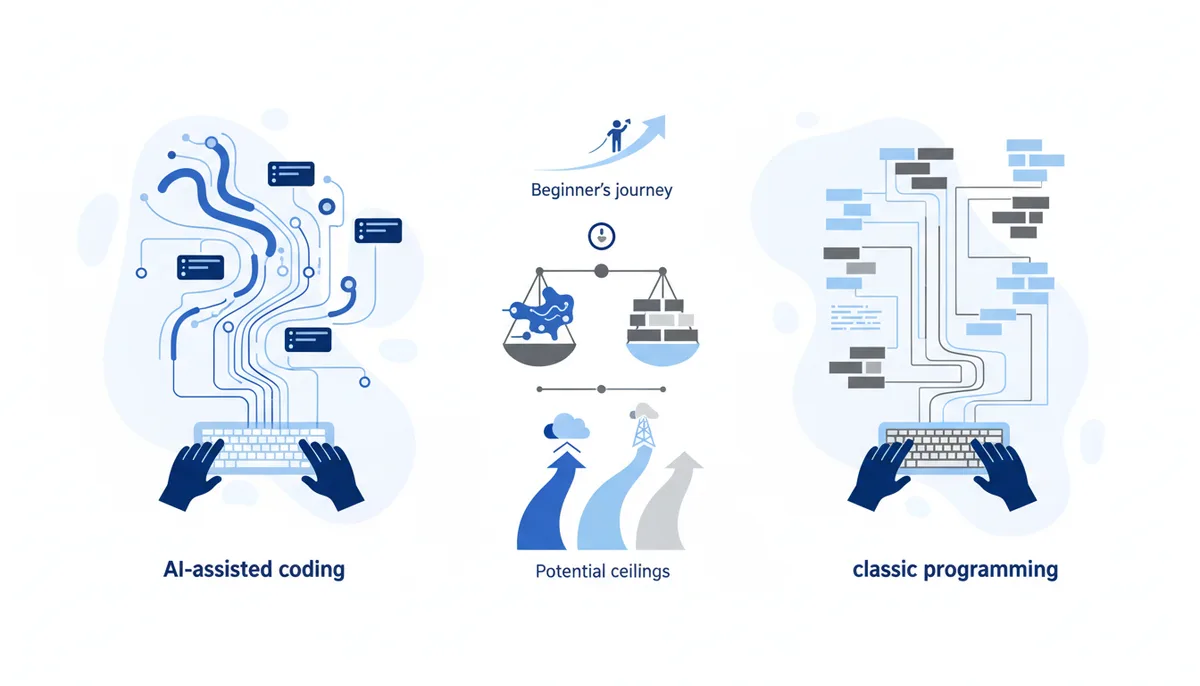
Vibe coding and classic programming aren't competitors — they're two levels of working with code. Vibe coding gets a beginner to a working product faster (days instead of months), but without a grasp of the fundamentals you'll hit a ceiling: you won't be able to fix hard bugs or take responsibility for security. The classic path gives you control and depth, but takes months to enter, and AI agents are already absorbing its routine parts. The workable trajectory for 2026 is to start with vibe coding while picking up the fundamentals alongside it; the either/or framing is a false dilemma.
What we're comparing: definitions without the marketing
Vibe coding is an approach where you describe a task to an AI agent in natural language and the model writes the code; your role is to set tasks, check results and make decisions. Andrej Karpathy proposed the term in February 2025, and by the end of that year Collins Dictionary named "vibe coding" its word of the year — that's how fast the approach went mass-market. A detailed breakdown is in what vibe coding is.
Classic programming is a craft in which you write and read the code yourself: you know a language, algorithms and data structures, you can debug and design systems. AI can assist here — autocomplete, generated tests — but understanding and responsibility stay with the human.
One important caveat: the line is blurring. In 2026 professional developers work through agents like Claude Code en masse, and thoughtful vibe coders eventually start reading code. So we aren't comparing people, we're comparing starting strategies: "describe tasks to an AI" versus "learn a language from scratch".
Vibe coding vs programming: a table across 5 criteria
| Criterion | Vibe coding | Classic programming |
|---|---|---|
| Barrier to entry | Low: a first working prototype in one evening | High: months of study before your first useful product |
| Speed | An MVP in hours or days; rewrites are fast too | Slower to start, but fewer surprises over the long haul |
| Control | Limited: you steer through task framing and checks | Full: you understand every line and can step in anywhere |
| Quality | Variable: depends on how the task was framed and what you verify | More predictable, driven by skill — though still not guaranteed |
| Career | A new niche: solo products, automation, "AI engineer" without a classic background | A proven junior → senior track, but entry keeps getting more competitive |
Now what that table means in practice.
When is vibe coding enough?
An honest list of tasks where betting on the agent already pays off today:
- Landing pages and simple web apps. A business-card site, a portfolio, a contact form — routine jobs an agent handles with almost no hand-holding; the step-by-step version is in the guide on how to build a site with AI.
- MVPs and hypothesis testing. When what matters is finding out in a week whether anyone needs the product, not building perfect architecture.
- Internal tools and automation. Scripts, scrapers, reports, Telegram bots — code for your own use, where a crash isn't a catastrophe.
- Pet projects and learning. A working product motivates far more than your hundredth array-sorting exercise.
What these share: the cost of a mistake is low, load is small, speed matters more than perfect code. If you're in that category, start right now — there's a step-by-step plan in how to get started with vibe coding.
When you can't do without classic programming
- Money and personal data. Payments, healthcare, fintech: where a bug or a leak is expensive, generated code has to pass through a human who understands it.
- High load. An agent will write a working service, but it won't notice on its own that the thing falls over at ten thousand concurrent users.
- Large legacy codebases. The more implicit context and old agreements a project carries, the more often the model gets it wrong.
- Non-standard algorithmic problems, where the solution has to be invented rather than reproduced from patterns in the training data.
Note: even in these areas professionals use agents heavily — but as a tool under expert control, not as a replacement for that expertise.
Honest ceilings: where each path runs out
Pure vibe coding hits its ceiling when the project stops fitting "inside the model's head". The symptoms are familiar to anyone who's tried it: the agent fixes one bug and breaks two others; you can't explain why the app works at all; every change is frightening to ship. The cause isn't weak models — it's your lack of control instruments. You don't read the code and don't manage the process, so quality rests on luck.
The classic path's ceiling is different: time and relevance. While you spend six months on a fundamentals course, a vibe coder has shipped three prototypes, collected feedback and possibly earned their first money. The market has already priced this in: routine junior tasks are being automated, and employers expect newcomers to work with AI agents as a baseline skill, not a resume bonus.
The conclusion is unpleasant for both "religions": pure vibe coding without growth runs into quality and security, pure classic development without AI runs into speed and competition in the job market.
Learn Python or vibe code right away? A beginner's 2026 trajectory
That's how beginners usually phrase the question. The answer: vibe code right away — but don't stop there. A workable scheme:
- Weeks 1–2: your first product through an agent. Pick up Claude Code or Cursor and build a real thing — a site, a bot, an automation. If you're starting from zero, begin with the Claude Code guide for beginners.
- Months 1–3: learn to read the code the agent generates. Not write — read. Ask the model to explain every decision in plain words: it's the cheapest personal tutor the industry has ever had.
- Months 3–6: fill in the fundamentals selectively. Git, the basics of HTTP and databases, the ability to state a task so the agent understands it. Learn Python or JavaScript not "by the course" but through your own project — where the code already solves your problem.
- After that, follow your goal. Aiming for employment — add algorithms and system design. Building your own thing — grow product skills; depth in code comes with the projects.
This order preserves vibe coding's main advantage — the motivation of a working product from week one — and closes its main risk: helplessness in the face of hard bugs.
How to vibe code without ending up with chaos
The difference between "talked at the agent, got mush" and "got a maintainable product" is methodology: rules for the agent, task decomposition, verification after every step. You can assemble it yourself from the arsenal guides — that's free, but it takes weeks of trial and error.
The second path is to take a ready-made one. That's why we built the Quest engine for Claude Code and Cursor: it gives the agent roles, stage discipline and result verification — exactly the guardrails the beginner in the previous section is missing. As of July 2026 the engine costs 4 900 ₽ as a one-time purchase, with add-on modules at 1 900 ₽ each; details are on the Quest engine page.
The engine doesn't cancel the learning point: it lowers the cost of mistakes and speeds up your growth, but you'll still have to read code and understand the basics — just now in parallel with real results rather than instead of them.
FAQ
Can you become a programmer through vibe coding alone?
Someone who ships working products — yes. An engineer who gets hired onto a complex system — no: that requires reading code, understanding architecture and debugging without AI. Vibe coding is an excellent entry point into the profession, but not a full substitute for the fundamentals.
Will vibe coding kill the programming profession?
No, but it's changing its structure: routine code writing is being automated, and value shifts toward framing tasks, verification, architecture and owning the outcome. The pressure is on developers who ignore AI agents — not on the profession as a whole.
Which language should you learn if you started with vibe coding?
The one your agent writes your projects in: for the web that's almost always JavaScript/TypeScript, for automation and data it's Python. Learning a language in a vacuum, before your first live project, is almost always a loss of momentum in 2026.
What does each path cost to start?
Vibe coding: a tool subscription — as of July 2026 entry-level Claude and Cursor plans sit around $20 a month (check current prices with the vendors). Classic: there's plenty of free material, and you mostly pay in time — months before your first practical results.