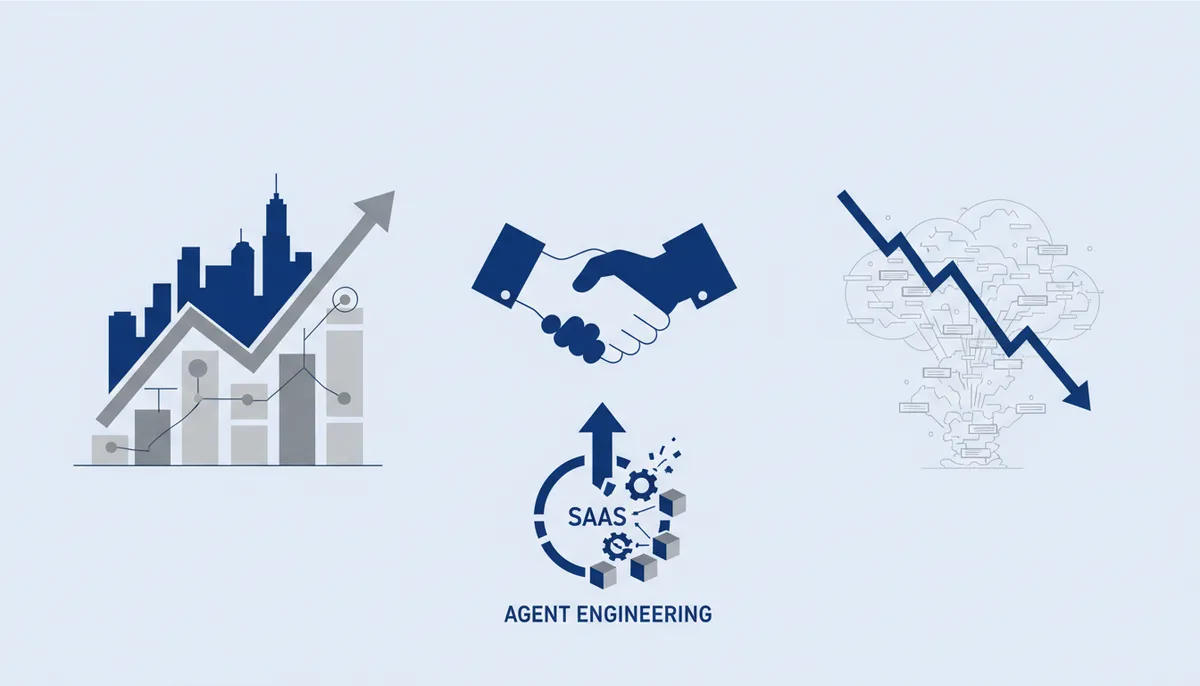
By mid-2026 it had become obvious that the chaotic vibe-coding popular in the early days of AI was producing terabytes of unreadable code and vulnerabilities. The industry responded by moving to a stricter discipline — agentic engineering. That shift changed not only how software gets built, but also triggered a major structural realignment in the off-the-shelf software (SaaS) market, now known as the "SaaSpocalypse."
What happened
The market for vibe-coding platforms reached $4.7bn by June 2026, overtaking the classic No-Code segment, with growth projected to $12.3bn by 2027. 92% of US developers use AI daily, and 41% of the world's codebase is generated by algorithms. But after the reliability crisis in production engineering at the turn of 2025-2026, classic vibe-coding gave way to agentic engineering.
The approach, described by Karpathy on 5 February 2026, gives AI agents autonomous access to terminals, browsers and runtime environments, but keeps them inside hard architectural boundaries defined by a human. The operating loop became strict: from intent to a detailed spec, to a change plan, to automatically written tests — and only then to deploy.
February 2026 brought the "SaaSpocalypse": the combined market cap of public SaaS companies fell by $285bn (roughly 10.2% of the market), and the median revenue multiple dropped from 12x to 8.5x. Businesses realised that subscribing to off-the-shelf software stops making sense when in-house analysts can assemble custom software for their own needs in a couple of hours. That pushed down the numbers in web form builders, task managers, simple CRMs and analytics dashboards.
By 2027, global technical debt from suboptimal AI code is projected to reach $1.5tn, since up to 45% of AI-generated code contains vulnerabilities without proper tuning.
Why it matters
The move to agentic engineering is not just a change of methodology but a fundamental shift in development philosophy. It reflects the industry's push for reliability, security and controllability in the AI era. Where the emphasis used to be on prototyping speed, the priority now is the quality and durability of systems. That means developers will have to pick up new approaches, focusing on architectural review and contextual prompt engineering rather than just language syntax.
The "SaaSpocalypse" is a direct consequence of that transformation. Companies are no longer willing to pay for one-size-fits-all SaaS when AI lets them quickly build customised software for specific needs. This opens huge opportunities for in-house development teams and for startups offering agentic engineering tooling. But it also creates new risks around technical debt and vulnerabilities in AI-generated code, which calls for mandatory static analysis and strict review processes.
What it means in practice
- Learn agentic engineering: move from free-form code generation to a strict loop: architectural constraints → automatically written tests → code generation → run in an isolated container → human review. This will raise the quality and reliability of your AI-built solutions.
- Use hybrid pipelines (Graduate Workflow): for fast UI prototyping and hypothesis testing, use cloud environments (Lovable, Bolt.new, for example), then move the stable codebase into more controlled environments (Cursor, Claude Code) for backend, logic and security.
- Focus on architecture and security: knowing syntax matters less than understanding system architecture, information security and working with data. Retarget staff training toward those skills and toward contextual prompt engineering.
- Adopt static analysis: given the high risk of vulnerabilities in AI-generated code, mandatory static analysis becomes critical for every project that uses AI in development.
- Rethink your SaaS stance: if you build SaaS products, think about how AI agents can help your customers build customised solutions. If you buy SaaS, assess what you can do yourself with AI agents to cut costs and get more precise tools.