How to Make Money with Vibe Coding in 2026: 4 Paths
In short
- Making money with vibe coding in 2026 is realistic, but it's work, not an "income" button. There are four working paths: freelancing, your own product, growth inside a job, and content.
- The fastest money is freelance: landing pages (as of July 2026 beginners on marketplaces charge 10,000–30,000 ₽, experienced ones 30,000–80,000 ₽), Telegram bots (10,000–70,000 ₽ for a custom one), and automations for small businesses.
- The highest ceiling belongs to your own micro-SaaS — and so does the highest chance of earning nothing: code is the smaller half of success, the rest is distribution.
- The most underrated path is employment: automating your own work converts into a raise faster than a first marketplace order does into cash.
- "Passive income in one evening" is a marketing fairy tale. AI lowered the barrier for everyone at once, so competition grew rather than vanished.
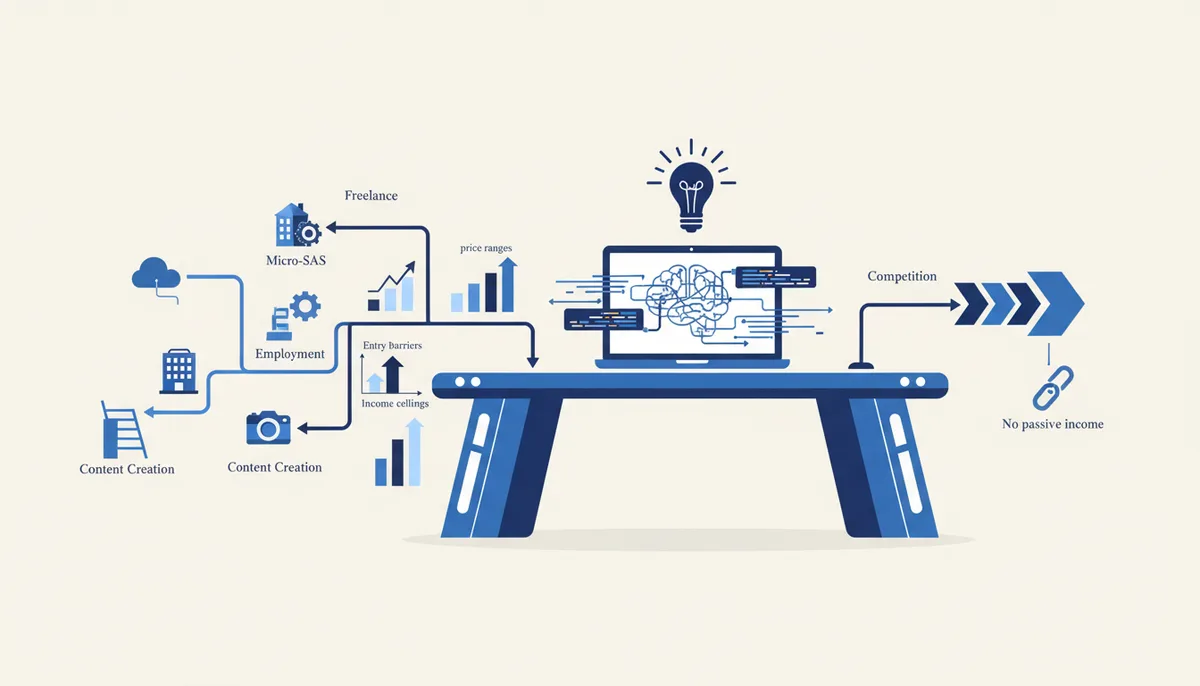
- The winner isn't whoever has the tool but whoever has the process: repeatable quality, deadlines, checklists. Below is a table of paths with entry barriers and ceilings.
Can you actually earn from vibe coding in 2026?
Yes — with a caveat. Vibe coding is a development approach where you describe the task to an AI agent (Claude Code, Cursor) in natural language and the model writes the code — there's a full breakdown in what vibe coding is. The approach removed the main barrier: to build a working site, bot or automation you no longer need two years of learning to program.
But nobody pays for "I can prompt" — they pay for a solved client problem. The barrier dropped for everyone simultaneously: according to freelance-market reviews from July 2026, job postings collect dozens of applications and competition keeps rising. The people who earn are the ones who take a project to production — with deployment, revisions and a warranty — not to a screenshot in a chat. How that role differs from a classical developer is covered in vibe coder: who they are.
Freelance: sites, bots, automations
The most direct path to first money. What actually sells and at what rates (benchmarks from marketplaces and studios as of July 2026):
- Landing pages and business-card sites. A builder-based assembly on Kwork (a Russian freelance marketplace) starts at 500–1,500 ₽ — that's the race-to-the-bottom segment, best avoided. A beginner delivering tidy quality charges 10,000–30,000 ₽, an experienced contractor 30,000–80,000 ₽, and projects with integrations (CRM, payments, bots) start at 100,000 ₽. The production technique is in how to make a website with AI.
- Telegram bots. Simple scripted bots on Profi.ru go for 3,000–25,000 ₽; a custom bot with logic and integrations from a freelancer, 10,000–70,000 ₽; the "analyst and developer in one" format, 80,000–140,000 ₽; studio projects start at 200,000 ₽. A step-by-step walkthrough is in building a Telegram bot with a neural network.
- Automations. Scrapers, CRM–spreadsheet–messenger pipelines, reports. The average project on FL.ru runs 15,000–40,000 ₽ as of July 2026; competition is lower here because you need to understand the business process, not just the code.
Where to find work: freelance marketplaces (Kwork, FL.ru, Profi.ru, Habr Freelance), Avito services (Russia's largest classifieds site), niche Telegram groups, and — the underrated channel — local small businesses with no website and no CRM. Selling directly takes longer but comes without commissions and without price wars. Foreign marketplaces remain largely inaccessible from Russia in 2026 (Upwork doesn't work with the country), so treat the CIS market and direct contracts as your baseline.
An honest word about the ceiling: a solo freelancer's income is capped by hours. Market estimates as of July 2026 put beginners at 30,000–50,000 ₽/mo in their first months and experienced developers around 190,000–200,000 ₽/mo and above. But every ruble here is hours sold and worked, plus free revisions.
Your own product: micro-SaaS
Micro-SaaS is a small paid online service that solves one narrow problem and lives on subscriptions: an invoice generator for freelancers, competitor price monitoring, a content planner. Vibe coding cut MVP assembly from months to weeks — that's a genuine advantage of the moment.
The dishonest part of the marketing is the silence about distribution. Most micro-products earn zero not because of the code but because nobody heard of them. The working strategy: build the product around a problem you've already seen in real clients while freelancing or employed, and sell the first subscriptions by hand — in person, in chats, through case studies. This path isn't capped by hours, which is why it gets romanticized, but it's sensible to enter it as a second step, with a cushion from freelancing or a salary.
Employment and content: two underrated paths
Inside a job. If you're a marketer, analyst or manager, vibe coding converts into money with no client hunting: automate your reports, build an internal dashboard, connect the two services "engineering has no capacity for." That's visible value to an employer, and raises and new roles grow out of it. Often it's the fastest return on invested time: the client already exists and already pays you. The one rule — record results in numbers (hours, money, speed), or the value goes unnoticed.
Content and teaching. Case studies, breakdowns, prompt templates, mini-courses. This only works if you have your own practice: projects first, content about them second. The "how to earn money" course market is saturated; audience trust goes to practitioners with results they can show. Bonus: content reinforces the other paths — it brings inbound freelance requests and gives your product distribution.
Path table: entry barrier, timeline, ceiling
| Path | Entry barrier | First money | Realistic ceiling | Main risk |
|---|---|---|---|---|
| Freelance: sites and bots | Low: a portfolio of 2–3 pieces | 2–8 weeks | ≈190,000–200,000 ₽/mo (July 2026 estimates), capped by hours | Price wars, dozens of bids per job |
| Business automations | Medium: you must understand processes | 1–2 months | Higher average check, less competition | Long sales cycle with small businesses |
| Micro-SaaS | Medium: MVP plus marketing | 3–12 months, often never | Not capped by hours | Zero users without distribution |
| Growth in a job | Low: the "client" already exists | 1–2 salary review cycles | A raise, a new role | Value goes unnoticed unless you record results |
| Content and teaching | Requires your own case studies | 3–6 months | Grows with your audience | Saturated market, burnout |
The freelance figures are benchmarks from marketplaces and market reviews as of July 2026; the other estimates are qualitative — niche, city and persistence move the ranges in both directions.
Why "passive income in one evening" is the anti-example
The typical reels formula: "built an app in an evening, added a subscription, money rolls in." What's wrong with it:
- Everyone can build it in an evening. If a product takes an evening to build, thousands of people will build the same thing — it has no moat.
- Subscriptions are paid for reliability. A "passive" service breaks the first time someone else's API changes, and customers leave without a word.
- Sales still exist. An app with no distribution channel is a repository, not a business.
Money in vibe coding is active: orders, revisions, support, marketing. AI speeds up production but doesn't repeal economics.
How to start earning
The sequence that works for most people:
- Learn the basics — the tool plus the process: where to start with vibe coding and vibe coding techniques.
- Build 2–3 demo projects in your chosen niche — a landing page, a bot, an automation. That's practice and portfolio at once.
- Pick one channel for orders and send ten personal applications instead of a hundred templated ones.
- Standardize production: freelance money comes from repeatability — consistently solid projects on predictable timelines.
Point four is where most people stall: every project starts from a blank page, quality swings, deadlines slip. That's exactly why we built the qvib engine — a layer of discipline on top of an AI agent: rules, roles, checklists, work planning. It exports to Claude Code, Cursor and the AGENTS.md format, so it doesn't tie you to a tool: switch editors and your process and quality move with you. As of July 2026 the engine costs 4 900 ₽ one time, with task-specific modules at 1 900 ₽ each — for a freelancer that's a fraction of a single order, repaid by the predictability of every order after it.
FAQ
Can you earn from vibe coding with no programming experience?
Yes, in simple niches — landing pages, scripted bots. But being able to read code at least at a basic level and verify the result quickly becomes a competitive edge: clients pay for what works, not for what was generated. A convenient starting point is the Claude Code guide for beginners.
How long until the first money?
With a freelance focus, usually 2–8 weeks: a week or two for a portfolio, then applications and first orders. The first invoices will be modest — on marketplaces, reputation and reviews are worth more than one-off margin.
Which path should I take first?
If you have a full-time job, start by automating your own work: zero risk and a fast, visible result. If you need money now, freelance. Leave micro-SaaS as a second step, once you've spotted a recurring problem among real clients.
Won't AI kill the market for these services?
Some simple orders really are moving to self-service — business owners assemble landing pages themselves. But demand is rising for people who own the outcome: integrations, reliability, support. Shift from "make me a page" to "fix this process" — competition is lower there and the checks are bigger.
Do I need to buy paid tools to start?
The minimum to start is access to an AI agent and an hour of practice a day. Add-ons like the qvib engine speed up your path to stable quality, but it's sensible to buy them after your first projects, once you can see your own bottlenecks.