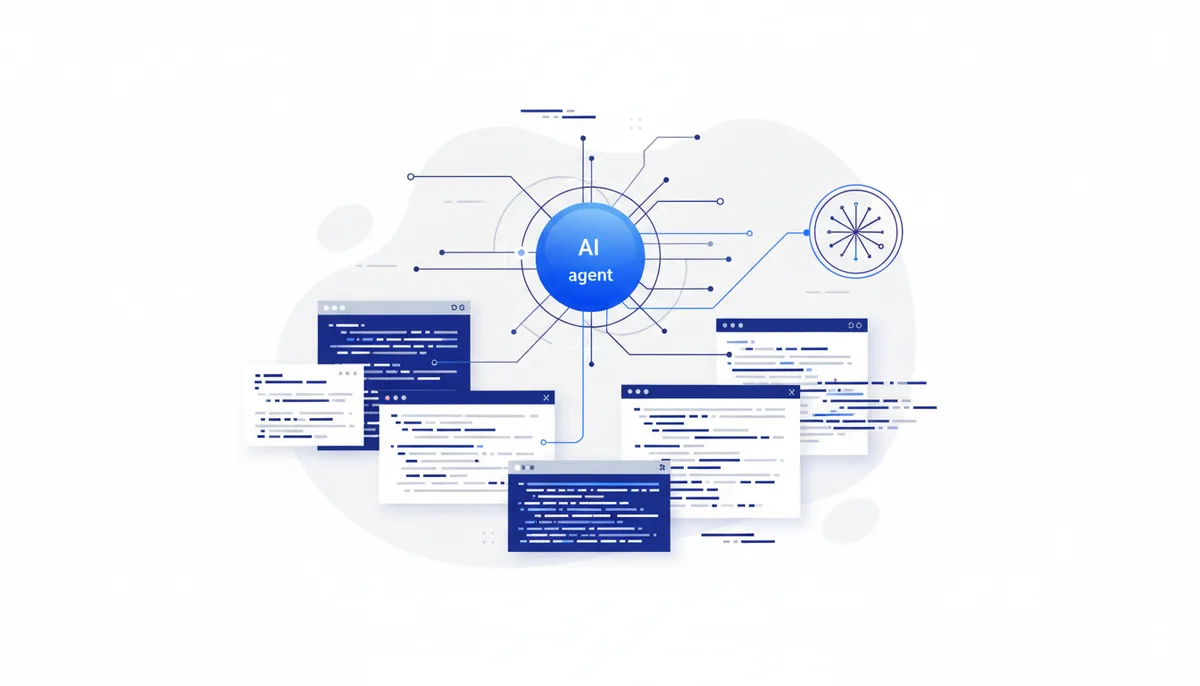
Picture this: instead of just asking a question, you hand it to a smart assistant that figures out what you actually want, finds the data, verifies it and returns a precise answer. That is not science fiction, that is agentic retrieval (Agentic RAG). For you as a vibe coder it means you can build systems that do not merely answer but genuinely solve tasks, cutting the error rate and raising the quality of every interaction with your data.
Why you need it
Classic RAG — one retrieval per query, answer generated immediately — no longer copes with hard tasks. It breaks on compound questions, cannot recover from a bad first result and does not pick the optimal search tool. Agentic retrieval fixes that by turning the process into a multi-step, self-correcting pipeline. That matters most when you need to:
- Answer compound questions: for example, "Compare the performance of product X with product Y and say which plans suit small businesses." The agentic approach splits that into several subqueries, each handled the best way.
- Cut hallucinations and raise accuracy: thanks to self-evaluation and repeated retrieval, an agent can push errors from 20%+ down to under 10% nepolyakov.ru. That is critical in systems where mistakes are expensive.
- Use different data sources: a question like "what is today's mortgage rate" needs a structured data call, not a search over similar text. Agentic retrieval uses a router to pick the right tool for each task nepolyakov.ru.
- Build more reliable and flexible systems: the agent does not just spit out an answer, it passes through several gatekeepers — a planner, a router, retrieval, pairwise comparison and a critic — which together guarantee quality and relevance nepolyakov.ru.
How to use it
Moving to agentic retrieval does not require rewriting your system from scratch. You can start by adding agentic pieces to the RAG pipeline you already have:
- Add a query rewriting step: if the first search result looks irrelevant, let the agent rephrase the original query. A small language model is enough to do this.
# Example prompt for query rewriting
You are an assistant that improves search queries. The user asked: "{user_query}". The first search returned irrelevant results. Rewrite this query so it is more precise and captures the essence of the question for a search over technical documentation. Output the new query only.
- Route to tools and sources: instead of a single index, give the agent a choice of several. That can be vector search, keyword search, an external API call or even running code.
# Example prompt for routing
The user asked: "{user_query}". Decide which tool best fits the answer: 'vector_search' (for general knowledge), 'api_call_finance' (for financial data), 'code_executor' (for running code). Output the tool name only.
- Add self-reflection and critique: the agent should be able to judge the quality of its own answer. If it is unsure, it can request more information or re-verify the facts.
# Example prompt for the critic
You are a critic evaluating the draft answer: "{draft_answer}" against the retrieved fragments: "{found_fragments}". Judge sufficiency, contradictions and freshness of the information. If the answer is incomplete or inaccurate, suggest what else needs to be found. If the answer is good, write 'OK'.
Tricks nobody tells you about
- Do not confuse "agentic" with "multi-agent": most production systems are a single language model performing different jobs at each stage, not a swarm of independent agents nepolyakov.ru. Focus on the feedback loops inside one model.
- Use intent categories: before you fire off expensive retrieval, work out the user's intent. Simple queries like "Hi!" or "2+2=?" need no retrieval at all, and the LLM can answer directly, saving time and resources datatalks.ru. Simple rules or a small classification model will do.
- Manage your sources deliberately: in the Russian ecosystem, for instance, Yandex (the Russian search engine) offers a
robots.txtdirective to allow or forbid the use of your pages in AI answers nepolyakov.ru. Use options like that to control what data your agent draws on.
How this ties into the engine
Modern engines ship ready-made rules, roles and skills that let you drop agentic patterns into your projects quickly. Instead of wiring all these steps by hand, you can use preconfigured modules for planning, routing and self-reflection, which speeds up development considerably and makes your systems more reliable.
Full card in the arsenal: https://qvib.pro/arsenal/trends/dev-agentic-rag/