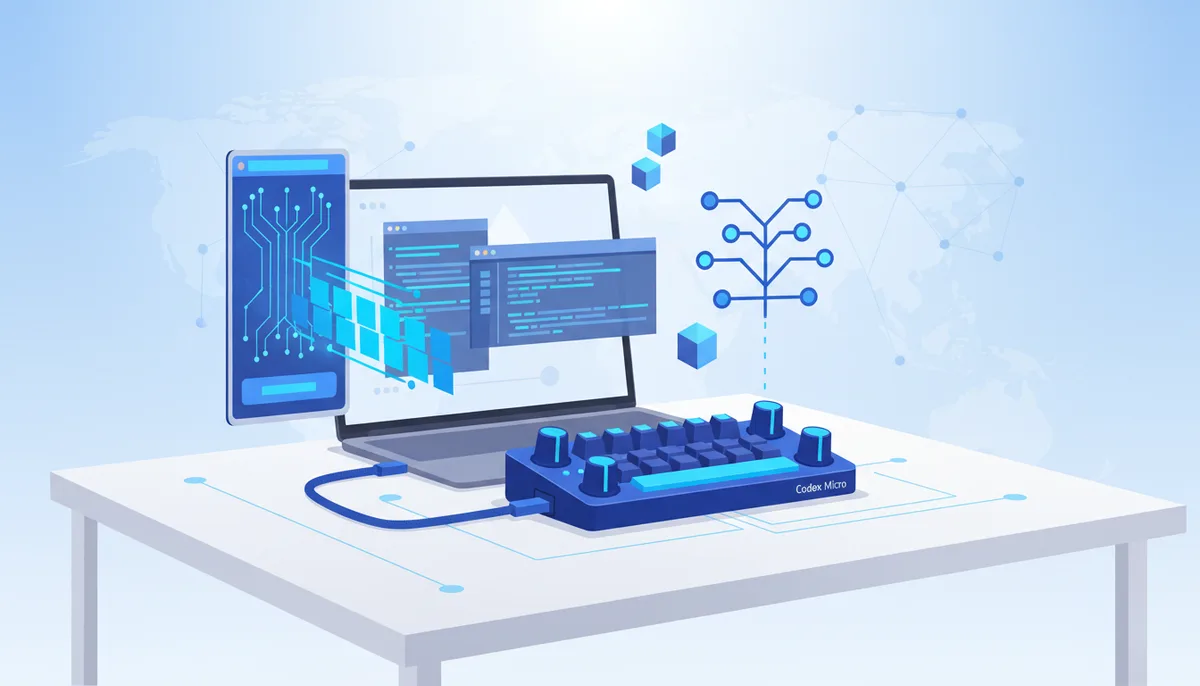
OpenAI, together with Work Louder, has released Codex Micro — a macropad built for physically controlling AI agents in Codex. This is not just another piece of peripheral hardware, it is an attempt to bring tactile control into the world of abstract AI systems. For developers and engineers who spend hours interacting with AI, a tool like this can noticeably improve the workflow and make agent control far more intuitive.
What it is
Work Louder and OpenAI have introduced Codex Micro, a dedicated macropad for driving AI agents in Codex. The device carries physical buttons, a joystick and a rotary encoder. The joystick launches work scenarios such as pull request reviews, code refactoring or bug hunting. The encoder dials the model's reasoning level up and down, and the remaining buttons can be mapped to activate voice mode, open a new chat or send a request. Together that lets you track task state and adjust how deeply the model reasons through physical controls.
Why it matters
The release of Codex Micro highlights the push toward more ergonomic and efficient interfaces for working with AI. While most AI interaction remains text-based, physical controllers can offer a faster and more intuitive way to steer complex processes. That is especially relevant for developers who constantly switch between different tasks and agent modes. Being able to fire off scenarios and adjust model parameters without leaving your main workflow can lift productivity significantly.
What it means in practice
- Faster workflows: physical buttons and a joystick let you instantly launch the scenarios you use most (code review, refactoring) and switch agent modes, cutting the time spent navigating an interface.
- Intuitive control: a rotary encoder for the model's reasoning level offers finer, more intuitive control over AI behaviour than typing commands or changing parameters in a menu.
- Lower cognitive load: offloading part of the control to physical elements can reduce cognitive load, letting developers focus on the hard parts of the task instead of managing the tool.
- Customisation: mapping functions to buttons lets you tailor the macropad to individual needs and preferences, building a personalised workflow.
- Potential for other AI tools: if Codex Micro succeeds, it could spur similar physical controllers for other AI tools and platforms, opening a new direction in interface design for AI.