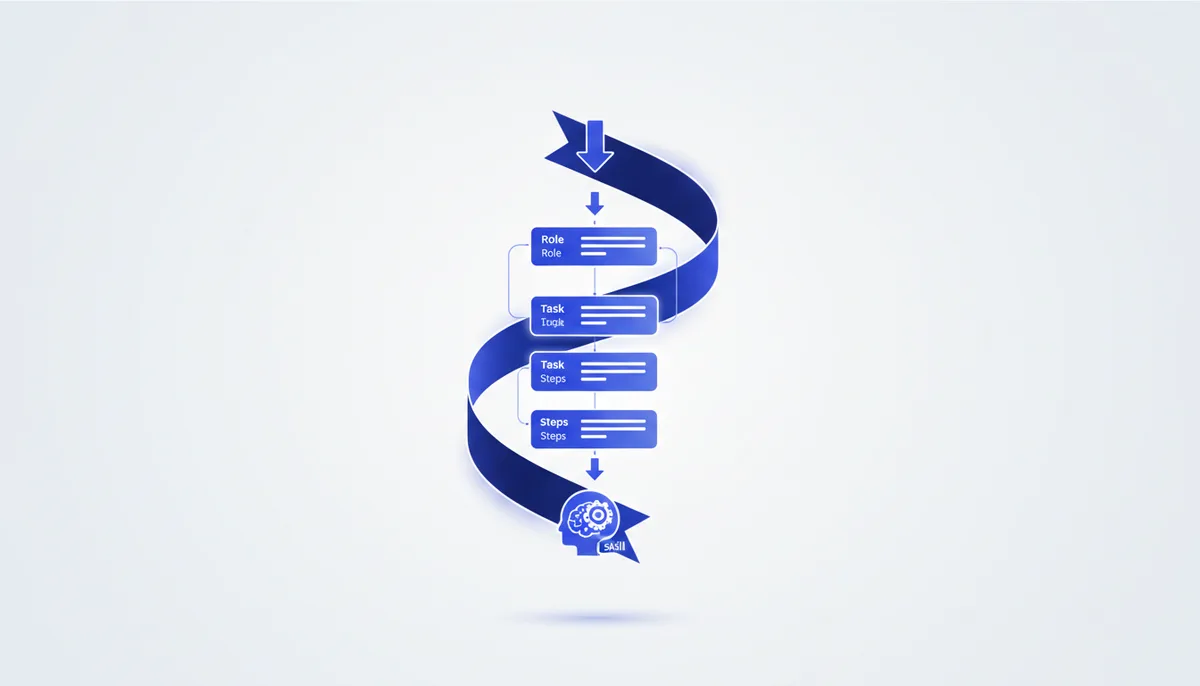
A personal brand normally gets "built" over months with a mentor. Claude does the same work in a single evening — as long as you give it structured prompts with a role, a task and steps, not vague requests. Below are four prompts that cover the basics: symbol, slogan, core idea and positioning focus. All of them in full — copy and use.
Why the Role → Task → Steps structure works
Asking "come up with a brand for me" gets you filler: the model doesn't know who you are or what counts as a good result. A structured prompt removes both problems: the role switches on the right expertise, the task sets the quality criterion, and the steps force the model to ask first and answer second. It's the same principle Claude skills are built on — reusable instructions for recurring tasks.
Prompt 1 — a signature symbol
The criterion: a symbol that can't be confused with anyone else's in your niche.
You are an expert in visual identity for personal brands.
Your task is to find a symbol that makes a person stop
scrolling and instantly recognise the author.

First ask me 5 questions, one at a time: niche, audience, character,
what I want to project, what I avoid. Don't answer until I'm done.

Then propose 3 options for a signature symbol. For each, explain:
why it won't be confused with anyone in my niche, how it scales
(avatar, covers, merch) and what its risk is.
Prompt 2 — a slogan people repeat
A good slogan gets quoted by the audience itself — that's free distribution. The criterion: hear it once and you know whose brand it is.
You are a copywriter of short signature phrases.
Ask me what I do, who for and what result I deliver.

Then propose 10 slogan options of up to 6 words:
— no cliches ("the key to success", "to the next level");
— with specifics drawn from my answers;
— phrased so that people want to say them out loud.
Mark the 2 strongest and explain the choice.
Prompt 3 — the non-obvious idea in your niche
Every niche has a truth that makes the audience say "hold on, seriously?". It's a reusable hook: openers for videos, first lines of posts, answers in interviews.
You are a researcher of non-obvious ideas in professional niches.
Ask me about my niche, my experience and the observations that diverge
from the accepted view.

Find 5 truths of my niche that contradict popular belief.
For each: why it's true, how it helps the audience,
and how to turn it into a gripping statement for content.
Pick the strongest one and expand it into the brand's "signature surprise".
Prompt 4 — positioning focus
One idea people choose you for. Not two, not three — one, specific enough to be unique.
You are a positioning strategist for personal brands.
Based on my previous answers, formulate the ONE
core brand idea in a single sentence.

Test it: name 3 audience segments and for each say whether
a person would say "that's me". If even one segment
says "no" — narrow the wording and repeat the test.
How to use them: order and sequence
The prompts work as a chain, in one conversation: you don't need the focus first — start with the symbol and slogan (they warm up the raw material), then the idea, and finish with the focus, which pulls everything into one sentence. Claude uses each step's answers in the next — don't start a new chat.
Next level: turn it into a skill
The four prompts are one process. In Claude you can package it as a skill: one command and the model walks you through the steps from symbol to focus, without making you paste walls of text. How to build skills like that is in the skills section of the qvib.pro knowledge base; there are ready-made skills for content and packaging there too. The whole base — 500+ cards on Claude, prompts and vibe coding — is open and free: it's the same knowledge pipeline we use to build the qvib engine for vibe coding.
Related links
- The arsenal's "Prompts" section: qvib.pro/arsenal/prompts/
- The "Claude skills" section: qvib.pro/arsenal/skills/
- How the qvib engine works: qvib.pro/