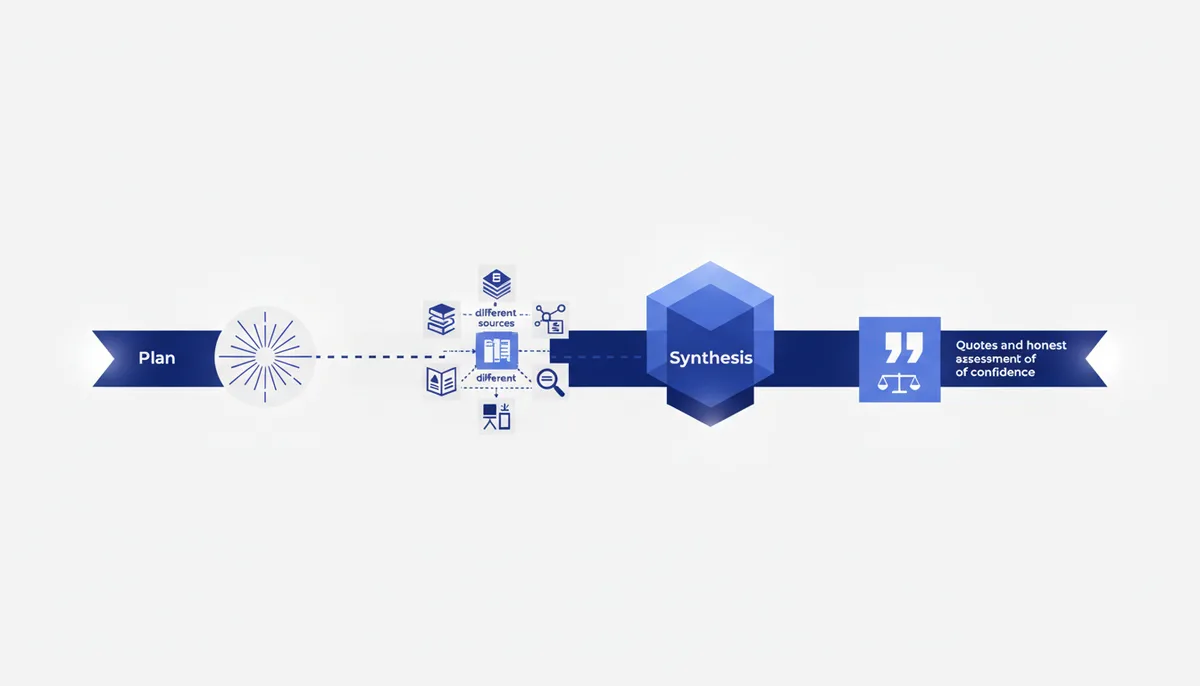
When to use it
A hard question where you need more than "the first Google result" — a breakdown of what's known, which positions exist, and what to trust. The AI's role is researcher-analyst (ideally in a mode with web search / deep research). Output: a structured review split into sub-questions, with links to specific sources and explicit flags where the data conflicts or is thin.
The prompt (copy and paste)
You are a researcher. Investigate the question below using web search. Don't answer from memory — rely on the sources you find.

QUESTION: "<PASTE THE QUESTION>".
PURPOSE AND READER: <what the answer is for and who it's for — e.g. a technology choice for a CTO>.
DEPTH: <e.g. a one-page review with sources>.

Work step by step:
1. PLAN: break the question into 3-5 sub-questions whose answers together form the full picture. Show me the plan.
2. SEARCH: find sources for each sub-question. Prefer primary sources and recent data; use DIFFERENT sources, not just one.
3. SYNTHESIS: answer sub-question by sub-question. After every meaningful claim, cite the source [URL/title]. Numbers and dates always with a source.
4. CONFLICTS: where sources disagree, show both positions — don't smooth it over. Where the data is thin or old, say so honestly.
5. BOTTOM LINE: a short conclusion aimed at the reader's purpose + a confidence level (high/medium/low) and what's missing for full clarity.

Don't invent sources or numbers. If a fact isn't confirmed by search, say so.
The technique: "plan → varied sources → synthesis with a citation on every claim → explicit conflicts and confidence" is the deep research methodology; citations make things checkable, but on their own they don't guarantee the conclusion follows from the source — hence the verification step.
Filled-in example
Question: "Should a startup in 2026 put SQLite in production or go straight to PostgreSQL?" Reader: a technical founder. Depth: a one-page review.
Expected AI behavior: the plan (sub-questions: SQLite's concurrent-write limits; production case studies; the cost of migrating later; what the maintainers say). Then a synthesis of each with links to the docs and engineering posts, a "they disagree: some praise the simplicity, others warn about writes under load" block, a bottom line aimed at a founder + confidence "medium, depends on the write profile".
Variations
- Competitive intel. "Compare 4 products on price/features/positioning, every fact with a link to their site or a review; flag where the data is stale."
- Mini literature review. "Find 5 key papers/articles on the topic, 2 lines of substance and a link for each; highlight where they agree and where they argue."
- Sources only. "First gather and rate 8 sources (recency, authority), and give the answer only after my OK" — control the evidence base before the synthesis.
Pro tips
- Split the question into sub-questions BEFORE searching: a broad query gives a shallow answer, while a plan forces the model to close each facet separately.
- Insist on DIFFERENT sources and a citation on every claim — but don't switch off your own skepticism: a link existing ≠ the conclusion following from it. On important facts, open the source and check it yourself.
- Make it show conflicts and a confidence level: an honest "the sources disagree / the data is thin" is more useful than a confident one-sided answer, especially when a decision rests on the research.