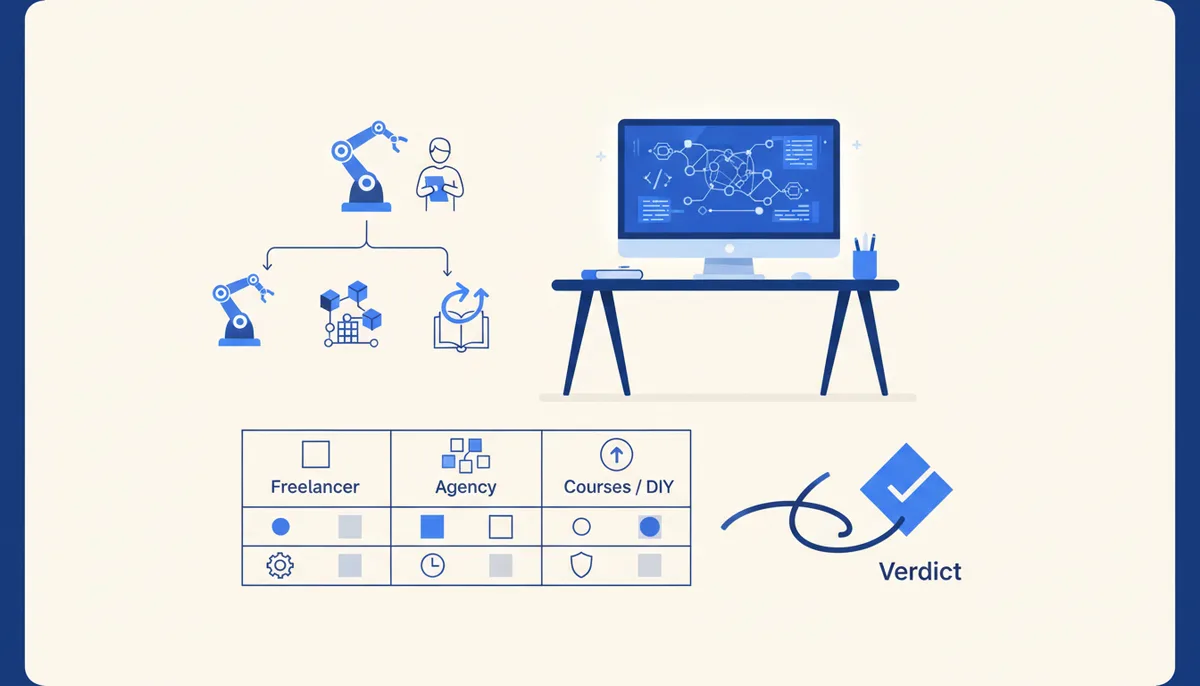
AI Adoption: Agency, Freelancer, or Do It Yourself
In short
There are four ways to bring AI into a small or mid-sized business in 2026, and the price spread covers two orders of magnitude. A freelancer: from 500 ₽ for a micro-task and 3,000-7,000 ₽ for a simple bot, but quality is a lottery. An agency: from roughly 100,000 ₽ to roll out an off-the-shelf tool, 150,000-500,000 ₽ for a custom AI agent, plus a retainer of 20,000-30,000 ₽ a month. Courses: popular business programs run 50,000-95,000 ₽, with an average across course aggregators of about 62,000 ₽ — you're buying a skill, not a result. Doing it yourself: a vibe-coding engine at 4,900 ₽ one-time, a Claude Code subscription from $20/month, and 5-10 hours a week of an employee's time. All ranges are as of July 2026. The short verdict: routine work (bots, reports, integrations) is cheaper to handle in-house; complex integrations where mistakes are expensive are agency territory. Below: the math and a table of when each path makes sense.
What a business is actually choosing between: four paths
Make-or-buy is the management fork of "build it ourselves or buy it outside". Applied to AI, it has four branches:
- Freelancer — you buy someone else's hands once, for one specific task.
- Agency or systems integrator — you buy a turnkey process: contract, deadlines, accountability.
- Courses — you buy a skill for an employee; turning it into a result is on you.
- Doing it yourself on a ready-made engine — an employee with AI tools solves the task inside the company.
Define the task first, then count the money. "Adopt AI" is not a task; a task is "the bot answers 80% of routine questions" or "the report is assembled in 10 minutes instead of two hours". Which processes are worth handing to AI agents at all, we covered in the guide on AI agents for business, and the prep steps common to all four paths are in the AI adoption checklist.
Freelancer: from 500 ₽ — why is it a lottery?
The range as of July 2026, based on public rates on freelance marketplaces: micro-tasks and the simplest chatbots start at 500 ₽; setting up a standard bot runs 3,000-7,000 ₽; a project with integrations (CRM, payments, knowledge base) runs 30,000-150,000 ₽.
Why it's a lottery:
- Wildly varying skill. For the same price you might get a solid developer, or someone who watched two videos about neural networks yesterday.
- A result you don't own. Often you get a working bot but no code, no prompts and no documentation — any change has to go back through the author.
- A bus factor of one. The freelancer disappears, the tool dies.
- Access. Your CRM, customer database and payment keys go to a stranger. How to limit the damage is covered in the article on the risks and security of vibe coding.
The risks come down with management: pay in stages, insist on handover of source code and prompts, grant access with minimum privileges. Under those conditions a freelancer is a perfectly reasonable option for routine, non-critical work.
What do agencies charge?
Benchmarks as of July 2026, from the public price lists of Russian systems integrators: rolling out an off-the-shelf AI tool, 100,000-300,000 ₽; a basic RAG agent (a bot that answers from your knowledge base), 150,000-200,000 ₽ and 3-8 weeks of work; custom development, 250,000-500,000 ₽ plus support at 20,000-30,000 ₽ a month; enterprise projects run into the millions.
What you're paying for: process discovery, a written spec, a contract with accountability, testing, support. That's real value, not a brand markup.
What stays off the invoice: the retainer never ends; every change is a new bill; and the expertise accumulates at the vendor, not with you. Two years later you know exactly what you knew before the project — except now your processes depend on an outside team.
Courses: buying a skill or a result?
Vibe-coding and "AI for business" courses cost from about 5,000 to about 180,000 ₽ as of July 2026; the average across aggregators is roughly 62,000 ₽, and the popular business programs sit at 50,000-95,000 ₽. A detailed breakdown of the programs is in our review of vibe-coding courses in 2026.
A course buys a skill, not a result: nobody guarantees a working bot at the end. It pays off when there's a specific, motivated employee with time carved out for practice. Without the time, the money turns into a certificate in a drawer. To get started, free material is cheaper: the basic concepts, roles and prompts are sitting in open knowledge bases, including ours — over 80 articles and 500+ cards, no payment required.
Doing it yourself: engine + Claude Code + employee time
A vibe-coding engine is a set of rules, roles and processes for an AI agent that turns Claude Code or Cursor from "smart autocomplete" into a manageable performer: the agent breaks the task down, writes the code, checks its own work and packages the result.
The economics as of July 2026: the Quest engine is 4,900 ₽ one-time (task-specific modules are 1,900 ₽ each), a Claude Code subscription starts at $20 a month (the Pro plan), plus the main and honestly not-small line item — employee time, 5-10 hours a week for the first month or two. Price that time at the employee's rate and you have the real cost of the "free" path. How to bring people onto AI tools without sabotage is covered in the article on training employees to work with AI.
In exchange you get what no vendor can give you: the expertise stays inside, and every next task is cheaper than the last. We live on this path ourselves: all of qvib — the site, the product, the knowledge base — is built by one person with AI agents, with no development staff. How that works is in the case study.
To be straight with you: we sell an engine and knowledge, not adoption services. The rollout is on you — or on your vendor.
When each path makes sense: the verdict table
| Situation | Best path | Budget range (July 2026) |
|---|---|---|
| Sole proprietor or micro-business, one routine task (bot, scraper, report) | Freelancer with a clear spec — or do it yourself on an engine | 500-15,000 ₽ |
| Small business, several processes, one motivated employee available | Do it yourself: engine + Claude Code | 5,000-10,000 ₽ upfront + $20/mo + time |
| Small business, many processes, nobody free | Freelancer for the routine + agency for the critical | 30,000-200,000 ₽ |
| Mid-sized business, integrations with 1C/CRM, expensive mistakes | Agency with a contract and an SLA | from 250,000 ₽ + retainer |
| No tasks defined yet, the team needs upskilling | Free knowledge base, then a course aimed at a real task | 0-95,000 ₽ |
These ranges are benchmarks from public market prices; your actual budget always depends on the task, not on company size.
When an agency really is better
The honest section: we make money on the engine, but recommending it to everyone would be a lie. Go to an agency if:
- A mistake costs millions. Payment flows, healthcare, legally binding documents: what you need here is a contract and vendor liability, not experiments.
- Heavy legacy integrations. 1C (the dominant Russian ERP/accounting platform) with in-house modifications, document management systems, homegrown software — that's work for a team with experience in exactly those projects.
- Personal data and 152-FZ (Russia's personal data protection law). If your AI touches personal data processing, the processes have to be brought into compliance. Our knowledge base describes the practical minimum, but it isn't legal advice — bring in a lawyer for the audit.
- Not a single person with spare time. Buying someone else's time is a sound management decision when your own is more expensive.
- A hard deadline. Learning and delivering simultaneously by date X is a bad plan.
If you're an agency or integrator yourself: the engine can be embedded in your own projects and recommended to clients — qvib runs a partner program with a 25-40% commission. You earn on the rollout and on the referral, and the client ends up with a tool that stays theirs.
A calculation template covering all four options for your specific task, plus a vendor selection checklist, is in the pinned post of our Telegram channel t.me/qvib.
FAQ
What should I pick for the company's very first AI task?
The cheapest way to test the water is a routine task through a freelancer (3,000-15,000 ₽) or doing it yourself off free material. The goal of the first task isn't saving money — it's understanding how AI fits your processes. Only after that is it worth deciding the budget question seriously.
Can I combine the paths?
You should. A working combination for a small business: routine internal tasks in-house on an engine, critical integrations to an agency, one-off hands to a freelancer. Make-or-buy isn't a permanent choice, it's a decision made separately for each task.
How much employee time does the DIY path eat?
Realistically, 5-10 hours a week for the first month or two: setting up the environment, first tasks, learning the hard way. It drops after that — routine automation takes hours, not weeks. If there's nobody to free up that time, it's more honest to plan for a vendor from the start.
Why doesn't qvib sell turnkey adoption?
Because the qvib team is one person plus AI agents. Adoption services require people staffed on projects, and a person doesn't scale. So we sell what does scale: the engine, the modules and the knowledge base. The rollout we leave to you — or to our integrator partners.