AI Adoption Checklist for Business: 30 Points
In short
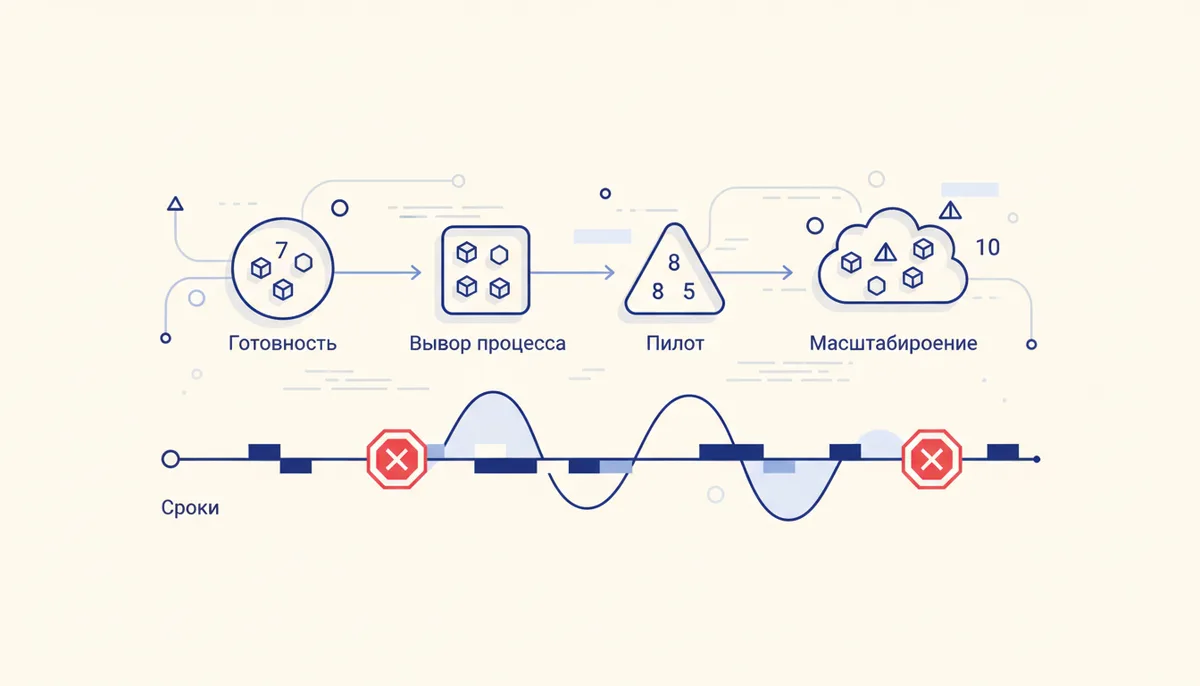
An AI adoption checklist is a sequence of 30 checks that takes a company from "we should do something with AI" to working automation. Four phases: readiness (6 points, 1–2 weeks), process selection (6 points, about a week), pilot (9 points, 2–6 weeks), scaling (9 points, two months and up). The core principle: one process, one metric, decisions made on numbers rather than feelings. If your processes aren't documented, nobody owns the effort, and there isn't much routine work to automate, you don't need AI yet — the stop signals are listed in their own section. A printable version of the checklist is pinned in the Telegram channel t.me/qvib.
How to use the checklist
Work through the points in order — each phase rests on the one before. Skipping phase one is the single most common cause of the "we bought subscriptions, played for a week, nothing changed" outcome. A point counts as closed when there's an artefact: a number, a document, a named person. "We discussed it" is not an artefact.
| Phase | Points | Phase output | Duration |
|---|---|---|---|
| 1. Readiness | 1–6 | A numeric goal, an owner, a budget | 1–2 weeks |
| 2. Process selection | 7–12 | One process for the pilot | ~1 week |
| 3. Pilot | 13–21 | A before/after metric, unit economics | 2–6 weeks |
| 4. Scaling | 22–30 | Policy, training, a queue of processes | 2–3 months and onward |
From start to steady operation: 3–6 months in total. It can go faster, but usually at the cost of skipped checks that come back later as data leaks and broken processes.
Phase 1. Readiness (points 1–6)
1. State the goal in numbers. Not "adopt AI," but "cut customer response time from four hours to thirty minutes." No number means nothing to verify in the pilot.
2. Name an owner for the rollout. One person with authority and 5–10 hours a week. "We'll all pitch in" means, in practice, that nobody will.
3. Check whether your processes are documented. If a process lives only in an employee's head, there's nothing to automate: write the instructions first, then bring in AI.
4. Count the routine. How many hours a week the team spends on repetitive tasks: boilerplate correspondence, reports, moving data between systems. That's the upper bound on your savings.
5. Budget the pilot. Assistants at the level of ChatGPT Plus or Claude Pro start at $20 per seat per month, with team plans costing more (as of July 2026); paying from Russia is a task of its own — see how to use ChatGPT in Russia. The biggest cost item isn't subscriptions, it's employee time.
6. Decide who does the work. Small businesses are usually better off going it alone and bringing in a contractor selectively; the selection criteria are in DIY or contractor.
Phase 2. How to pick the process (points 7–12)
7. List 5–10 candidates. Routine processes with a clear input and output: answering standard questions, first-pass triage of enquiries, document drafts, summaries and reports.
8. Filter out high cost of error. Payments, legally binding decisions and HR matters get automated last, and only with a human in the loop.
9. Check the frequency. The process should repeat at least 10–20 times a week, or the savings won't cover setup and maintenance.
10. Check it can be formalised. Can you describe the process in a one-page instruction? If not, write it first: it often turns out half the steps are unnecessary before any AI gets involved.
11. Assess the input. Language models handle text, email and spreadsheets well. Contracts, acceptance certificates and primary accounting documents are a discipline of their own — see AI in document workflows.
12. Choose one process. Not three. The criterion: maximum hours saved at minimum cost of error. The remaining candidates go into the queue for the scaling phase.
Phase 3. Pilot (points 13–21)
A pilot is a time-boxed rollout of AI on a single process with a metric chosen in advance, at the end of which you decide "scale it or shut it down."
13. Measure the "before." How much time and money the process costs today. Without a baseline number, the pilot's result is unprovable.
14. Fix the deadline. Two to six weeks. A pilot with no deadline turns into a permanent experiment with a permanent budget.
15. Pick the format: assistant or agent. An assistant helps a human through dialogue; an agent executes the task itself according to set rules. Which one is justified when is covered in the guide to AI agents for business.
16. Screen the data for personal information. Customers' names, phone numbers and ID details must not be sent to cloud models without anonymisation — details in the explainer on AI and 152-FZ (Russia's personal data protection law). This is not legal advice: bring in a lawyer for an audit.
17. Use volunteers. Two or three pilot users who are genuinely curious. Conscripts sabotage a pilot quietly.
18. Store prompts in a shared place. Working instructions for AI are a company asset, not a private stash in someone's chat history.
19. Introduce a review rule. Anything going to a customer or into reporting is read by a human before it's sent. During the pilot, no exceptions.
20. Keep a failure log. Where the AI got it wrong, how you caught it, what you fixed in the prompt or the process. That log is half the value of the pilot.
21. Do the unit economics. Hours saved × employee rate, minus subscriptions and setup time. Compare it to the number from point 13 — that's the pilot's answer.
Phase 4. Scaling (points 22–30)
22. Decide on the numbers. The pilot paid off — scale it; it didn't — shut it down or switch processes. "Feels handy, I guess" is not grounds for a second budget.
23. Write a policy. What employees may do with AI, what's forbidden, who's accountable for the result. Structure and template in the article on an AI usage policy for companies.
24. Train on real tasks. Not a lecture on "what neural networks are," but a walkthrough of actual cases from a specific department. How that works is in the employee training guide.
25. Centralise prompts. A single instruction library with an owner and versions. When someone leaves, the work stays with the company.
26. Move everyone onto corporate accounts. Employees' personal subscriptions mean unmanaged access and a data leak the moment someone resigns.
27. Embed AI into the tools you already use. Automation inside the CRM and the task tracker gets used every day; a standalone "AI platform" is forgotten within a month.
28. Give every process an owner. Automation without an owner degrades: models get updated, prompts go stale, quality quietly slips.
29. Revisit the economics quarterly. Models get cheaper and smarter; a process that didn't pay off in spring may pay off by autumn.
30. Grow the queue gradually. Take the next process from your phase-2 list once the previous one has run a month without manual babysitting.
When you don't need AI yet
Honest stop signals. Postpone adoption if:
- your processes aren't documented at all — AI accelerates order; it accelerates chaos too, and you end up with more chaos;
- there's nobody with 5 hours a week to be the owner — the rollout will die two weeks after launch;
- your main costs aren't routine work but physical labour, procurement or rent: there's little for language models to save there;
- the company has a cash flow gap — an experiment that pays back in months is not your current priority;
- the goal sounds like "competitors already have it" — without the metric from point 1 you'll get expenses and disappointment, not results.
A stop signal isn't "never," it's "close this first, then come back to point 1."
Printable version and what's next
The checklist on one page is pinned in the Telegram channel t.me/qvib: handy to print and tick off as you close points.
And honestly about us: qvib is a knowledge base and the Quest vibe coding engine. The team is one person plus AI, which is why we sell tools and knowledge rather than implementation services: 500+ free arsenal cards, ready-made combos for CRM, payments and Telegram bots. How one person with AI runs the whole project is in the qvib case study. Agencies that roll out AI for clients may want our partner programme with a 25–40% commission.
FAQ
What does AI adoption cost for a small business?
An in-house pilot is mostly employee time plus subscriptions from $20 per seat per month (as of July 2026). Contractor price tags differ by an order of magnitude, so compare not price lists but which candidate asked first about your metric from point 1.
How long does AI adoption take?
The first measurable result comes from a pilot in 2–6 weeks. Reaching steady operation with a policy and trained staff usually takes 3–6 months. Anything faster almost always comes from skipping the readiness phase.
Do I need a developer to adopt AI?
For assistants, no: solid instructions and prompts are enough. For agents, CRM integrations and Telegram bots you need either a developer or vibe coding — the approach where software is assembled in natural language with tools like Claude Code.
Can I skip the pilot and roll out company-wide right away?
Technically yes; practically, it's the fastest way to lose the budget. Without a before/after metric you won't know whether the AI worked, and failures will hit every customer at once instead of two or three volunteers.