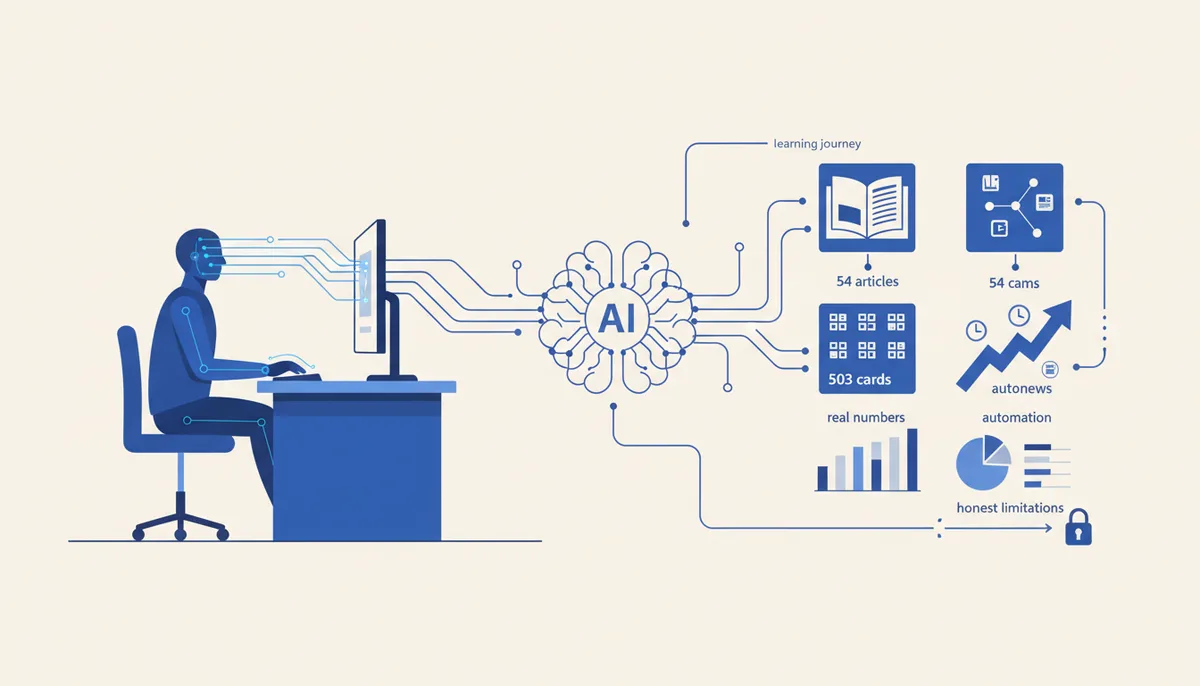
One Person and an AI Running a Product: The qvib Case Study
In short
qvib.pro is a product run entirely by one person and an AI: Anton Laskov plus Claude Code on our own Quest engine. Over roughly two months in the summer of 2026 we built and shipped: a store for the engine with 13 modules, a knowledge base of 80+ articles and 550+ cards, daily auto-generated news on a cron schedule, cross-posting to social platforms, and an SEO layer covering 760+ URLs in the sitemap. News generation, the SEO layer and the publishing queue are fully automated; strategy, fact-checking, product decisions and every production deploy stay manual. The AI does make mistakes — it invents numbers and breaks working code; that gets caught by a "every number needs a source" rule, multi-angle independent review (prisms), and a hard block on shipping without human confirmation. This case study answers the question "can one person and an AI seriously run a business?": yes, but with honest limits, described below.
What qvib is and where build in public comes in
qvib.pro is a store for "vibe coding engines": the base Quest engine at 4,900 ₽ one-time and 13 modules at 1,900 ₽ each (prices as of July 2026), plus a free knowledge base. The engine is a set of rules, roles and checks that turns Claude Code or Cursor from a chatty autocomplete into a manageable executor with predictable output.
Build in public means a company openly shows its internal workings: numbers, processes, mistakes. For us it isn't a marketing pose but the only honest way to sell: the qvib team is one person and an AI, and the site itself is built with the same Quest engine that's on the shelf. We sell what we run on. One thing to be clear about up front: we sell a box and knowledge, not implementation services. You'll implement it yourself or with an integrator; for agencies we offer a partner program with a 25–40% commission.
The numbers as of July 2026: what's actually built
Every figure is verifiable — the articles and cards are public, the sitemap is public.
| Metric | Value |
|---|---|
| Team | 1 person + Claude Code |
| Time to build the system | ~2 months (summer 2026) |
| Articles in the knowledge base | 80+ |
| Arsenal cards (10 sections) | 550+ |
| Paid engine modules | 13 |
| URLs in the sitemap | 760+ |
| Auto news | daily, cron at 09:00 |
| SEO self-audit | 69 → 81 out of 100 over two weeks in July |
One caveat, without which the table is misleading: these are production metrics, not revenue. 760+ URLs do not equal traffic — the domain is young, search engines take months to warm up, and at this stage the analytics counters are nearly empty. That's normal, and we're not hiding it.
What's fully automated and what stays manual?
The practical question any manager asks is where the line runs. Here's ours.
| Loop | Done by the AI | Done by a human |
|---|---|---|
| News | finding news hooks, writing, SEO markup, cron publishing | spot-checking after the fact |
| Articles and cards | draft, structure, internal linking, images | topic choice, facts, final edit |
| Cross-posting | scoring "does this fit the platform", draft queue, slots | approving every post |
| SEO layer | sitemap, schema.org, IndexNow pings, RSS for Dzen (Yandex's content platform) | strategy and keyword research |
| Site code | feature implementation, tests, review | writing the tasks, accepting the result |
| Production deploy | build and checks | only a human confirms the release |
| Sales, pricing, support | — | fully manual |
The pattern is simple: we automated everything where an error is cheap and reversible — a bad news post can be fixed in a minute. Where an error is expensive — deploys, money, promises to customers — the AI prepares and the human decides. Why the line sits exactly there is covered in our article on vibe coding for business.
Where the AI gets it wrong and how that's caught
This list isn't hypothetical — it all comes from two months of practice.
Invented numbers. A language model will happily "recall" statistics that don't exist. The fix is a strict content rule: every number needs a source, recent facts get re-verified with a search, and price ranges are stamped with a date. A card without a source never enters the knowledge base.
Breaking changes. The AI can fix one thing and silently break another. The first barrier is prisms. A prism is an angle of independent evaluation of a finished artifact from the perspective of a specific role (security, regressions, data integrity) with a pass/warn/block verdict. The base Quest engine has 13 of them, five with veto power. The logic: an agent that wrote the code and then approved its own code is a conflict of interest; independent angles build distrust into the process.
Dangerous actions in production. The second barrier is administrative: no production release without the owner's explicit confirmation, even when every check is green. The rule is baked into the configuration rather than resting on discipline.
Small formatting traps. Infographics broke the news layout until we introduced the "inline HTML on a single line only" rule; the classifier confused production static files with working files. You can't predict this kind of thing in advance — each trap becomes an engine rule as it surfaces. Systematizing those findings is essentially what vibe coding techniques are, and the typical failure modes and defenses are covered in the piece on vibe coding risks and security.
What does it cost?
Ballpark fixed costs as of July 2026, not counting the owner's time:
- Claude subscription: Pro at $20/mo; for heavy daily work with Claude Code, Max at $100–200/mo is more realistic (official plans at claude.com/pricing).
- VPS and API usage for auto-generated news — secondary line items whose size depends on volume and the model you pick.
- The qvib engine and modules, if you take our route: 4,900 ₽ one-time plus modules at 1,900 ₽.
The fixed portion adds up to noticeably less than one specialist's salary. But the real currency here is time: automation didn't remove the owner's work, it changed its type from "doing things by hand" to "assigning tasks, reviewing and making decisions". If the founder doesn't have that kind of time, it's more honest to compare scenarios in implementing AI yourself vs. hiring a contractor.
The honest limits of the solo model
Bus factor is the number of people whose loss would stop the project. At qvib it equals one, and AI doesn't yet compensate for that: strategy, accountability and access all converge on a single person.
Other things worth knowing if you're sizing this model up for yourself:
- We deliberately don't do turnkey implementation, audits or custom development. One person can't honestly promise an SLA to dozens of clients, so the product is a box plus knowledge, and implementers get the partner program.
- Support speed is limited: answers within a day, not within minutes.
- Content volume doesn't equal demand: the pipeline produces faster than search indexes, and some material will never take off. That's normal content economics.
- AI doesn't add domain expertise the owner doesn't have. On legal topics like 152-FZ (Russia's personal data law) we stay at the practical "what to do" level and say plainly: this is not legal advice, an audit needs a lawyer.
What can you copy from this case into your own business?
Five transferable decisions, whatever tools you use:
- Start with a single loop where errors are cheap — news, FAQs, product descriptions — not with "let's automate everything".
- Introduce a sourcing rule: AI content without a source doesn't get published. That one rule removes most of the reputational risk.
- Split "the AI prepares" from "the human decides" by cost of error — and write it down in an AI usage policy.
- Forbid irreversible actions without human confirmation: deploys, mailings, payments.
- Turn accumulated traps into written rules, not oral tradition — otherwise every new AI session will walk straight into them again.
How agent loops are structured systematically and which process to start with is covered in the AI agents for business hub. Our working checklist — "the automation line: what to hand to AI and what to keep with a human" — lives in the pinned post of our Telegram channel t.me/qvib; subscribe and grab it.
FAQ
Is it really one person, with no hidden team of contractors?
Yes. One owner sets the tasks and makes the decisions; Claude Code on the Quest engine executes: code, content, SEO layer, publishing. There's no staff and no contractors; design, copy and infrastructure are done in the same loop. That's why the case is verifiable — everything listed is visible on the site itself.
How much time a day does maintaining a system like this take?
The automated loops — news, SEO pings, RSS — need almost no attention. But the product as a whole remains a full-time job for the owner: strategy, new material, accepting code, answering customers. AI removed the drudgery of execution, not the work itself.
Can I order a turnkey implementation from qvib?
No. We sell the engine, the modules and an open knowledge base — and deliberately don't provide implementation services. If you need hands, bring in an integrator; for agencies we have a partner program with a 25–40% commission.
Won't a pipeline like this flood the site with low-quality AI content?
The risk is real, which is why the pipeline is asymmetric: news is published automatically (a cheap error, fixable in a minute), while articles and cards go through human editing and the "every number needs a source" rule. Search engines don't punish AI content as such, they punish useless content — the line runs along quality, not authorship.