AI Agent Repos on GitHub Worth Knowing
In short
Most "best AI agent repos" lists are star-count rankings with no filter behind them. Stars measure how many people once thought a project looked interesting — not whether it still ships, who owns it now, or whether it will eat your token budget. Two examples from July 2026 make the point: microsoft/autogen has around 60,000 stars and its own README says the project is in maintenance mode; stitionai/devika has around 19,500 stars and has had no commits since September 2025. Both still show up in listicles.
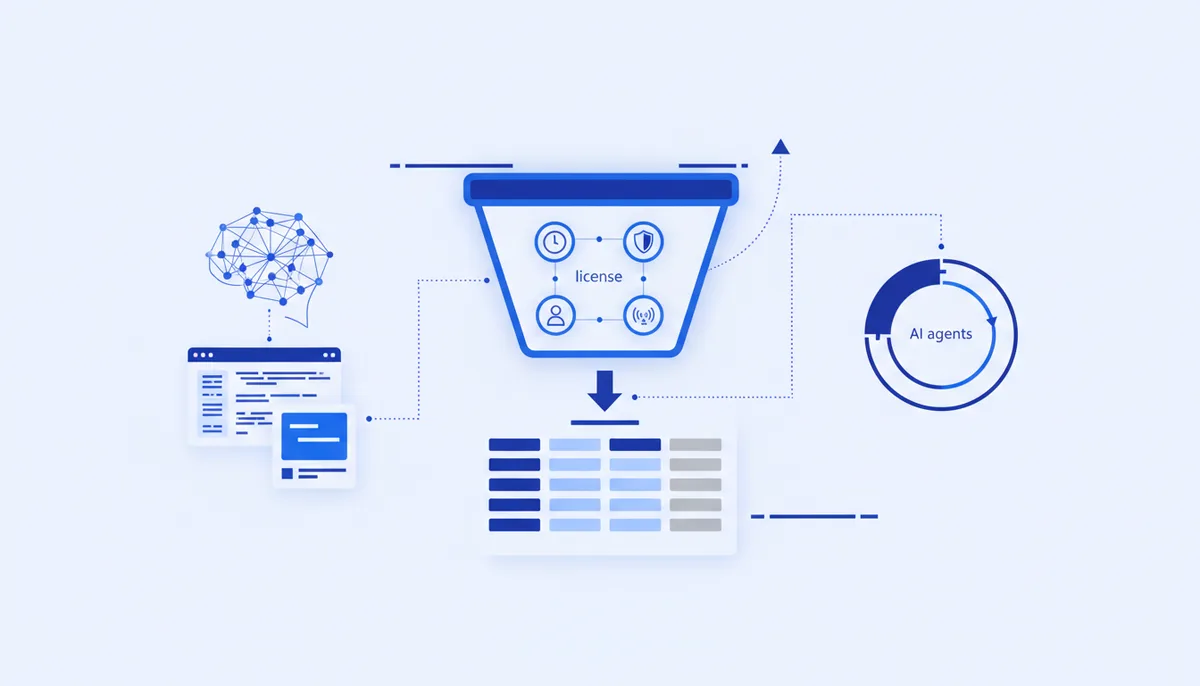
The repos worth your attention split into three groups: frameworks that actually run an agent loop, tooling that sits around the agent (browser control, sandboxes, memory, gateways), and quality-control tools that keep agent output from rotting your codebase. This piece names the ones that pass a real filter, and gives you a five-minute check you can run on any repo before typing npm install — last commit date, license, governance owner, open-issue shape, and blast radius.
How this list was filtered
Four rules, applied before anything got named:
- Commits in the last 60 days. An agent framework that hasn't been touched since the last model release is already broken — provider SDKs, tool-calling formats and context limits all moved.
- A license you can read.
NOASSERTIONon the GitHub API means GitHub couldn't classify the LICENSE file — sometimes a harmless custom license, sometimes source-available with a commercial-use clause. Either way, read it. - A named owner. A company, a foundation, or a person with a track record. Anonymous orgs that appeared three months ago are a supply-chain question, not a technology one.
- It does one thing. "Full autonomous AI software engineer" repos have a terrible survival rate. Narrow tools survive because their scope doesn't drift.
Star counts below come from the GitHub API on 28 July 2026. Treat them as order-of-magnitude, not as a ranking.
Frameworks that run the agent
| Repo | Stars (Jul 2026) | License | Health signal | Best for |
|---|---|---|---|---|
anomalyco/opencode |
~190k | MIT | Very active; org renamed from sst |
Terminal coding agent, model-agnostic |
langflow-ai/langflow |
~152k | MIT | Very active | Visual flow building, prototyping |
langgenius/dify |
~150k | NOASSERTION | Very active; read the license | Self-hosted agent/RAG platform |
OpenHands/OpenHands |
~82k | MIT | Active; org renamed from All-Hands-AI |
Sandboxed autonomous dev agent |
cline/cline |
~65k | Apache-2.0 | Very active | IDE-embedded agent + SDK |
crewAIInc/crewAI |
~56k | MIT | Active | Role-based multi-agent orchestration |
aaif-goose/goose |
~52k | Apache-2.0 | Active; moved to AAIF governance | Local-first MCP-native agent |
langchain-ai/langgraph |
~38k | MIT | Very active | Graph-shaped, resumable agent state |
openai/openai-agents-python |
~28k | MIT | Active, small issue backlog | Thin OpenAI-native agent loop |
pydantic/pydantic-ai |
~19k | MIT | Very active | Typed agents, validation-first |
microsoft/agent-framework |
~12k | MIT | Very active | .NET/Python enterprise orchestration |
microsoft/autogen |
~60k | CC-BY-4.0 | Maintenance mode | Nothing new — migrate off |
The AutoGen row is the whole argument for filtering. Its README states: "AutoGen is now in maintenance mode. It will not receive new features or enhancements," and points new users to Microsoft Agent Framework. A star-ranked list puts AutoGen five times higher than its own successor.
Two renames also matter. sst/opencode now lives under the anomalyco org, and block/goose moved to aaif-goose after Block contributed goose to the Linux Foundation's Agentic AI Foundation, alongside Anthropic's MCP and OpenAI's AGENTS.md. GitHub redirects the old URLs, so nothing breaks today — but anything pinned by org name in a script, submodule or Docker build needs updating eventually. It also signals something: a project under foundation governance is less likely to change its license next quarter than one owned by a single startup.
Tooling around the agent
The framework is the least interesting part of an agent stack. What decides whether it works in production is everything around it.
browser-use/browser-use(~107k, MIT) — gives an agent a real browser. Honest caveat: browser agents are slow and expensive per task, and any site with serious bot detection still blocks you. Use it where no API exists, not as a default.e2b-dev/E2B(~13k, Apache-2.0) — sandboxed cloud VMs for running agent-generated code. Small star count, tight issue backlog, clear scope: what a healthy repo looks like when it isn't chasing attention.mem0ai/mem0(62k, Apache-2.0) and29k, Apache-2.0) — memory layers, both open source with a hosted commercial tier. Check which features are self-hostable before you build on them.getzep/graphiti(BerriAI/litellm(~55k) — one gateway across providers, plus spend tracking. Roughly 4,400 open issues: at this scale that reflects surface area rather than neglect, but edge-case bugs do sit unfixed for a while.modelcontextprotocol/servers(~89k) — the reference MCP server collection. Treat the community directory as a package registry, not a curated allowlist. We wrote up the specific checks in MCP server security: what to check before you install, and the failure modes are catalogued in the MCP supply chain card.ogulcancelik/herdr(~22k, Apache-2.0) — a terminal multiplexer for running several coding agents at once, each in a real pane with its shell and logs intact. Created March 2026, commits daily. Useful once you're past one-agent-at-a-time.
Our running catalogue of tools lives in the arsenal; MCP servers are indexed here.
Token economy and quality control
This is the category most lists skip, and it is where the money actually goes.
Agents produce two kinds of waste. The first is token waste: re-reading the same files, pulling whole directories into context, running the same failing test loop six times. The fix is mostly configuration — a tight AGENTS.md or CLAUDE.md, narrow tool permissions, and a model routed per task rather than one frontier model for everything. A gateway like LiteLLM helps because it gives you per-request spend data instead of a monthly surprise.
The second is output waste — code that compiles and reads fine but is structurally empty. A small ecosystem grew around this in 2026:
hardikpandya/stop-slop(~14.6k, MIT) — a skill file that strips AI tells from prose. Worth naming precisely because of the trap it illustrates: 14,600 stars for what is essentially one markdown file, and no commits since March 2026. High stars, near-zero maintenance surface. That's not a criticism of the file — it's a reminder that stars measure a moment of attention, not ongoing work.scanaislop/aislop(~500, MIT) — a deterministic linter for agent-generated code smells: narrative comments, swallowed exceptions,as anycasts, dead code, oversized functions. No LLM at runtime, so it costs nothing per run. 500 stars, actively maintained. The inverse of the previous case.
The pattern to internalise: a 500-star tool with weekly commits is usually a better bet than a 15,000-star tool that stopped a quarter ago.
How to judge a repo in five minutes before installing
| Check | Where | Red flag |
|---|---|---|
| Last commit | Repo header, or api.github.com/repos/OWNER/NAME → pushed_at |
Nothing in 90+ days on a fast-moving category |
| License | spdx_id on the API |
NOASSERTION, or a custom license with usage clauses |
| Owner | Org page | Created recently, no other projects, no humans named |
| Issue shape | Open issues + recency of replies | Thousands open, maintainer silent for months |
| Release cadence | Releases tab | Last release far behind the last commit |
| Blast radius | Install instructions | curl | bash, or an agent that gets shell access by default |
| Secrets | README + code search for env |
Wants your provider key and phones home to a third-party endpoint |
The API call is the fastest of these:
curl -s https://api.github.com/repos/OWNER/NAME \
  | python3 -c "import sys,json;d=json.load(sys.stdin);print(d['pushed_at'], (d.get('license') or {}).get('spdx_id'), d['open_issues_count'])"
If it redirects, the repo was renamed or transferred — worth knowing before you pin it.
The blast-radius row deserves the most weight. An agent framework is not a library — it's a program you hand a shell, your API keys, and write access to your source tree. Read the entry point, run it in a container first, and give it a scoped token, not your personal one.
Three things this list skips on principle: anything promising a fully autonomous engineer, anything using a Discord invite as its documentation, and anything whose README leads with a self-produced benchmark.
FAQ
What is the best open source AI agent framework right now?
There isn't one, and any list that names one is selling something. For a terminal coding agent, anomalyco/opencode and aaif-goose/goose are the strongest actively maintained options. For a product with agent workflows, langchain-ai/langgraph or pydantic/pydantic-ai give you resumable state and typed contracts. For a self-hosted platform with a UI, Dify or Langflow. Pick by problem shape, then run the five-minute check.
Are GitHub stars a useful signal at all?
For one thing: telling you whether enough people have used a project that its obvious bugs have been found. Beyond roughly a thousand stars the number stops carrying information, and stars never decay — a project popular in 2024 and abandoned in 2025 keeps its score forever. Pair the count with pushed_at and it's worth something; alone, it isn't.
Is it safe to install an MCP server from a community directory?
Not by default. An MCP server runs on your machine with whatever permissions you grant it and can read the context your agent sees. Directories index submissions; they don't audit them. Read the source of anything small enough to read, check what network calls it makes, and give it scoped credentials. The full checklist is in the MCP security guide linked above.
How do I tell if a repo has been renamed or transferred?
Request it through the GitHub API without following redirects. A 301 Moved Permanently with a Location header means the repo now lives somewhere else. In July 2026 this affects several well-known agent projects — sst/opencode, block/goose and All-Hands-AI/OpenHands all resolve to new orgs. Web and clone traffic still redirects, so nothing breaks immediately, but pinned references in build scripts are worth updating.
Should I use an "awesome AI agents" list to find tools?
As a discovery surface, sure. As a shortlist, no — awesome lists almost never remove entries and rarely record when a project was last checked. Use one to generate candidates, then run each through the freshness, license, ownership and blast-radius checks above. GitHub topic pages sorted by recently updated give similar coverage with a freshness signal attached.