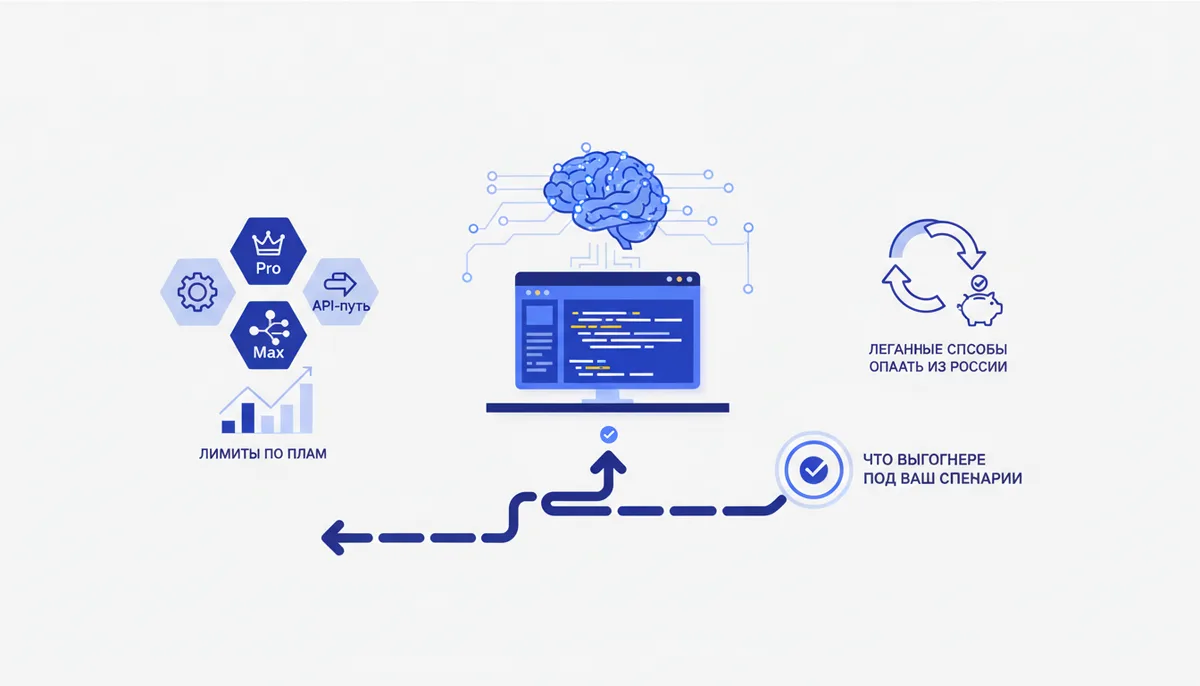
Claude Code Pricing and Paying from Russia in 2026
In short
- Claude Code is Anthropic's coding agent: it runs in the terminal, reads your whole project, and edits code itself. It has no separate plan of its own — it comes with Claude subscriptions from Pro upward, or you pay per use through the API.
- Prices as of July 2026: Pro — $20/mo ($17/mo billed annually), Max 5x — $100/mo, Max 20x — $200/mo, Team — from $25 per seat. API: Haiku 4.5 — $1/$5 per million tokens, Sonnet 5 — $2/$10 on a promo running until 31 August 2026 (then $3/$15), Opus 4.8 — $5/$25.
- Limits work on two levels: a rolling 5-hour window plus weekly ceilings. On 6 May 2026 Anthropic doubled the 5-hour limits on every paid plan. The pool is shared between the Claude chat and Claude Code.
- Russian cards don't work, and Russia isn't on Anthropic's list of supported countries. The legal routes: a foreign card if you hold an account abroad, the API through aggregators such as OpenRouter, and payment intermediaries — only if you understand the risks.
- The practical default from Russia is the API through an aggregator: you pay for what you actually burn. Setup is covered in the guide to the Claude API from Russia.
- Your bill depends not only on the plan but on discipline: the less the agent regenerates for nothing, the longer your limits last.
What does Claude Code cost in July 2026?
There is no "Claude Code only" price. The tool is bundled into the general Claude subscriptions, and chat and agent usage draw from the same pool. The numbers below are fixed as of July 2026 from the official claude.com/pricing page and Anthropic's docs — check before you pay: the lineup has changed more than once in the past year.
| Plan | Price (July 2026) | What matters |
|---|---|---|
| Free | $0 | Claude chat only, Claude Code not included |
| Pro | $20/mo ($17/mo billed annually) | Claude Code included; Sonnet by default, Opus available |
| Max 5x | $100/mo | 5x the Pro allowance, higher output limits |
| Max 20x | $200/mo | 20x the Pro allowance, early access to new releases |
| Team | $25/seat Standard, $125/seat Premium, from 5 seats | $20/$100 billed annually; Claude Code included |
| API | pay per token | no monthly fee, spend visible in the console |
A subscription is a fixed monthly sum with a usage ceiling. The API route is payment for the tokens you actually spend, with no monthly fee. The difference matters for budgeting, so let's break down limits and prices separately.
What are the limits on each plan?
Anthropic doesn't publish exact token quotas — officially there are only multipliers: Pro is the base allowance, Max is 5x or 20x that. Actual consumption depends on context size, the model you pick, and session length.
How it works as of July 2026:
- The 5-hour window. Usage is counted inside a rolling session: burn through it and you wait for the reset. On 6 May 2026 Anthropic doubled these limits for Pro, Max, and Team and removed peak-hour throttling.
- Weekly ceilings. On top of that there are weekly limits, with heavy-model usage counted separately. These are what people running agents around the clock hit first.
- A shared pool. Claude chat and Claude Code spend the same allowance. The
/statuscommand shows what's left.
By third-party measurements, Pro covers roughly 45 chat requests per window, or one to two medium coding sessions a day. Max 5x handles dense daily work; Max 20x handles nearly continuous work, including subagents, which burn tokens in parallel. Opus drains the pool noticeably faster than Sonnet — switch it on selectively rather than by default.
Subscription or API: which should you pick?
The API wins on irregular workloads: you pay $10, you spend exactly $10. Anthropic's official prices as of July 2026:
| Model | Input, $/M tokens | Output, $/M tokens |
|---|---|---|
| Haiku 4.5 | 1 | 5 |
| Sonnet 5 (until 31 Aug 2026) | 2 | 10 |
| Sonnet 5 (from 1 Sep 2026) | 3 | 15 |
| Sonnet 4.6 | 3 | 15 |
| Opus 4.8 | 5 | 25 |
Three details that change the math:
- The tokenizer. On Sonnet 5 and the newer Opus models it produces roughly 30% more tokens for the same text — compare final bills, not the price per million.
- Prompt caching. Re-reading cached context costs 10% of the base price; for agent sessions this is the main source of savings, and Claude Code applies it automatically.
- The break-even point. An hour of dense agent work means dozens of requests with large context. With daily use, the API bill quickly overtakes $100 for Max 5x. A subscription is a fixed spending ceiling; the API is flexibility.
How to pay legally from Russia
Straight up: Russia is not on Anthropic's list of supported countries, and Russian bank cards aren't served abroad. Below are only legal routes, no gray schemes.
- A foreign bank card. If you hold a legally opened account abroad — through residency, work, or an account set up while travelling — a Pro/Max subscription pays through normally, as from any supported country.
- The API through aggregators. OpenRouter is an AI model aggregator that sells access to Claude models at the same per-token prices as Anthropic, with a fee of around 5.5% when you top up your balance. You top up by card or crypto, and credits don't expire. Connecting Claude Code to gateways like this is covered in the article on the Claude API from Russia. There are also Russian API resellers that bill in rubles — check their markup against the table above before you buy.
- Subscription payment intermediaries. Services that set up a foreign subscription for a fee. The risks are substantial: you're trusting an account to a third party, a terms-of-service violation can get it banned, and getting your money back in a dispute is next to impossible. If you go this way, use a separate account and attach as little data as possible.
What not to do: buy "shared" accounts or open cards under someone else's identity. That's a direct terms-of-use violation and the fastest path to a ban with your money gone.
What's the best fit for your scenario?
- Trying out vibe coding. Start with the free options — reviewed in Claude Code for free, with basic setup in the beginner's guide. After that, Pro or $10–20 on an API balance.
- Evenings and weekends. Pro at $20, or the API through an aggregator: at 10–15 hours of coding a month the API is often cheaper than a subscription.
- Daily work. Max 5x at $100 is the standard choice for a full-time developer: the ceiling is predictable and the limits cover a dense day.
- Agent pipelines. Max 20x at $200 if you're running subagents and long autonomous sessions.
- From Russia without a foreign card. The API through an aggregator is the only route that avoids intermediaries — and the one where you control spending best.
How to spend your limits more efficiently
The plan is half the equation. The other half is how many tokens burn for nothing: chaotic prompts make the agent re-read the project and redo the same thing three times. Basic hygiene: plan before you generate, /clear between tasks, a compact CLAUDE.md, Haiku and Sonnet for routine work, Opus only where it counts. Concrete techniques are collected in vibe coding techniques, and the tools are in the arsenal.
The systematic option is the qvib Quest engine (4 900 ₽ one-time): a ready-made layer of rules, scenarios, and controls that keeps the agent inside the task and cuts pointless regeneration. Against a backdrop of shifting pricing, something else matters too: the engine exports to Claude Code, Cursor, and a universal AGENTS.md — so if Anthropic changes limits or prices again, you switch tools, not your whole process. More on this in the article on engine portability.
FAQ
Can I use Claude Code for free?
There's no full free tier: Claude Code isn't part of the Free plan. Anthropic grants new API users a small amount of starter credit, and promos appear from time to time. All the workable options are in Claude Code for free.
Why is my Russian card declined?
Visa and Mastercard suspended service for Russian bank cards abroad, and Russia isn't on Anthropic's list of supported countries. This is a payment-infrastructure restriction — no setting fixes it; only the legal routes in this article work.
Are Claude chat and Claude Code limits shared?
Yes. On a subscription there's a single usage pool across all Claude products. The /status command shows what's left inside Claude Code, and warnings arrive in advance.
What happens to Sonnet 5 pricing after summer 2026?
The promo price of $2/$10 per million tokens runs until 31 August 2026. From 1 September 2026 the standard $3/$15 kicks in — the same as Sonnet 4.6. If you're budgeting the API route for the autumn, plan around the new numbers.
Where should a beginner start: subscription or API?
If you have a way to pay for a subscription, take Pro: a flat $20 and no token arithmetic. If you don't, use the API through an aggregator with $10 on the balance — that lasts several weeks of unhurried vibe coding, and setup takes half an hour following the beginner's guide.