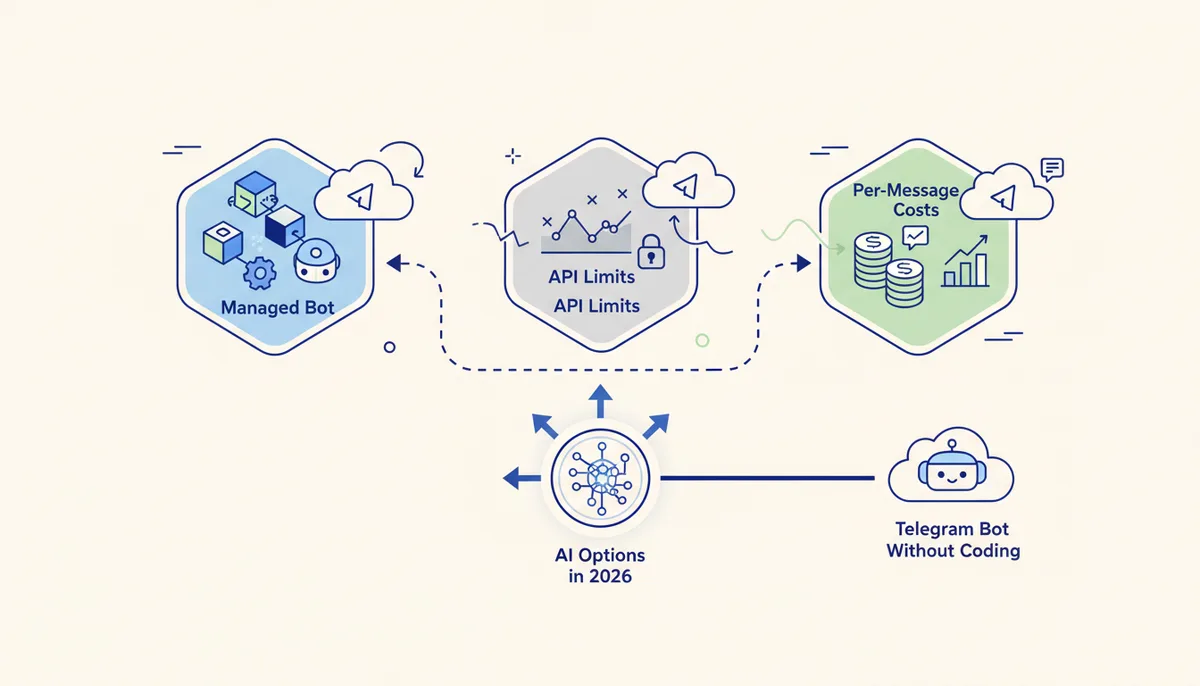
Telegram Bot Without Coding: AI Options in 2026
In short
You can ship a working Telegram bot today without writing code, and in 2026 there are three honest routes. The first is Telegram's own Managed Bots, added in Bot API 9.6 on 3 April 2026: a "manager" bot creates and holds a bot on your behalf, so you tap a link instead of registering through BotFather yourself. The second is a hosted chatbot builder, where you draw a flow in a visual editor and paste in an AI provider key. The third is an automation platform such as Make or a self-hosted n8n, wired to Telegram's webhook.
All three hit the same ceiling. Telegram's own developer docs still say building bots needs "at least some skills in computer programming", and no-code stops working the moment you need real per-user state, retries, or a behaviour the editor has no block for. Costs stay near zero until traffic arrives — then model tokens, not hosting, become the bill.
What "no code" on Telegram actually means now
Every Telegram bot is a token. You talk to @BotFather, register a name, and get a string that authenticates every API call. Historically that token went into code you wrote and hosted. "No code" means somebody else runs that loop for you.
On 31 March 2026, Telegram announced Bots Managed by Bots — bots that "create and manage other bots on your behalf", pitched as letting anyone launch a bot "with no coding required". Days later, Bot API 9.6 shipped the plumbing: a can_manage_bots field on User, the methods getManagedBotToken and replaceManagedBotToken, and deep links of the form https://t.me/newbot/{manager_bot_username}/{suggested_bot_username} (Bot API changelog, 3 April 2026; the API is at 10.2 as of 14 July 2026).
The part most coverage got wrong: Telegram did not ship a visual bot builder. It shipped an API primitive letting a third-party manager bot mint and hold bots for its users. The no-code experience still comes from whoever wrote that manager bot — a real convenience, not a product you can log into.
The three routes, compared
| Managed Bots (via a manager bot) | Hosted chatbot builder | Automation platform (Make, n8n) | Writing ~100 lines yourself | |
|---|---|---|---|---|
| Time to a first reply | Minutes | Under an hour | An evening | An evening, with an AI agent |
| Who holds the bot token | The manager bot | The builder vendor | You, in the platform's vault | You |
| Choice of AI model | Whatever the manager offers | Vendor's list, or your own key | Any provider with an HTTP node | Anything |
| Custom logic | None beyond exposed settings | Flow blocks only | Branches, loops, code nodes | Unlimited |
| Where it breaks first | Vendor shuts down or changes terms | Anything the editor has no block for | Execution quotas, debugging async flows | Nowhere technical — only your time |
| Cost floor | Usually free, model included | Free tier, then per-contact pricing | Free self-hosted, or paid cloud | Hosting + tokens only |
| Portability | Rotate the token and leave | Locked to the vendor | Export the workflow JSON | Total |
If you only want a bot that answers FAQs in one chat, the first two columns are fine. If it will touch your database, a payment provider, or anything you would be embarrassed to lose, start at column three.
Building it in one evening
The automation-platform route gives the most control per hour spent. None of it requires code.
- Register the bot. Message BotFather, send
/newbot, pick a display name and a username ending inbot, copy the token. Treat it like a password. - Store the token as a credential. Every serious platform has a credential vault. Paste it there, not into a plain text field in a workflow node.
- Add the Telegram trigger. The platform calls
setWebhookfor you against a public HTTPS endpoint it owns. Check whether your plan gives an instant webhook trigger or a scheduled poll — on free tiers it is often the latter, at a coarse interval, making it a notifier rather than a chatbot. - Branch on
/start. One path sends a greeting and a menu; the other is everything else. - Call the model. Pass the message text plus a short system prompt describing what the bot is and, crucially, what it must refuse.
- Send the reply back to
message.chat.id, then test in a private chat before touching a group.
The friction is not the flow editor. It is Telegram's group semantics: with privacy mode on, a bot in a group only receives commands aimed at it (/command@your_bot) and general commands such as /start if it was the last bot to post (Telegram Bot FAQ). Users report the bot "ignoring them" and it is almost always this.
Our no-code Telegram bot card in the arsenal tracks the current tool list.
Wiring in an AI model
Two options: use the builder's built-in model, or bring your own API key.
Built-in is faster and hides token accounting, which is exactly the problem — you cannot see what you pay for, pin a model version, or escape the vendor's data-retention terms. Bring-your-own-key costs one more field and fixes all three.
To test at zero cost, OpenRouter's free model pool allows 20 requests per minute and 50 per day; buying at least $10 in credits raises the daily ceiling to 1,000 (OpenRouter rate limits, checked July 2026). Fifty a day proves your flow works and is nowhere near enough for a public bot.
For anything real, price a small model. Claude Haiku 4.5 is $1 per million input tokens and $5 per million output as of July 2026 (Anthropic pricing). Anthropic's own worked example puts 10,000 support-ticket conversations averaging roughly 3,700 tokens at about $37 on that model — cents per conversation, not dollars.
Two things save money: keep the system prompt short, and do not resend the whole conversation history on every turn. A flow that naively appends every previous message multiplies your bill as chats get long.
If you would rather keep inference on your own hardware, a local model behind the same webhook works — see our Ollama setup guide for the model-serving half.
Costs and limits
Hosting a Telegram bot is close to free. The limits that bite are Telegram's, all published:
- Per chat: avoid more than one message per second.
- Per group: no more than 20 messages per minute.
- Bulk: roughly 30 messages per second across all users. Paid broadcasts, enabled through BotFather, raise that to 1,000 per second at 0.1 Stars per message beyond the free threshold.
- Files: bots can send files up to 50 MB and download files up to 20 MB through
getFile.
Source for all four: the Telegram Bot FAQ. The bulk figure surprises people building notification bots — a 100,000-subscriber broadcast is not instant, and at scale it becomes a paid feature.
On the platform side: n8n's Community Edition is free if you self-host, costing a small server plus your upkeep; hosted clouds charge by execution volume. Chatbot builders usually price per contact, so your bill scales with popularity even when each conversation is trivial. Free automation tiers cap active scenarios and enforce a minimum interval between runs — fine for a cron-shaped bot, wrong for a chat one.
When you should just write the code
No-code is right more often than developers admit. It stops being right at predictable points:
- You need per-user state that outlives a single conversation — profiles, quotas, subscription status.
- You need retries and idempotency, because "the model call failed and the user got nothing" is unacceptable.
- The bot talks to more than two external systems and the flow diagram no longer fits on a screen.
- You want tests. Visual editors are largely untestable; you find out in production.
- Token custody matters. If a third party holds your token and disappears,
replaceManagedBotTokenhelps only if the manager bot cooperates. - Volume makes model cost worth optimising, and you need caching or routing between models.
The honest comparison in 2026 is not "no-code in an evening versus code in a week". With a coding agent, a python-telegram-bot or grammY handler with a webhook and a model call is also an evening — and the artefact is a repo you own, can diff, and can move to any host. Our notes on publishing a service cover where to put it.
Pick no-code when the bot is a leaf: small, self-contained, cheap to abandon. Pick code when it is a door into something that matters.
FAQ
Can I make a Telegram bot without coding at all?
Yes. Register with BotFather, then hand the token to a hosted builder, an automation platform, or a manager bot supporting Telegram's Managed Bots API. The constraint is not setup but everything after: any behaviour the tool has no block for is unavailable to you.
Did Telegram release its own no-code AI bot builder?
Not exactly, and a lot of coverage overstated it. Telegram's 31 March 2026 announcement and Bot API 9.6 added the ability for one bot to create and manage other bots on a user's behalf. That is infrastructure. The actual no-code interface is built by third parties on top of it, and Telegram's own developer documentation still says bot development needs some programming skill.
How much does an AI Telegram bot cost to run?
Hosting is usually free or a few dollars a month; model tokens dominate. On Claude Haiku 4.5 at $1 per million input and $5 per million output tokens (July 2026), a support-style conversation costs a fraction of a cent, and Anthropic's own example prices 10,000 of them at roughly $37. Hosted builders that charge per contact often cost more than the model does.
Can my bot message people who haven't started it?
No. Telegram's broadcasting guidance is written in terms of your bot's existing subscribers — users who opened a chat with it and pressed Start. There is no supported way to cold-message a Telegram user from a bot, and any tool promising it is heading for a ban.
Is it safe to let a third-party builder hold my bot token?
A bot token lets its holder read every message sent to the bot and post as the bot. Managed Bots makes rotation an official API operation, which helps, but while the arrangement is live the manager has full access. For a public FAQ bot that is usually acceptable. For anything touching payments, private groups, or personal data, hold the token yourself.