Vibe Coding for Business: Benefits, Risks, Rollout
In short
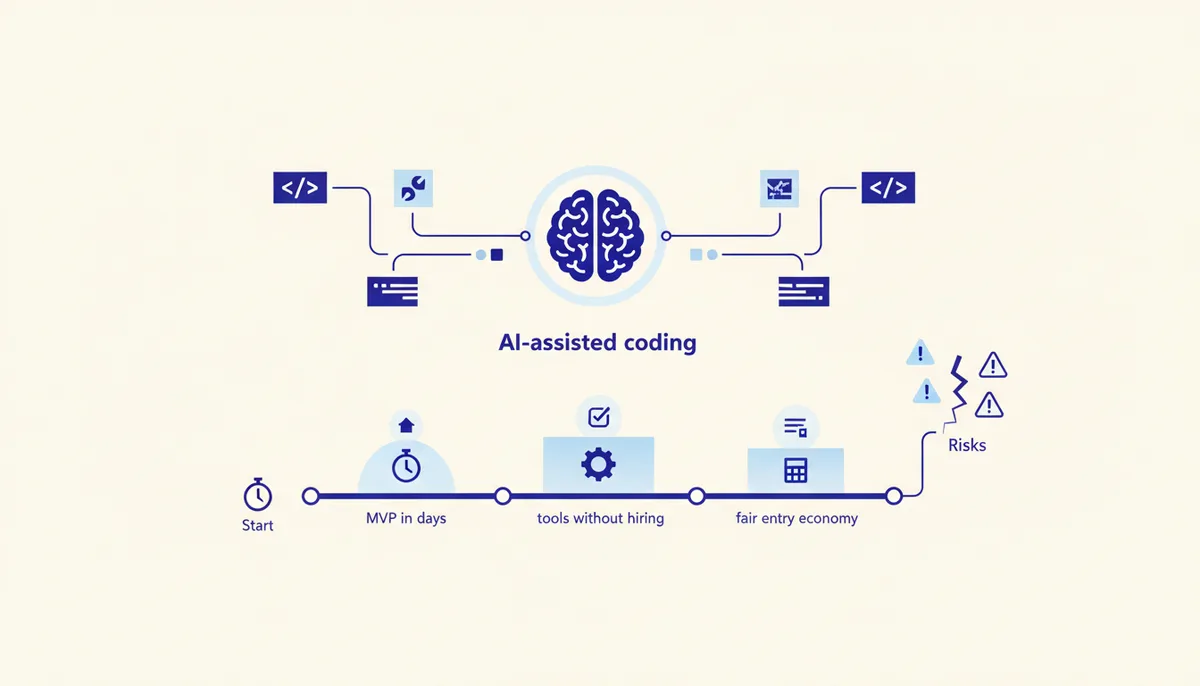
Vibe coding is an approach where an AI agent writes the software from a task stated in plain language, and a human checks and accepts the result. For a business that means three concrete benefits: an MVP in days instead of months, internal tools without hiring developers, and routine work automated by the team you already have. Entry is cheap: a tool subscription from $20 to $200 a month (as of July 2026) plus the time of one committed employee. The traps are just as real: insecure code (up to 45% of AI-generated code fails checks at the OWASP Top 10 level), orphaned projects with nobody maintaining them, and a "last 20%" of polish that eats weeks. All of them are closed off not by talent but by process: rules for the agent, review, tests, discipline around secrets. Below is the honest economics of getting started and three rollout scenarios: for a sole trader, a small business and a mid-sized company.
What vibe coding means from a business point of view
Vibe coding shifts the programmer's labor onto an AI agent: you formulate the task, the agent (Claude Code, Cursor) writes and runs the code, you look at the result and refine. A detailed breakdown of the term is in the article "What vibe coding is"; what matters here is the business meaning.
For a business, vibe coding isn't "programming without programmers" — it's shortening the path from an idea to a working tool from months to days. Previously, between "we need a delivery calculator on the site" and a finished page stood a budget, a contractor, a spec and three rounds of revisions. Now one employee covers that path in an evening or two.
The scale is no longer startup-only: Gartner forecasts that by the end of 2026 roughly 60% of new code will be AI-generated, and in Y Combinator's winter 2025 batch a quarter of the startups had codebases that were 95%+ AI-written. This isn't an enthusiasts' experiment — it's a new way of producing software.
Why a business needs it: three scenarios that work
An MVP in days. Testing a hypothesis no longer requires a development team. A landing page with a calculator, a Telegram booking bot, a service prototype — assembled in 2–5 days and shown to real customers. Being wrong becomes cheap: if the hypothesis flops, you lost a week rather than a quarter's budget. The step-by-step process is in the guide "How to build an app with AI".
Internal tools. The most underrated niche. A sales dashboard built from Google Sheets, a supplier price-list parser, a proposal generator, a stock reconciliation script — tasks nobody would hire a developer for because "that's expensive for such a small thing". Vibe coding makes them economically sensible: the cost of a tool drops to a few hours of an employee's work.
Automation without hiring. The next level is when the agent doesn't just write code but performs the routine itself: sorting incoming requests, preparing reports, tracking competitors' prices. Where such agents genuinely pay off and where they stay a toy is covered separately in "AI agents for business".
What entry costs: the honest economics
Let's count without the "free in 5 minutes" framing. Prices are as of July 2026.
| Cost item | Range | Comment |
|---|---|---|
| AI tool subscription | $20–200/month | Claude Pro/Max, Cursor Pro; the entry tier is enough to start |
| Employee time | 5–20 h/month | The main hidden item: the task needs an owner |
| Hosting and services | 0–3,000 ₽/month | VPS, domain, third-party service APIs |
| Process and training | 0–15,000 ₽ one-off | Rules and guides; a free base is in the qvib arsenal |
That puts a workable entry point at around 5,000 ₽ a month. For comparison: a small order from a studio or freelancer in Russia starts at roughly 100,000 ₽, and an in-house developer costs from 100,000 ₽ a month before taxes.
Now the traps the marketing keeps quiet about:
- The "last 20%". A prototype in one evening is true. Turning it into a product (auth, payments, access rights, backups) takes another 3–5x the time. Budget for that from the start.
- Rework caused by having no rules. An agent with no constraints will happily rewrite working code and break what used to work. The cost of that chaos grows along with the project.
- The orphaned project. The tool rests on one enthusiast: he quits, the code dies. The cure is documentation and keeping the process in the repository rather than in someone's head.
What the risks are — and why they aren't a reason to walk away
The main risk of vibe coding isn't "the AI will write badly", it's "the human won't check". The key areas:
- Code security. Research from 2025–2026 shows up to 45% of AI-generated code fails OWASP Top 10 checks: SQL injection, weak password handling. AI writes "like the average of the internet", and the average of the internet is written insecurely.
- Leaked secrets. A classic: an API key committed to a public repository and a sudden cloud bill for tens of thousands of rubles.
- Customer data. Sending personal data into a prompt on a third-party service is both a legal risk (152-FZ, Russia's personal data protection law) and a reputational one.
- The illusion of readiness. "Works on my machine" is not the same as "works under load for customers".
A full checklist with examples is in "Vibe coding risks and security". The key thought: all of these risks are standard and long known, so they're closed off in advance — by process, not by heroics.
How process discipline closes the risks
What distinguishes companies where vibe coding works in production isn't "prompting talent" but boring rules:
- Rules for the agent. A file with the project's constraints — what must not be touched, which stack, how to format changes. The agent reads it on every run.
- Review before production. A human looks at the changes; on large tasks a second agent does a draft review, with the human as the final filter.
- Tests and staging. Verify on a copy first, then roll out. This one rule alone closes off most "oops, we wiped the database" stories.
- Secrets outside the code. Keys and passwords live in environment variables, not in prompts and not in the repository.
- Git and a change log. Version history turns any mistake from a catastrophe into a five-minute rollback.
You can assemble this discipline yourself from guides — or take a ready-made one. That's why we built the Quest engine: a set of rules, commands and processes for Claude Code and Cursor where review, tests and secret handling are already baked into the working cycle (a one-off purchase of 4,900 ₽ as of July 2026, no subscription). Free material on AI in business — case studies, tool combinations, templates — is collected in the "Business" section of the arsenal.
Three rollout scenarios by company size
| Size | Who does it | Where to start | First result |
|---|---|---|---|
| Sole trader / micro (1–5 people) | The owner personally | One tool for a personal pain point: booking bot, calculator, landing page | 1–2 weeks |
| Small (5–50 people) | One "AI operator" from the team | Internal tools: reports, parsers, spreadsheet integrations | 1 month |
| Mid-sized (50+ people) | A pilot group of 2–3 people | A security policy first, then a pilot in one department | 1 quarter |
Sole traders and micro businesses. Don't "adopt AI" — solve one specific pain. Take the task you've been putting off because development was too expensive and build the tool yourself over a couple of evenings.
Small business. Appoint an owner for the area — an employee who enjoys figuring tools out. Give them a subscription, a set of rules and a list of five internal pain points. In a month you'll have 2–3 working tools and a sober sense of where this pays off.
Mid-sized business. Here the main risk is organizational rather than technological: fifty employees with personal subscriptions and customer data in their prompts. So the order is reversed: policy first (what may be sent to AI, where secrets live), then a pilot in one department, and only then scaling whatever has proven its value in numbers.
FAQ
Can vibe coding replace a programmer?
For the standard small-business tasks — sites, bots, integrations, reports — usually yes. For complex products, no: there AI speeds a developer up but doesn't replace them. An honest comparison of the approaches is in "Vibe coding vs programming".
How much money do I need to start?
The minimum is a subscription of about $20 a month (as of July 2026) and 5–10 hours of time. A sensible small-business budget is 5,000–20,000 ₽ a month including hosting and services. That's an order of magnitude less than hiring or outsourcing.
How dangerous is it to trust AI with customer data?
Dangerous if you work without rules: data in prompts, keys in code. Acceptable if you work by process: anonymize the data, keep secrets in environment variables, review before rollout. The standard mistakes and defenses against them are covered in the article on vibe coding risks.
Where do I start if there isn't a single technical person in the company?
With a small personal project by the owner: one task, one tool, one week. A step-by-step plan for a first project is in the guide "Vibe coding: where to start".