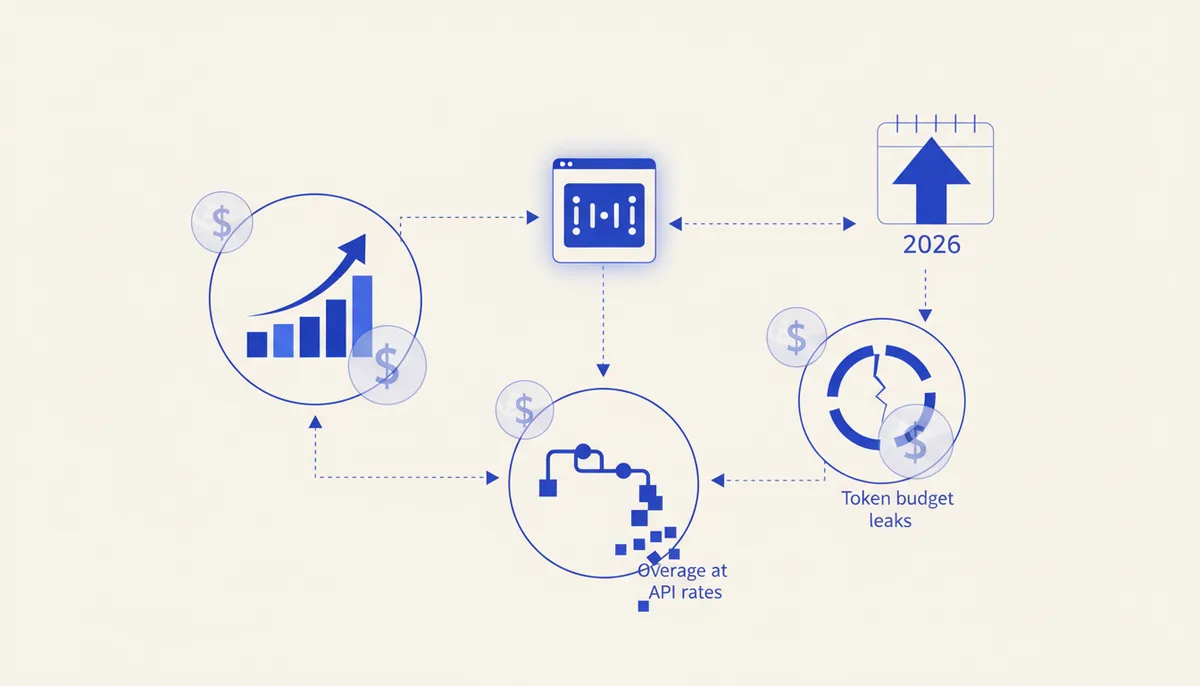
What AI Coding Actually Costs Per Month in 2026
In short
A subscription is the floor, not the bill. As of July 2026, Claude Pro is $20/month, Claude Max is $100 (5x) or $200 (20x), Cursor Pro is $20 and Ultra $200, and GitHub Copilot runs $10 to $100 for individuals. But Anthropic's own cost documentation puts real Claude Code usage at roughly $13 per developer per active day and $150–250 per month, with 90% of users under $30 on any active day. The gap between sticker price and that number is where the surprises live: overage billed at API rates once your pool runs out, credit pools that only cover third-party models, agent teams that multiply token burn, cache misses after breaks, and a tokenizer change that makes the same code cost more. A solo developer working a few hours a day on one repo usually lands between $20 and $60. Anyone running parallel agents or CI automation should budget three figures and instrument the spend first.
The bills nobody lists upfront
Vendor pricing pages show one number. Your card sees several.
The seat. The only predictable line: $20 for Claude Pro or Cursor Pro, $10 for Copilot Pro.
Overage at API rates. Every major tool sells a bucket and then meters you past it. Cursor Pro includes $20 of third-party model usage, Pro Plus $60/month includes $70, Ultra $200/month includes $400 — past that you upgrade or add on-demand usage at API rates. On Claude Pro and Max, usage credits keep you working past the plan limit at standard API rates. Copilot does the same through GitHub AI Credits.
The second subscription. Almost nobody runs one tool. Claude Max plus Cursor Pro plus a Copilot seat from the org is $120–$220/month before a single token of overage.
Infrastructure that only exists because of the agent. Preview deploys per branch, a staging database the agent can break, CI minutes burned pushing eleven commits to get one test green. These land on different invoices and rarely get attributed to the AI budget — which is why they get missed.
Server-side tools. On the Claude API, web search is $10 per 1,000 searches and code execution is free for 1,550 hours per org per month, then $0.05 per container-hour. Small numbers that compound under automation.
What each plan actually buys you
Verified against the Claude, Cursor and Copilot pricing pages, July 2026.
| Plan | Monthly price | What's included beyond the seat | Overage behaviour |
|---|---|---|---|
| Claude Pro | $20 ($17 annual) | Code + chat share one pool; 5-hour and weekly windows | Usage credits at API rates |
| Claude Max 5x / 20x | $100 / $200 | 5x or 20x Pro usage per 5-hour session | Same usage-credit mechanism |
| Claude Team | $25/seat ($20 annual); premium $125/$100 | Per-seat allowance across Code, chat and Cowork | Admin enables credits, sets caps |
| Cursor Pro / Plus / Ultra | $20 / $60 / $200 | $20 / $70 / $400 of third-party model usage, plus a separate pool for Cursor's own models | On-demand usage at API rates |
| Cursor Teams | $40/user (Premium $120) | 5x agent limits on Premium | Pooled, billed centrally |
| Copilot Pro / Pro+ / Max | $10 / $39 / $100 | $15 / $70 / $200 in GitHub AI Credits | Metered past the allowance |
| Claude API direct | $0 | Nothing — pure metering | Opus 5 $5/$25 per MTok; Sonnet 5 $2/$10 (introductory, to 31 Aug 2026); Haiku 4.5 $1/$5 |
Two things fall out of that table. The "$200 tier" is a convention now, not a coincidence — Max 20x, Cursor Ultra and Copilot Max all cluster there. And at the top tiers you are prepaying API credit at a discount, which only pays off if you consume it: Cursor Ultra is a bad deal at $150 of monthly usage and a good one at $400.
A real month, broken down
Take a solo developer on one production repo, five days a week, four focused hours a day. Sonnet for implementation, Opus for architecture and hard debugging, Haiku for mechanical subagent work.
At Anthropic's published benchmark of about $13 per developer per active day, twenty active days is near $260 of raw API value — above the $200 Max 20x price. That is the whole argument for the subscription, and Anthropic's cost guidance puts typical usage in the $150–250 band. Halve the intensity — two hours a day, one agent, no CI automation — and the same developer sits inside Claude Pro at $20. Most people at that level are overpaying on Max.
Realistic monthly ranges:
- Occasional (a few hours a week): $0–20. Copilot Free and Cursor Hobby genuinely work here.
- Daily solo work, one agent: $20–60. One Pro subscription, maybe a second tool.
- Full-time agentic work, parallel sessions: $100–250. Max 20x or Cursor Ultra, and you will use it.
- Automation, agent teams, CI-driven agents: $250–600+. Metering becomes mandatory.
These are arithmetic from published list rates and vendor averages, not a measurement of your team. Run a two-week pilot and read your own numbers before committing a budget.
Where the money leaks
The expensive habits are boringly consistent, and Anthropic documents most of them.
Long sessions never cleared. Claude Code sends the full conversation with every message, so a one-line question in a day-old session bills against the whole thing. /clear costs nothing; /compact costs a full read of what it summarizes.
Cache misses after a break. Prompt caching cuts repeated context to 10% of input price, but caches expire — an hour on a subscription, five minutes on usage credits or an API key. Come back from lunch and your first message reprocesses everything at full price.
Opus left as the default. Opus 5 costs $5/$25 per million tokens against Sonnet 5's introductory $2/$10 — a 2.5x multiplier on every routine edit, and the single highest-leverage setting most people never change. Our model routing guide covers which task belongs on which model.
Agent teams. Useful and expensive: Anthropic's docs put them at roughly 7x the tokens of a standard session when teammates run in plan mode, because each teammate carries its own context window.
The tokenizer change nobody budgeted for. Claude Opus 4.7 and later use a newer tokenizer that produces approximately 30% more tokens for the same text. If your spend jumped when you upgraded models and your habits did not, this is part of why.
MCP servers you forgot you installed. Tool definitions are deferred by default now, but an over-stuffed setup still costs context. /context shows what is eating space; a gh or aws CLI call is cheaper than the equivalent MCP server.
Cutting spend without cutting output
Ranked by effect per minute of effort:
- Route models deliberately. Sonnet as default, Opus only for architecture and hard debugging, Haiku for mechanical subagents. Set it in
/configso you do not have to remember. - Clear between tasks. Not because context is precious — because you pay for it on every single message.
- Turn on spend limits before you need them. Workspace limits on the Console, org-level limits on Team and Enterprise. A cap set on a calm Tuesday beats a bill disputed on a Friday.
- Read
/usageweekly. On paid plans it attributes usage to skills, subagents, plugins and individual MCP servers, and flags long context or cache misses at 10%+ of usage. A diagnosis, not a guess. - Filter tool output at the source. A PreToolUse hook that greps test output for failures turns a 10,000-line log into a hundred lines — two orders of magnitude fewer tokens.
- Lower the effort level on simple work. Thinking tokens bill as output, and the default budget can run to tens of thousands per request.
- Batch what is not interactive. The Batch API is a flat 50% off.
None of this helps if the real cost is rework. An agent producing code you throw away is expensive at any token price, and the fix is a tighter spec plus a verification step, not a cheaper model. If you are comparing tools rather than tuning one, the Claude Code and Cursor pricing breakdowns go plan by plan, and the Anthropic API pricing guide covers the metered route.
FAQ
How much does AI coding cost per month for one developer?
For one developer, $20/month covers light-to-moderate daily use on any of the major tools. Full-time agentic work — several hours a day, parallel sessions, large repos — lands between $100 and $250. Anthropic publishes $150–250 per developer per month as the enterprise average, with 90% of users under $30 on any active day. Session hygiene and model choice drive that spread far more than vendor choice does.
Is a $200/month plan worth it, or should I use the API directly?
Compare metered spend to the flat price. At $13 per active day, twenty working days is about $260 of API value — Max 20x pays for itself on a heavy month and wastes money on a light one. The API wins when usage is bursty or scriptable: you pay for what you consume and get Batch and caching discounts. The subscription wins when usage is steady and heavy.
Why did my bill go up when I did not change how I work?
Three documented suspects. You upgraded to Opus 4.7 or later, whose tokenizer produces roughly 30% more tokens for the same text. You started using agent teams, which run about 7x the tokens of a standard session in plan mode. Or you moved from a subscription to usage credits, dropping your cache lifetime from an hour to five minutes — so every pause costs a full context reprocess.
Do free tiers work for real projects?
For learning and small side projects, yes. Copilot Free includes 2,000 completions per month, Cursor's Hobby tier gives limited agent requests, and Claude's free tier includes Claude Code at reduced limits. What they do not survive is a large codebase or a long agentic session. Treat them as evaluation, not infrastructure.
How do I track what I am actually spending?
In Claude Code, /usage breaks down recent usage by skill, subagent, plugin and MCP server, with day and week views. Organizations get a spend report in claude.ai org analytics, workspace cost tracking in the Console, or OpenTelemetry export. Cursor and Copilot expose credit consumption in account settings. Set a spend limit when you turn tracking on — visibility without a cap just means watching the number climb.