Will AI Replace Programmers? An Honest Look at 2026
In short
The honest answer: no, AI will not replace programmers wholesale — but the profession is changing faster than it did over the previous twenty years. AI handles routine work beautifully (boilerplate code, tests, the first draft of a function) and reliably breaks on architecture, security and "almost right" code that costs more to fix than to rewrite from scratch. In Stack Overflow's 2025 survey, 84% of developers use AI, but 46% don't trust the accuracy of its output — up from 31% a year earlier. The job market is shifting: fewer openings for a "coder, plain and simple", more demand for engineers who direct AI and own the result. Below is a breakdown without the hype: what gets replaced, what doesn't, and what to do about it.
What AI can already do — and where it's overrated
By July 2026, AI agents such as Claude Code and Cursor can do more than finish a line: they read the repository, edit several files, run commands and execute tests. On the SWE-bench Verified benchmark (real GitHub issues) Claude Code scores around 78% and the Cursor agent around 67%. Five years ago those numbers looked like science fiction.
But a benchmark is an isolated task with a clear statement. In a live project things look different. METR's 2025 study produced a sobering result: experienced developers felt they were working about 20% faster with AI, while in fact, on complex tasks in familiar code, they were 19% slower. The gap between perception and measurement is forty percentage points. AI speeds up the start and takes the time back during review and debugging.
Vibe coding is an approach where you describe the task in natural language, AI writes the code, and you steer and verify. More in what vibe coding is and vibe coding versus classic programming.
Where AI reliably breaks
Three weak spots repeat from project to project:
- Security. Across academic and OWASP research combined, 30–40% of AI-generated snippets contain at least one CWE-class vulnerability. In regulated industries, AI code adds 15–18% more vulnerabilities.
- Quality over time. GitClear's analysis of millions of lines of code showed that with AI the share of code rewritten within the first two weeks goes up and reuse goes down — copy-paste instead of careful architecture.
- "Almost right". The biggest pain point in the Stack Overflow survey: 66% of developers complain about solutions that are "almost correct, but not quite", and 45% say debugging AI code takes more time than doing the work by hand.
The common denominator: AI doesn't understand business context, carries no responsibility, and is wrong with confidence. So the final word stays with a human.
Task → replaces, assists, or can't
| Task | Verdict | Why |
|---|---|---|
| Boilerplate, CRUD, scaffolding | Replaces | Predictable, thousands of training examples |
| Unit tests and documentation | Replaces | Mechanical work on existing code |
| The first draft of a function | Assists | A fast start, but needs review |
| Refactoring legacy code | Assists | Speeds things up, but easily breaks hidden couplings |
| Debugging a non-trivial bug | Assists | Suggests hypotheses — the fix is on you |
| Designing architecture | Can't | No business context, no accountability |
| Security and user data | Can't | 30–40% of snippets carry vulnerabilities |
| Priorities and talking to the client | Can't | That's a human's job, not a model's |
Which roles are changing and which are disappearing?
One segment is shrinking: the mechanical "junior coder" who turned tickets into template code, plus commodity outsourcing of simple landing pages and CRUD apps. The 2026 numbers are harsh: employment among developers aged 22–25 has fallen 20% since 2022, recent graduates make up 7% of new hires at big tech companies versus 9.3% in 2023, and the number of junior openings dropped 60% between 2022 and 2024.
At the same time, demand is growing for mid-level and senior engineers who deliver end to end, and for AI and cybersecurity specialists. In Russia, labor-market reviews for 2026 show total job postings down about 28% year over year, IT cooling by roughly 13%, and demand shifting toward mid/senior roles in AI and security — the market needs fewer "programmers, plain and simple". Meanwhile the US Bureau of Labor Statistics still projects the profession to grow about 17% through 2033. The contradiction is only apparent: the entrance narrows while the bar rises.
Why demand for "AI orchestrators" is growing
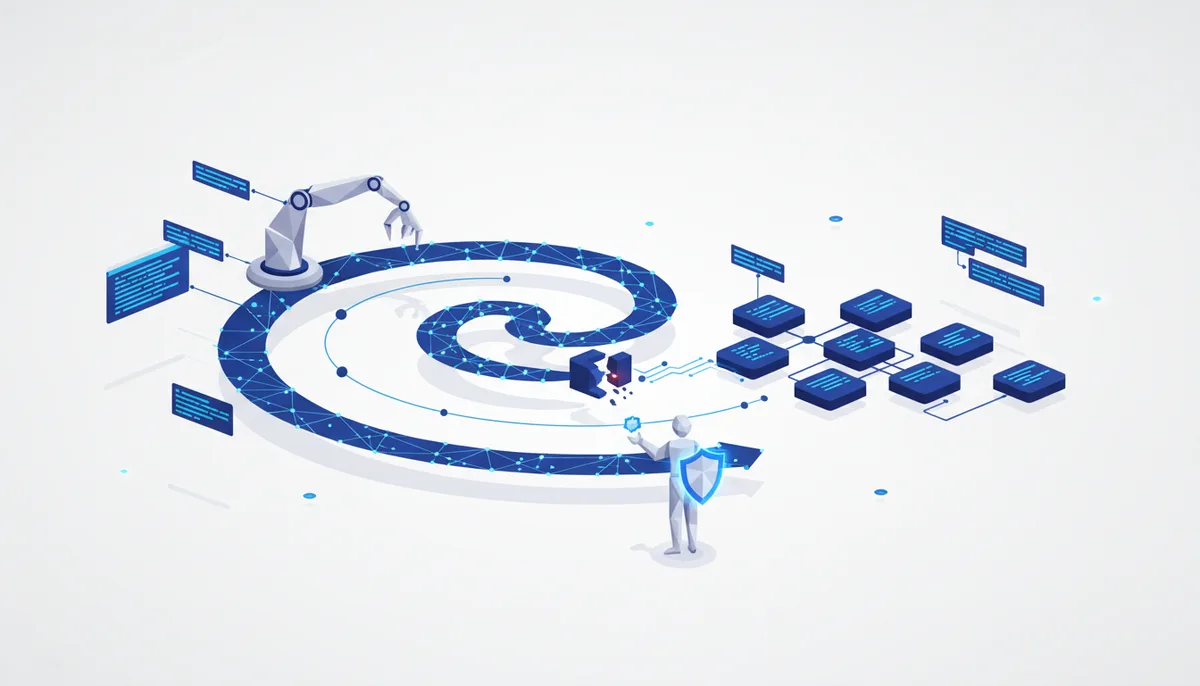
An AI orchestrator is an engineer who assigns tasks to one or several AI agents, designs the constraints they work within, and checks the result while answering for it to the business. They don't "write code by hand" — they manage whoever does and guarantee the quality.
The demand shows up in the numbers. Gartner forecasts that by 2028 about 75% of enterprise engineers will use AI assistants, up from under 10% in early 2023; writing code by hand stops being the core of the job and the center of gravity shifts to orchestration and architecture. Postings requiring AI skills grew roughly 109% between 2024 and 2026 — faster than the market can train such people. That's exactly why "programmer + AI" is worth more today than "programmer" was a year ago.
An honest forecast and what to do
No clickbait: over a three-to-five-year horizon AI will not replace programmers, but programmers who don't use AI will be replaced by those who do. The profession isn't vanishing — it's raising the bar. Coasting on copy-paste as a junior no longer works, while someone who can frame a task for AI, read someone else's code and answer for the result is valued more highly than a year ago.
What to do right now:
- If you're a developer: learn the agentic tools (Claude Code, Cursor), but build up what AI can't do — architecture, code review, security, talking to clients.
- If you're a beginner: don't skip the fundamentals. An AI assistant doesn't replace understanding, it amplifies it: learn to read and verify code, not just generate it. It helps to figure out early what a vibe coder is and how people make money at it.
- For everyone: treat AI as a junior developer on the team — fast and eager, but requiring review.
The qvib engine helps you walk this path systematically: Quest for Claude Code and Cursor and the knowledge base in the /learn/ hub collect proven prompts, MCP servers and working scenarios so you become that AI orchestrator rather than the person being let go.
FAQ
Will AI replace programmers entirely?
No. As of July 2026 AI covers the routine but fails at architecture, security and accountability for the result. The US Bureau of Labor Statistics forecasts growth for the profession, not its disappearance. The nature of the work changes, not the fact that it exists.
Is it worth going into development as a beginner in 2026?
Yes — if you're ready to learn the fundamentals, not just generate code. Entry has gotten harder: there are fewer junior openings. But demand for people who work with AI deliberately and own the quality is rising, not falling.
What is an "AI orchestrator" in plain terms?
An engineer who assigns tasks to AI agents, sets their boundaries and checks the result. Gartner forecasts that by 2028 about 75% of enterprise engineers will use AI assistants, and the center of the work shifts from hand-written code to orchestration.
Can you trust code written by AI?
Partly. In Stack Overflow's 2025 survey, 46% of developers don't trust AI's accuracy. Code has to be reviewed, tested and checked for security — especially anything headed to production.
Where do you start so you don't fall behind?
Learn one AI tool and get the basics down. Start with what vibe coding is and practice in the /learn/ hub, then move on to real tasks.