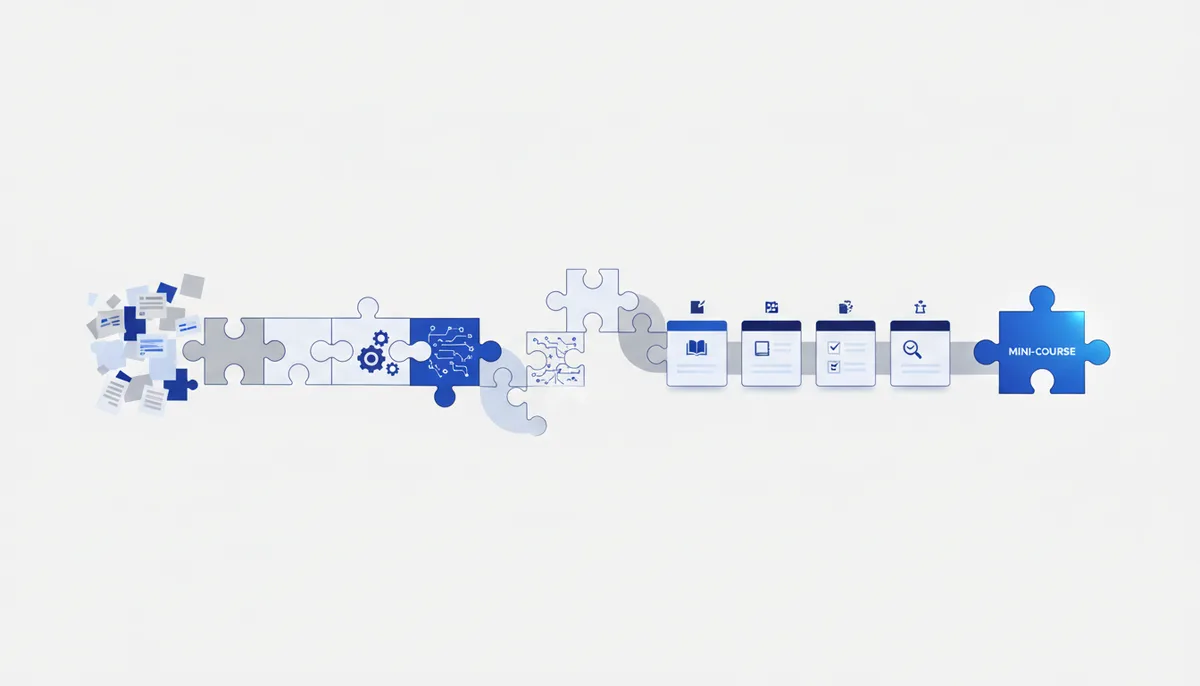
A ready-made setup: your experience becomes a sellable (or free) mini-course. The AI helps you build the curriculum out of your own material, write out the lessons, invent assignments and quizzes, and put together slides and a landing page. From "scattered knowledge in my head" to a structured course over a weekend.
What you end up with
- A course curriculum: modules → lessons → the outcome of each lesson (what they'll be able to do).
- Lesson copy and outlines built from YOUR material (not "filler off the internet").
- Practical assignments and knowledge-check questions or quizzes for every lesson.
- Slides or a deck and, optionally, audio/video narration for the lessons.
- A course landing page with the curriculum and payments.
What you'll need
Tools from the library (by name): ChatGPT/Claude (curriculum, lessons, assignments, quizzes), the prompt "Learning plan for a topic from scratch (in N weeks)" (the curriculum frame), the prompt "Article/video summary + what to apply" (turning your own material into lessons), the prompt "Summary of a long document (by structure)" (compressing big sources), Gamma (slides, decks and a landing page from text in minutes), ElevenLabs or Kokoro TTS (lesson narration), the combo "Faceless video (no camera)" (if the course is video-based), the combo "Landing page + payments in one evening" (selling it). Accounts/money/hardware:
- Free route: ChatGPT/Claude (free), Gamma (free tier), Kokoro/OpenCut for audio and video; any PC.
- Fast route: a paid model (smoother copy), Gamma Pro (no watermarks, exports), ElevenLabs for narration, a platform to host the course.
Step by step
- What you're building and for whom. What to do: define the topic, who the course is for, and what the graduate walks away with ("after this course a student can do X"). Gather your own material (notes, articles, case studies, recordings). How you know it worked: you can state the course promise and the final skill in one sentence, and you have a folder of source material.
- Curriculum. Tool: the prompt "Learning plan for a topic from scratch" in ChatGPT/Claude. Ready-made prompt:
I'm building a mini-course. TOPIC: "<topic>". FOR WHOM: <level, who>. OUTCOME: "<what the graduate can do>".
MY MATERIAL (in brief): <what your notes/experience cover>.
Draft the curriculum: 4–6 modules, 2–4 lessons in each. For every lesson: a title,
the outcome (what they'll learn), 3–5 key points, and an idea for a practical assignment.
Simple to complex, no filler; end each module with a mini-project.
How you know it worked: the curriculum flows logically (simple to complex), every lesson has a clear outcome, and nothing is duplicated. 3. Lessons from your own material. Tool: the prompt "Article/video summary + what to apply" or "Summary of a long document". What to do: rework your own sources into lesson text (rather than writing from scratch "out of the model's head"). Ready-made prompt:
Turn my material into a lesson outline for the course. MATERIAL: "<paste your text/notes>".
LESSON: "<title from the curriculum>". LESSON OUTCOME: <what we're teaching>.
Structure: 1) why this matters (one paragraph); 2) the substance step by step, in plain words, with an example;
3) the mistake beginners usually make; 4) a practical assignment; 5) 3 check questions with answers.
Work from my material; don't add anything unverified of your own.
How you know it worked: the lesson rests on your material, has an example, an assignment and a check; nothing was made up. 4. Assignments and quizzes. Tool: ChatGPT/Claude. What to do: add practice and a quiz to every lesson (feel free to ask for different formats: a case study, a checklist, a mini-project). How you know it worked: the assignment tests exactly the lesson's outcome, and the quiz has unambiguous answers. 5. Slides and narration. Tool: Gamma (slides or a deck from the lesson text) plus ElevenLabs/Kokoro, or the combo "Faceless video" if you need video. What to do: turn the lessons into slides and narrate them if you like. How you know it worked: the slides are readable and follow the lesson structure; the narration is even (if you're doing it). 6. Landing page and selling. Tool: the combo "Landing page + payments in one evening" (or Gamma as the landing page). What to do: build a page with the curriculum, the outcome and payments; publish the course on a platform or in a private channel. How you know it worked: it's clear what the course teaches and what it costs; payment goes through and access is granted.
Free route vs fast (paid)
| Step | Free route | Fast (paid) |
|---|---|---|
| Lesson copy | ChatGPT/Claude free | top-tier model (smoother, longer) |
| Slides/landing | Gamma free | Gamma Pro (no watermark, exports, domain) |
| Narration/video | Kokoro / OpenCut | ElevenLabs + the "Faceless video" combo |
| Selling | free channel + ЮKassa | a course platform / Tilda Personal |
You genuinely can build a mini-course for free. Paying buys production quality (narration, clean slides, your own platform). But a course's value isn't in the wrapper — it's in your real experience and whether the student actually reaches the outcome.
Common problems and fixes
- The course is "filler off the internet". Feed the AI YOUR material and case studies (step 3) and forbid it from adding anything unverified; your experience is the whole difference from free guides.
- Bloat: 40 lessons and nobody finishes. A mini-course means 1 clear outcome and 8–15 lessons; cut everything else and keep the path to a single skill.
- No practice means no learning. Every lesson needs a hands-on assignment plus a check; without practice it's a lecture, not a course.
- Factual errors in the material. The AI can get details wrong — proofread the lessons against your own expertise, especially numbers and facts.
- Course is finished, nobody buys. Validate demand first (the combo "Niche and competitor analysis", or presell against the curriculum), then record the whole thing; what sells is the outcome, not the volume.
Time and money
- Time: curriculum — 1–2 hours; lessons from your own material — the bulk of the work, 1–3 days depending on scope; packaging (slides/landing) — another day.
- Money: free (ChatGPT/Claude free + Gamma free) or about $15–40/month for a paid model + Gamma Pro + ElevenLabs.
- Honestly: AI speeds up structuring and packaging enormously, but the content and the expertise are yours. A good mini-course is your real experience + a clear outcome + practice, not "I generated 50 lessons".