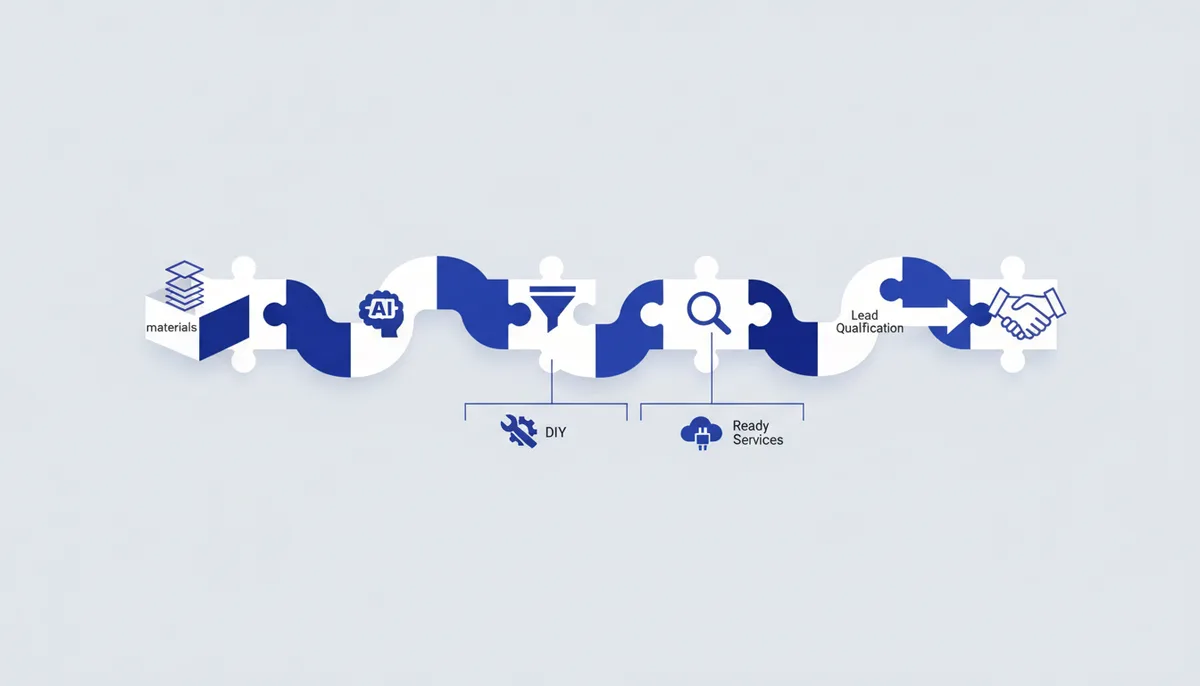
"Answered in 10 seconds — took the client off a competitor." A regular FAQ bot answers and then goes quiet; an AI seller answers, works out what the person actually needs, handles objections using YOUR materials and drives toward a request or a payment — 24/7, while you sleep. 🤖💬
What you get: a bot that doesn't just answer but sells. You upload your offer, FAQ, price list and objection handling — the bot answers from those (not off the top of its head), qualifies the lead (who they are, what they need, urgency and budget), gently works through the standard objections from your materials, and drives toward a target action (a lead in the CRM, a booking, a payment link). Money, discounts, guarantees and anything contentious get handed to a human. This is an upgrade on a plain support bot: from "answered" to "closed".
What you end up with
- A selling bot on your site or in Telegram: answers from your knowledge base AND drives toward a deal.
- Lead qualification: the bot works out the need, urgency and budget and marks the lead "warm" or "cold".
- Objection handling — strictly from your materials (offer, script), no invention.
- A target action: a lead in the CRM, a booking or a payment link, not just "answered and done".
- Money, discounts and contentious topics passed to a live human (the bot doesn't promise refunds or guarantees on your behalf).
- First contact in seconds, 24/7 — while a competitor "gets back to you tomorrow".
What you'll need
Tools from this library (by name): ChatGPT/Claude (the bot's brain plus script design) or Ollama (private and local), the "Private AI over your own files (local RAG)" combo (the "answers from your own materials" mechanics), n8n (wiring channel → AI → CRM/reply, no code), the Filesystem MCP (access to your offer and script files for the local setup), the "Persona: build an expert role for the task" prompt (the seller's role and tone), and the "Support chatbot over your own knowledge base" combo (the base RAG mechanics we're taking further into sales here). Outside the library but relevant: sales materials — offer, price list, answers to common objections, a simple "question → offer" script; a channel — a site widget or a Telegram bot (get a token from @BotFather); a CRM (amoCRM, Bitrix24 and the like) for leads; for a no-code build — n8n plus a vector store, or a ready-made bot builder with RAG. Accounts, money, hardware:
- Free path (DIY): Ollama locally (private, $0 in software, needs a GPU or Apple Silicon — see "Local / private"), self-hosted n8n, a free Telegram bot.
- Fast path (DIY): an API key for a cloud model (ChatGPT/Claude/YandexGPT — pay per token), n8n Cloud, a bot builder (usually a free tier plus paid plans).
- Turnkey path: a ready-made RU "neuro-seller" on subscription (see the section below) — faster, but pricier and locked to the vendor.
Step by step
- Knowledge base plus sales materials. What to do: gather into clean text/markdown everything the bot sells with — the offer, price list, service descriptions, answers to 10-15 common objections, a simple qualification script. How you know it worked: 80% of typical questions and objections already have an answer in those files.
- The "seller" role and its limits. Tool: the "Persona" prompt in ChatGPT/Claude. What to do: set the bot's role, tone and hard rules. Ready-made system prompt:
You are the AI sales consultant for <project>. Your goal is to help the customer and take them to <target action: a request / a booking / a payment>.
Rules:
1) Answer ONLY from the materials provided (offer, price list, FAQ, objection handling). If the data isn't there, don't invent it — call a human (tag "escalate").
2) Find out the need first: 2-3 short questions (what they need, what for, urgency/budget) — then make an offer.
3) Handle objections gently and from our materials, without pressure or hard selling.
4) Money, discounts, guarantees, refunds, anything contentious — do NOT decide yourself, tag "escalate".
5) Drive toward the <target action> with one clear link or button, don't push aggressively.
6) Be honest: if asked, you are an assistant, not a human.
Tone: <friendly / businesslike>, brief, in the customer's language.
How you know it worked: the bot asks first and offers second; on a discount or refund question it calls a human instead of promising anything itself. 3. The "answers from materials" engine (RAG). Tool: Ollama (local) or a cloud model plus a vector store. What to do: stand up RAG over the step 1 materials (the mechanics are in the "Private AI over your own files" combo): embeddings → search → an answer grounded in what was found. How you know it worked: the bot closes a test question about the product and a standard objection by quoting your offer directly. 4. Channel plus CRM. Tool: n8n + a Telegram bot (or a site widget). What to do: build the flow "message → RAG engine → reply + write the lead to the CRM"; for Telegram get a token from @BotFather. How you know it worked: a conversation with the bot creates a card or a lead capturing the gist of the request. 5. Target action and escalation. What to do: set it up so a "warm" lead gets a link to a request form, a payment or a booking, while questions about money, discounts or anything contentious (the "escalate" tag) go to you in Telegram or by email together with the conversation. How you know it worked: a warm lead reaches the button, a money question lands in your notifications, and the customer sees "let me bring in a colleague". 6. Test on real conversations. What to do: run 15-20 genuine enquiries through it: where the bot qualified correctly, where it lied about the product, where it pushed too hard, where it called a human needlessly or too late. Tune the materials and the prompt. How you know it worked: it handles the typical cases itself and drives to an action, escalates the contentious ones correctly, and there is no invention and no hard selling.
DIY or a ready-made turnkey service
The Russian market is full of services selling themselves as an "AI seller", a "neuro-seller" or under some catchy brand name. Honestly: behind the pretty name is almost always an ordinary neuro-seller on GPT/YandexGPT — the same RAG bot plus sales script plus integrations you're building here yourself. There is no separate magic in there.
- Ready-made service (turnkey SaaS): fast start, integrations out of the box (site, Telegram, WhatsApp, Avito, CRM), vendor support. The downside is the subscription and the lock-in: one such service starts at 19,990 ₽/month for a single channel (an example — prices vary by vendor), and your customer data and conversation logic live on the vendor's side.
- DIY (this combo): slower to build and you maintain it yourself, but the data is yours, you control the script completely, and over time it's cheaper. A private setup (Ollama plus self-hosted n8n) never sends conversations to the cloud at all — a plus for 152-FZ compliance. The rule: if you count conversations in single digits and want it yesterday, take a ready-made one and pilot it; if you're building for the long run and data and cost per volume matter, build it DIY.
Common problems and fixes
- The bot hard-sells and pushes. Take the aggression out of the prompt (step 2): question first, offer second, one soft CTA, none of the "buy now or miss out".
- It promises a discount, guarantee or refund. Those topics are "escalate" only; the bot must not commit on your behalf (that's both a reputational and a legal risk).
- It invents product specs. Be strict: "only from the materials, otherwise call a human" (step 2); check that RAG is finding the right chunk of the offer.
- It sends everyone straight to a manager (no qualification). Add 2-3 qualification questions and a "warm/cold" criterion to the prompt — pass only the warm ones to a human.
- The customer realises it's a bot and gets annoyed. Don't pass the bot off as a human: an honest "I'm an assistant" plus a quick handover to a live operator defuses things far better than pretending.
- The local model struggles with a large knowledge base. Shrink the chunks and the context, use a better embedding model; push complex conversations to a cloud model.
Time and money
- Time: a working MVP takes 4-8 hours (materials + role prompt + RAG + channel + CRM + escalation + testing); tuning against real conversations is an ongoing trickle.
- Money: DIY is free on software with a local stack (you need a GPU or Apple Silicon) or pay-per-token for a cloud model plus optional n8n Cloud or a bot builder. A ready-made service is a subscription from around 20,000 ₽/month (example: neuroprodavec.ru).
- Honestly: "a bot that sells by itself" is largely marketing. In practice it takes first contact, qualifies and warms the lead; complex, high-value deals are closed by a human. And the loud brand name in the ads is usually an ordinary neuro-seller on GPT, not a separate technology. Quality equals the quality of your offer and knowledge base: garbage in, garbage out.