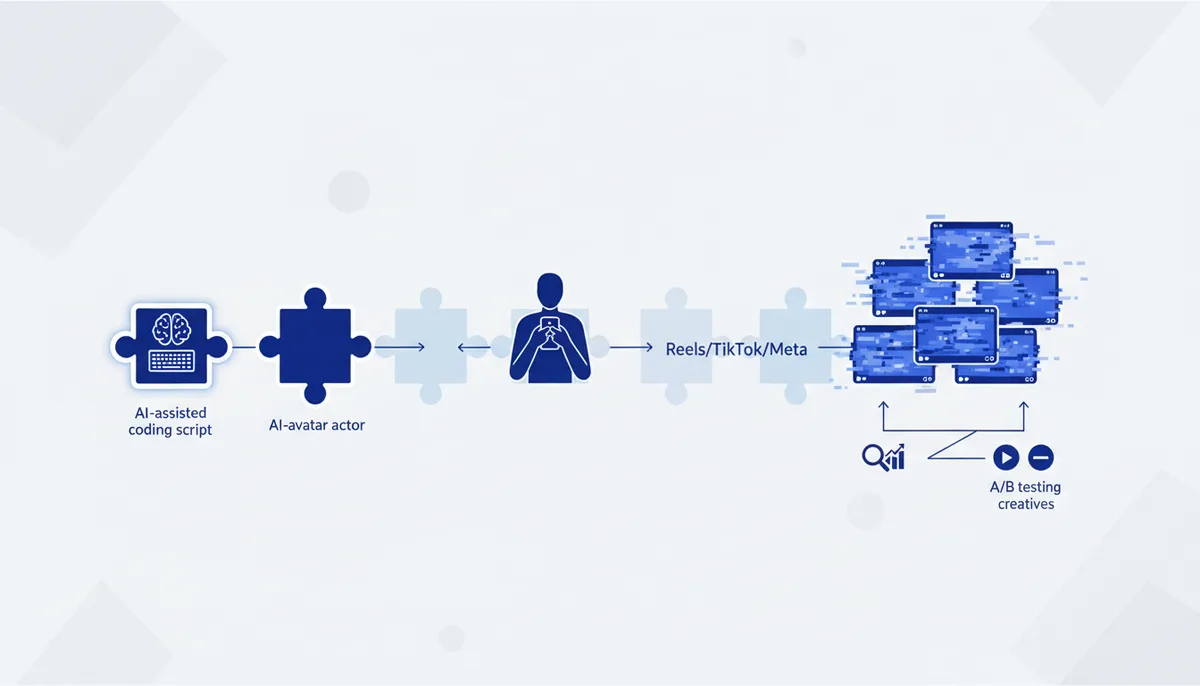
A ready-made setup: a dozen lifelike ad videos with an AI actor in a day, with no filming. The AI writes UGC scripts that hit your audience's pain points, an AI avatar (a realistic "actor") delivers them, and you push a batch of variants into ads and watch what lands. One product → many creatives to A/B test.
What you end up with
- A batch of 5–10 UGC-style videos (vertical 9:16) with an AI actor, sized for Reels/TikTok/Meta.
- Different angles across the scripts (pain, before/after, testimonial, unboxing) — for testing.
- Voiceover and captions; a consistent format for ad placements.
- A read on which creative and which angle gets the best response (from your ad metrics).
What you'll need
Tools from the library (by name): ChatGPT/Claude (UGC scripts, angles), the prompt "Shorts script: hook → retention → CTA", the prompt "Ad creatives (5 angles)" (angles to test), Creatify (UGC video with an AI avatar from a product link — built for Meta/TikTok) or HeyGen (a talking avatar "actor"), ElevenLabs or Fish Audio (OpenAudio) (natural voice, if you need it separately), OpusClip (clipping and captions), vidIQ (if you're running on YouTube — packaging), Publer/SMMplanner (organic posting). Not in the library but relevant: an ad account (Meta Ads / TikTok Ads) and a testing budget. Accounts/money/hardware:
- Free route: ChatGPT/Claude (free) for scripts, the HeyGen free tier (1–3 min/month), free TTS; any PC. Enough to try 1–2 videos.
- Fast route: paid Creatify/HeyGen (bulk generation of variants), ElevenLabs (about $5–22/month). Plus an ad budget for the A/B test (separate from the tools).
Step by step
- Angles and pain points. Tool: the prompt "Ad creatives (5 angles)" in ChatGPT/Claude. What to do: get 5 different angles for the product (pain/solution, before→after, testimonial, against a stereotype, direct offer). How you know it worked: 5 distinct angle hypotheses, each hitting a different pain point.
- UGC scripts. Tool: the prompt "Shorts script: hook → retention → CTA". Ready-made prompt:
You're a UGC creator. Write 5 short ad scripts (15–30 sec) for this product: "<what it is, the benefit>".
Audience: <who, what pain>. Platform: Reels/TikTok. One script per angle:
pain/solution, before→after, "honest review", against a stereotype, direct offer.
Each one: HOOK (first 2–3 sec, like a real person, not an ad) → the substance/demo → one CTA.
Conversational, first person, like a real user. No promises the product doesn't deliver.
How you know it worked: the scripts sound like a real person (not an announcer), the hook grabs in the first seconds, and each has a single CTA. 3. The AI actor delivers it. Tool: Creatify (video from a product link + an avatar) or HeyGen (pick an avatar "actor", paste the script). What to do: generate a video for each script; with Creatify, give it the product link and the script and pick an actor and format. How you know it worked: the avatar speaks naturally, the lips match the audio, and the video looks like UGC rather than "a robot reading". 4. Voice and captions (optional). Tool: ElevenLabs/Fish Audio (if you want your own voice instead of a stock one) plus OpusClip (big captions, cropping to format). What to do: swap the voice if you need to and burn in subtitles (a lot of people watch on mute). How you know it worked: the voice sounds alive, the captions are large and in sync, and the format is 9:16. 5. A batch of variations for A/B. What to do: make two versions of your strongest scripts (different hook/actor/opening frame) so there's something to test. How you know it worked: you have 5–10 videos that differ meaningfully (angle/hook), not cosmetically. 6. Test in ads and pick winners. What to do: upload the batch to Meta/TikTok Ads (or run organic via Publer/SMMplanner), change one variable at a time, cut the weak ones on CTR/CPA after 3–5 days, and build a new batch of variations off the winner. How you know it worked: you can see which angle and hook pull the best response, and you scale exactly that one.
Free route vs fast (paid)
| Step | Free route | Fast (paid) |
|---|---|---|
| Scripts | ChatGPT/Claude free | top-tier model (smoother, more angles) |
| AI actor | HeyGen free tier (1–2 videos) | paid Creatify / HeyGen (a batch of variants) |
| Voice | free TTS / Fish Audio | ElevenLabs (more natural, multiple voices) |
| Clipping/captions | by hand | OpusClip (automatic) |
You can try the format for free (1–2 videos on the HeyGen free tier). Paying pays off on VOLUME of test variations — UGC advertising works by cycling through angles, not by one "perfect" video. The real money here is the ad budget for testing, not the tools.
Common problems and fixes
- The avatar looks artificial. Use realistic actors (Creatify and HeyGen are built for UGC), write the script as real first-person speech, and add captions — they bring it to life.
- The videos are too similar and the test is meaningless. Change one variable at a time (angle OR hook OR actor), not everything at once — otherwise you won't know what worked.
- Weak response. The bottleneck is the hook and the angle: the first 2–3 seconds decide it; test more angles (step 1) instead of tweaking one.
- Advertising law. No guaranteed results, no "#1/best" without proof, no other people's logos and no fake testimonials. An "honest review" from an AI actor must not pass invention off as real experience — that's about trust and about regulator fines.
- The platform suppresses AI video reach. Vary the actors and opening frames, add real elements (your product in frame, real captions), and don't push 10 identical clones.
Time and money
- Time: a batch of 5–10 videos — 2–5 hours (scripts + generation + captions); the next batch from the template — 1–2 hours.
- Money: trying it — free (free tiers) or about $20–60/month for Creatify/HeyGen + ElevenLabs; SEPARATELY, an ad budget for the A/B test (the main line item).
- Honestly: AI UGC is cheaper and faster than shooting with real creators, but a real person still carries more trust in some niches. People use this for VOLUME of creatives to test — cycling through angles wins, not one single video.