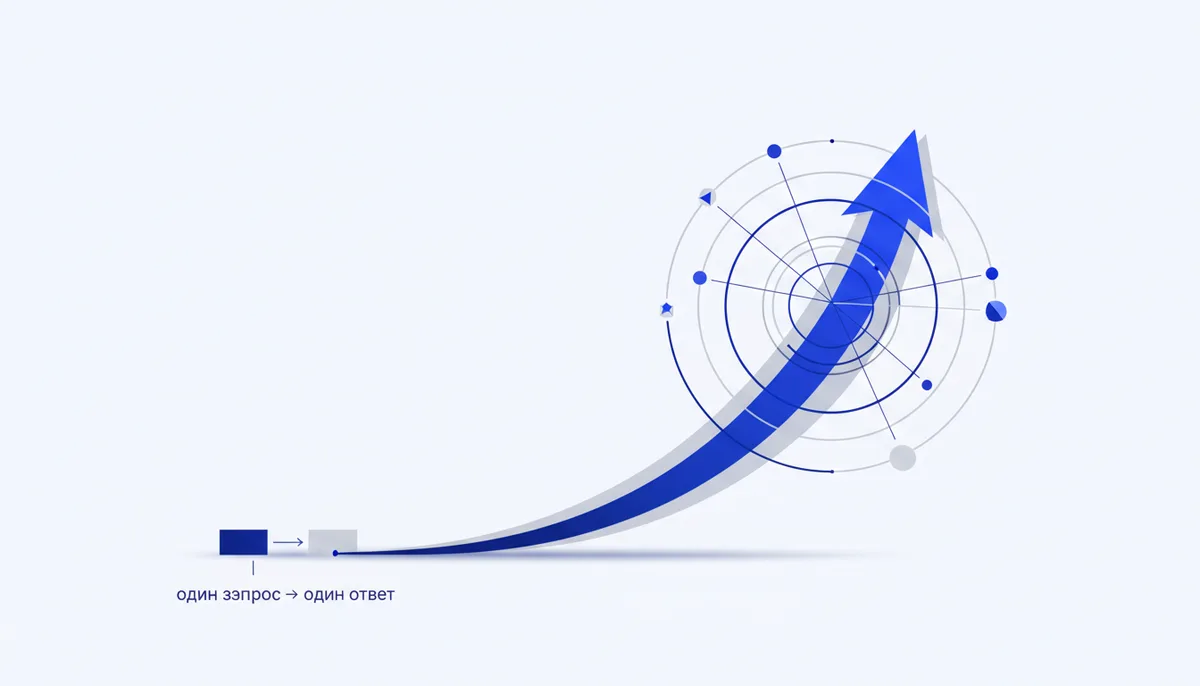
What it is
Agentic RAG is the evolution of classic Retrieval-Augmented Generation. Instead of "one retrieval pass → stuff it into the prompt → answer", the agent plans steps, rewrites queries, calls tools, consults memory and iteratively refines the result while judging its own output. Retrieval becomes multi-step and self-correcting.
Where it came from
- 2023–24 — classic RAG became the standard way to "hook an LLM up to your own data".
- January 2025 — the survey paper "Agentic RAG: A Survey" (arXiv 2501.09136) comes out and frames the approach as a field of its own.
- 2025 — vendors (Redis, RAGFlow, agent frameworks) move the logic from "pipelines" to "agents".
Why it took off
- Static RAG handles complex multi-step questions poorly — you need adaptivity.
- Self-evaluation and repeated retrieval reduce hallucinations: in several measurements errors drop from 20%+ to under 10%.
- It coincided with the industry's general turn towards agents: "search" naturally became one of an agent's abilities.
How to use it today
- If you already have RAG — add a step where the agent reformulates the query when the results are weak.
- Give the agent several sources and tools, and the right to choose where to go for the answer.
- Build in verification: the agent grades its own answer and searches again when unsure.
What to watch out for
- Multi-step is more expensive and slower than single-pass RAG — it isn't justified everywhere.
- More steps means more places to fail; you need caps on iterations.
- Quality still bottoms out at the quality of your sources: garbage in, garbage out.