A Mobile App With AI: From Idea to the App Store
In short
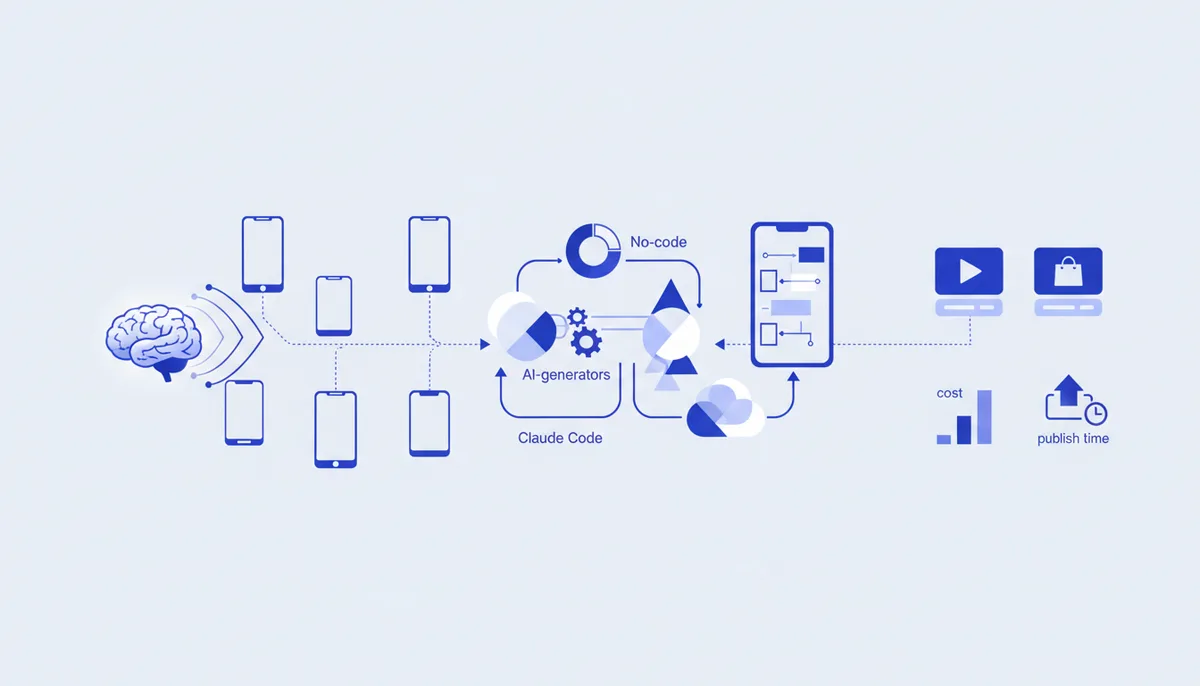
A mobile app is a program the user downloads from a store and installs on their phone. Building one with AI is genuinely possible, but let's be honest: it's harder than building a website. Three working routes as of July 2026:
- No-code builders (FlutterFlow, Bubble) — a visual editor, from $70-199/month; store publishing included. Glide only produces a web app (PWA) and doesn't go into the stores.
- AI generators (Rork, a0.dev) — you describe the idea in text and get React Native code plus "two-click" publishing.
- Claude Code + Expo/React Native — real code that belongs to you; maximum flexibility, but a steeper learning curve.
The hard part isn't building the app, it's publishing it. Apple charges $99 a year (and paying from Russia is a quest of its own), Google charges $25 one-time plus a closed test with 12 people over 14 days for new personal accounts, and RuStore (Russia's national Android app store) is free. Over a weekend you can realistically build a working single-purpose MVP, but not "the next Instagram".
Why is an app harder than a website?
A website opens from a link in a browser: you edit the code and a minute later everyone has the new version. An app plays by different rules. It has to be compiled into a binary for each platform (iOS and Android), pushed through the store's review, and updated only by shipping a new version.
Review (moderation) is the store team checking your app against their rules: privacy, security, no broken screens. Apple can reject a build and ask you to redo something — that's normal, not a disaster, but it eats time.
If what you actually need isn't phone-specific functionality (camera, push notifications, offline mode, geolocation) but a storefront or a service, weigh honestly whether a website would do. The differences between routes are covered in the guide on how to build a website with AI, and the general logic is in how to build an app with AI.
Three routes to building an app with AI
| Route | What you get | Learning curve | Price (as of July 2026) | Store publishing |
|---|---|---|---|---|
| No-code builder | Visual editor, ready-made blocks | Low | FlutterFlow from $70/mo, Bubble from $199/mo | Yes; Glide is PWA only |
| AI generator | Code from a text description | Low | Service subscription | Yes, "one or two clicks" |
| Claude Code + Expo | Real code under your control | Medium | Claude subscription + store fees | Yes, via an EAS build |
Now honestly, one by one.
No-code builders: fast, but with a ceiling
A no-code builder is a visual editor where screens and logic are assembled with a mouse, without writing code.
- FlutterFlow — from $70/month per user (as of July 2026); it builds native apps and can publish to the stores, but you connect and pay for the database (Firebase/Supabase) separately.
- Bubble — from $199/month on annual billing; backend included. It started as a web platform, but store publishing is available.
- Glide — from $60/month, but it produces a PWA (a web app) and doesn't go into the App Store or Google Play on any plan.
The no-code ceiling is customization. The moment you need non-standard logic or an integration, you run into the platform's limits — and into its monthly subscription, which isn't going anywhere.
AI generators: prompt -> app
An AI app generator is a service that generates working code from a text description. As of July 2026:
- Rork specializes in mobile apps and generates React Native (Expo) code. The Rork Max tier can also build native Swift apps and offers "two-click" App Store publishing without Xcode.
- a0.dev (a Y Combinator project) assembles a React Native app from a prompt and ships it to the App Store and Google Play; payments, analytics and a choice of database are built in.
This is the fastest way to see a working prototype. The downside is that you depend on the service and its limits, and serious polishing still has to happen in code. The result depends heavily on how you phrase the task — see how to brief an agent so it actually understands.
Claude Code + Expo: full control
Vibe coding is development where you describe the task in words and an AI agent writes and edits the code. Claude Code runs in the terminal, sees the whole project and makes multi-step changes: creating screens, fixing errors, kicking off builds.
The Claude Code + Expo/React Native combination gives you what builders can't — real code that belongs to you. Expo is a framework on top of React Native, and EAS Build compiles store-ready files in the cloud, with no local Xcode or Android Studio setup.
The learning curve is higher: you need to understand project structure and git. In exchange there's no customization ceiling and no subscription holding you hostage. Techniques that speed this work up are collected in vibe-coding techniques, and the systematic "idea -> working app" framework is in the Quest engine: a set of rules and structure for Claude Code/Cursor so the agent doesn't lose context over a long project.
What can you realistically finish in a weekend?
Honestly, not a TikTok killer. But in 1-2 days you can genuinely build a single-purpose MVP: a habit tracker, a catalog, a calculator, notes with sync. An MVP is the minimal version with one key feature that you can already put in front of users.
The trick is cutting scope. One main feature, one scenario, the fewest screens possible. Everything "for later" honestly goes to later. How to plan that sprint step by step is in a weekend MVP with AI.
Publishing to the stores: difficulty and cost
Building the app is half the job. Publishing it is the other half, and often the more tedious one.
| Store | Developer fee (July 2026) | Notes |
|---|---|---|
| App Store (Apple) | $99 per year | Paying from Russia is its own task; strict review |
| Google Play | $25 one-time | New personal accounts: 12 testers x 14 days |
| RuStore | Free | Individuals can publish; monetization requires a registered business |
Details as of July 2026:
- App Store. A developer account is $99 a year. Paying a foreign service from Russia is a separate task: Mir cards and Russian-issued VISA/Mastercard don't go through Apple's billing. The legal routes are a prepaid foreign card or a card from a foreign bank opened during a trip or through a legitimate intermediary. Budget the time and a possible markup; this isn't about bypassing blocks, it's about paying for a legal service.
- Google Play. A one-time $25 fee. But new personal accounts (created after November 13, 2023) face a requirement: before publishing, a closed test with at least 12 real testers over 14 consecutive days. Organization accounts are exempt, and what counts is genuine tester activity, not dead souls on a list.
- RuStore. Registration and publishing free apps costs nothing, and individuals can publish. But starting February 1, 2026, monetization through RuStore's payment tools is being switched off for individuals and self-employed persons — in-app sales will require registering as a sole proprietor or a legal entity.
The final budget comes down to three line items: the tool subscription (builder/generator/Claude), the store fees ($99/year Apple + $25 Google, RuStore free), and a backend if you need a database. A sensible order for testing a hypothesis: MVP first, then RuStore and Google Play, and Apple once the idea is confirmed.
From there, pick the route by the task: no-code for a storefront, a generator for a fast prototype, Claude Code + Expo when you need control and room to grow. Ready-made prompts, tools and roles are in the free arsenal and the learning tracks at /learn/, and the systematic framework for Claude Code on a long project is in the Quest engine.
FAQ
Can I build an app with no code at all?
Yes — through no-code builders (FlutterFlow, Bubble) or AI generators (Rork, a0.dev). But the more complex the logic, the faster you hit the platform's ceiling. To grow without limits you need access to the code — for example, through Claude Code + Expo.
What's cheaper, a website or an app?
A website is almost always cheaper and faster: no store fees, no review, no per-platform builds. If phone-specific features aren't critical, start with a website — see how to build a website with AI.
Do I have to pay Apple to release an app?
To publish in the App Store specifically, yes — $99 a year (as of July 2026). But you can start on Android: Google Play is $25 one-time and RuStore is free. That way you test the idea without Apple's fee.
How long does a first app take?
A working single-feature MVP is realistic over a weekend. Publishing adds days to weeks: Apple's review, and the 12-tester requirement for new Google accounts. A sprint plan is in a weekend MVP with AI.
Do I need RuStore if I'm already on Google Play?
For the Russian market, yes: RuStore comes preinstalled on many Android devices and charges no fee. Publishing to both is sensible. For in-app sales on RuStore you'll need a registered sole proprietorship or company.