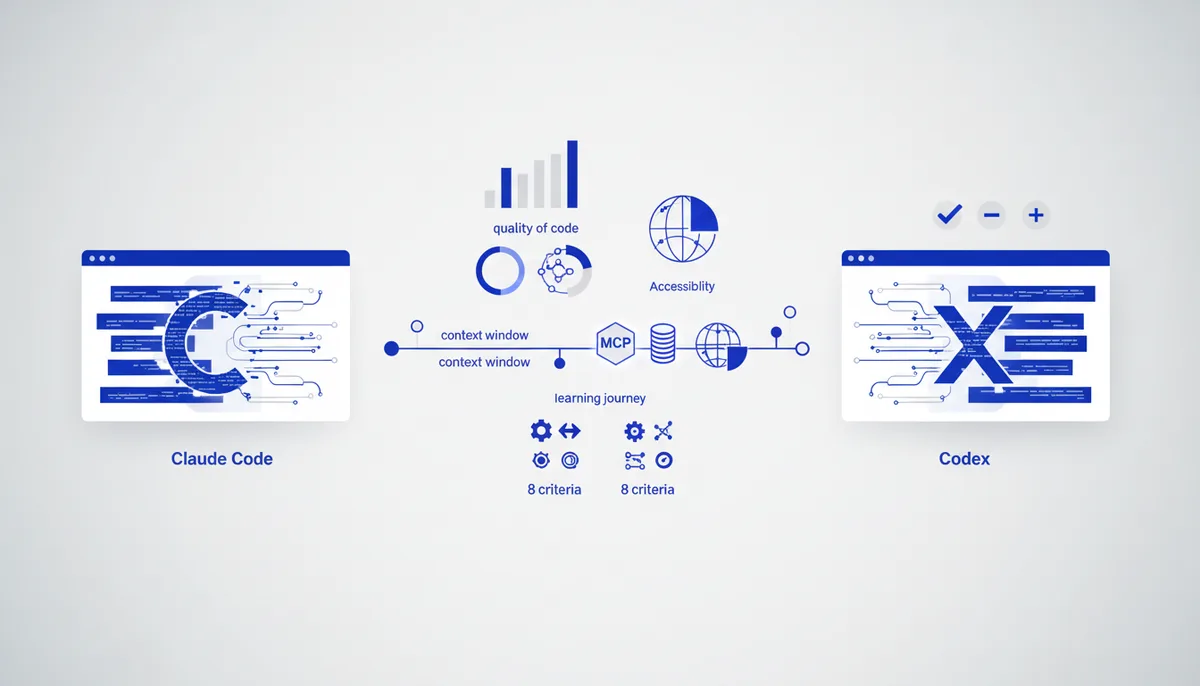
Claude Code vs Codex: Comparing the Agents in 2026
In short
Claude Code is Anthropic's terminal agent; Codex is OpenAI's agent platform, living in the CLI, the IDE and the cloud at once. Where things stand in July 2026: Claude Code on Opus 4.8 is stronger on hard tasks (69.2% versus 58.6% for GPT-5.5 on SWE-bench Pro), and in blind reviews its code is more often judged cleaner. Codex wins on agent hours per dollar, cloud background tasks and automatic pull request review — for the same $20 a month you get noticeably more "runtime". Neither is officially available from Russia: free ChatGPT works, but you can't pay for a subscription with a Russian card; Anthropic doesn't serve Russia at all — which leaves foreign bank cards, resellers (with the attendant risks) and API aggregators. The practical conclusion: don't marry a single tool. Keep your project rules in a portable layer — the qvib engine exports to both Claude Code and AGENTS.md, which Codex reads, so moving between agents takes minutes.
What are Claude Code and Codex?
Claude Code is Anthropic's development agent. It installs in the terminal (plus extensions for VS Code and JetBrains), reads the codebase, edits files itself, runs tests and writes commits. The philosophy is a shared session: the agent works on your machine, every step is visible, and you can step in at any moment. If you're just starting, keep the Claude Code guide for beginners handy.
Codex is OpenAI's agent system under the shared ChatGPT account: an open-source CLI, an IDE extension, a web interface, an iOS app, a GitHub review bot and cloud sandboxes where tasks run without you. The philosophy is delegation: hand off a batch of tasks, come back to finished pull requests. A detailed breakdown is in our OpenAI Codex review.
Both tools belong to agentic coding: the AI doesn't suggest lines, it completes the whole task. The overall picture as of July 2026:
| Criterion | Claude Code | Codex |
|---|---|---|
| Models | Opus 4.8, the Sonnet line | GPT-5.5, the coding build GPT-5.3-Codex |
| Code quality | Cleaner in ~67% of blind reviews | Parity on SWE-bench Verified, faster on routine work |
| Where it runs | Terminal + IDE extensions | CLI, IDE, cloud, web, iOS |
| Context | Up to 1M tokens on Opus 4.8 | Window up to 400K tokens (~258K usable) |
| Extensibility | MCP, subagents, hooks, skills | MCP, subagents, hooks, automatic PR review |
| Price (July 2026) | Pro $20, Max $100/$200, API per token | Free (limited), Go $8, Plus $20, Pro $100-200 |
| Access from Russia | Officially closed; API via aggregators | Free tier works; payment through legal workarounds |
| Ecosystem | Author of the MCP standard; ~10% of public GitHub commits | GitHub bot, Slack, Codex Cloud |
Which one writes better code?
By the benchmarks as of July 2026 — parity, with caveats. On SWE-bench Verified the gap is symbolic: 88.7% for GPT-5.5 against 88.6% for Opus 4.8, with Terminal-Bench marginally in GPT-5.5's favour. But on the heavier SWE-bench Pro, Opus 4.8 pulls away: 69.2% versus 58.6%. The human measure is telling too: in a survey of 500+ developers on Reddit, 65% prefer Codex for daily work — faster and cheaper — yet in blind reviews Claude's code was judged cleaner in 67% of cases.
Translated into practice: Codex chews through standard tasks brilliantly — CRUD, tests, migrations, template-shaped edits. Claude Code is stronger where architecture has to hold: legacy refactoring, long autonomous sessions, code you'll have to answer for in production.
Terminal or cloud: where should the agent live?
Claude Code is local. It runs on your machine, with your git, your keys and your environment: full control and instant feedback, but the machine has to be on and you have to be nearby. A web mode exists, but the core scenario is the terminal.
Codex was multi-surface from the start. Its most characteristic scenario is cloud sandboxes: you hand over three to five tasks, each runs in an isolated container, and out come pull requests that the GitHub bot will even review for you. Tasks can be filed from Slack or from your phone. If your style is "hand it off and check later", Codex is objectively more convenient.
Is there enough context for a big project?
Context is the volume of code and conversation the model holds "in its head" in one pass. Opus 4.8 has a 1M-token window on by default — the agent sees the architecture of a mid-size project in full. Codex's nominal million on GPT-5.5 is trimmed in reality: the window is capped at 400K tokens, of which roughly 258K are usable — the rest goes to the system prompt and tool descriptions.
Project memory works similarly on both sides: Claude Code reads CLAUDE.md, Codex reads AGENTS.md. AGENTS.md is an open format for AI agent instruction files: Codex, Cursor and dozens of other tools understand it; Codex reads such files from the repository root down through subfolders, up to 32 KB by default. This format is what makes a portable setup real — more on that shortly.
MCP, subagents and extensibility
MCP (Model Context Protocol) is an open protocol for connecting an agent to external systems: databases, APIs, issue trackers. Anthropic invented it, but by 2026 it had become an industry standard — Codex supports MCP on equal terms with Claude Code, so your server collection is shared.
Beyond that, the differences get finer. Claude Code has subagents with their own context and permissions, hooks, skills and agent teams that break tasks apart in parallel. By July 2026 Codex had caught up on the basics (native subagents, hooks) and added its own: automatic code review and deep GitHub integration. The score is close; the difference is emphasis: Anthropic offers a process construction kit, OpenAI a ready-made pipeline built around pull requests.
What does it cost, and how do you pay from Russia?
Prices as of July 2026 (both companies change them regularly — check the official price pages):
- Claude Code: Pro — $20/month, Max — $100 or $200/month; limits are shared with the Claude chat, in 5-hour windows plus weekly caps. The alternative is the API with per-token billing.
- Codex: included in ChatGPT subscriptions — Free (limited), Go — $8, Plus — $20, Pro — $100-200 depending on the review you read; since April 2026 usage is counted in token credits. The CLI ships as open source and also works with an API key.
For the same $20, Codex gives more agent hours — a weighty argument when you're starting out.
Neither works directly from Russia: Russia isn't on the supported-country lists of OpenAI or Anthropic, and payment systems decline Russian cards. The legal options: a foreign bank card, if you have one; paying through colleagues or relatives abroad; resellers and digital goods marketplaces — with the caveat that this always carries a risk of account blocking and lost money, and nobody guarantees anything. For Claude the practical route is the API through aggregators: we covered it in the guide "Claude API from Russia".
Who should pick Claude Code, and who Codex?
- Claude Code — if you work with a large codebase, refactor a lot, value quality over speed and like the terminal. The choice for code you'll answer for in production.
- Codex — if budget is tight (Go at $8 is the cheapest entry into agentic coding), the tasks are many and similar, and your working style is "delegate and review the PR". A strong option for a solo developer with a stream of small projects.
- Both at once — the mature 2026 pattern: Claude Code designs and refactors, Codex grinds through routine and reviews. How these agents compare to the editor camp is covered in Claude Code vs Cursor.
The main risk with either choice is getting welded to your settings: rules, prompts and checklists buried in one tool become a form of vendor lock-in. We solve that with a discipline layer on top of the agent: the qvib engine keeps contracts, pipelines and project rules in one place and exports them to Claude Code, to Cursor and to AGENTS.md — and therefore to Codex. Bought once (4 900 ₽, no subscription), one setup, any agent; more on portability in our Claude Code vs Cursor vs VS Code breakdown.
FAQ
Can I use Claude Code and Codex at the same time?
Yes, and it's common practice: Claude Code takes architecture and hard refactoring, Codex takes background tasks and review. To avoid maintaining two rule sets, keep them in a portable format: AGENTS.md, or an engine that exports to both tools.
Which is cheaper — Claude Code or Codex?
As of July 2026, $20/month buys noticeably more agent time on Codex, and the Go plan at $8 is the cheapest entry. On Claude Pro the quota is shared with the regular chat and burns down faster. But the number to count is the cost per accepted task, not per token: if Claude's code needs redoing less often, the gap narrows.
Does Codex work for free from Russia?
The free ChatGPT tier opens in Russia and includes limited Codex access, and the CLI ships as open source. Paid subscriptions can't be bought with a Russian card — only a foreign bank card or resellers, with risk to the account.
Does Codex support MCP?
Yes. MCP left the Anthropic ecosystem long ago: the Codex CLI connects MCP servers on equal terms with Claude Code, so databases, trackers and internal APIs are available to the agent either way.