Agentic Coding: What It Is and How It Differs
In short
Agentic coding is a development method in which the AI doesn't suggest individual lines but completes the whole task: it plans the steps, edits files, runs commands and checks the result itself. What separates an agent from autocomplete is the autonomous "act → check → fix" loop; what separates it from chat is that it doesn't hand you code to copy, it makes the changes in your project. Its relationship to vibe coding is method versus style: agentic coding is how the tool works, vibe coding is how the human frames tasks. An agentic system consists of a model, tools (files, terminal, search), an iteration loop and checks. Examples as of July 2026 are Claude Code, OpenAI Codex and Cursor's agent mode. The main risk is trusting the agent with too much without rules and tests, which is why a layer of "discipline" grew up around agents fast: project instructions, roles, checklists.
What is agentic coding?
Agentic coding is an approach to development in which an AI system receives a task in natural language and carries it through to a result on its own: it explores the codebase, drafts a plan, edits several files, runs tests and fixes its own mistakes. In this arrangement the human sets the task, answers clarifying questions and accepts the work — like a tech lead, not like the author of every line.
Two concepts need separating. A model is a neural network that generates text: on its own it can't "do" anything in your project. An agent is a model wrapped in a program with tools: access to files, the terminal, search. It's the tools and the loop that applies them that turn a "clever chat" into a worker. More on how the agent itself is built in our article on what an AI coding agent is.
The word "agentic" carries a specific meaning: the system acts (from Latin agere, to act), it doesn't only answer. The agent chooses each next action based on the outcome of the previous one: a test fails, the agent reads the log, finds the cause, fixes the code and runs the test again.
How does an agent differ from autocomplete and chat?
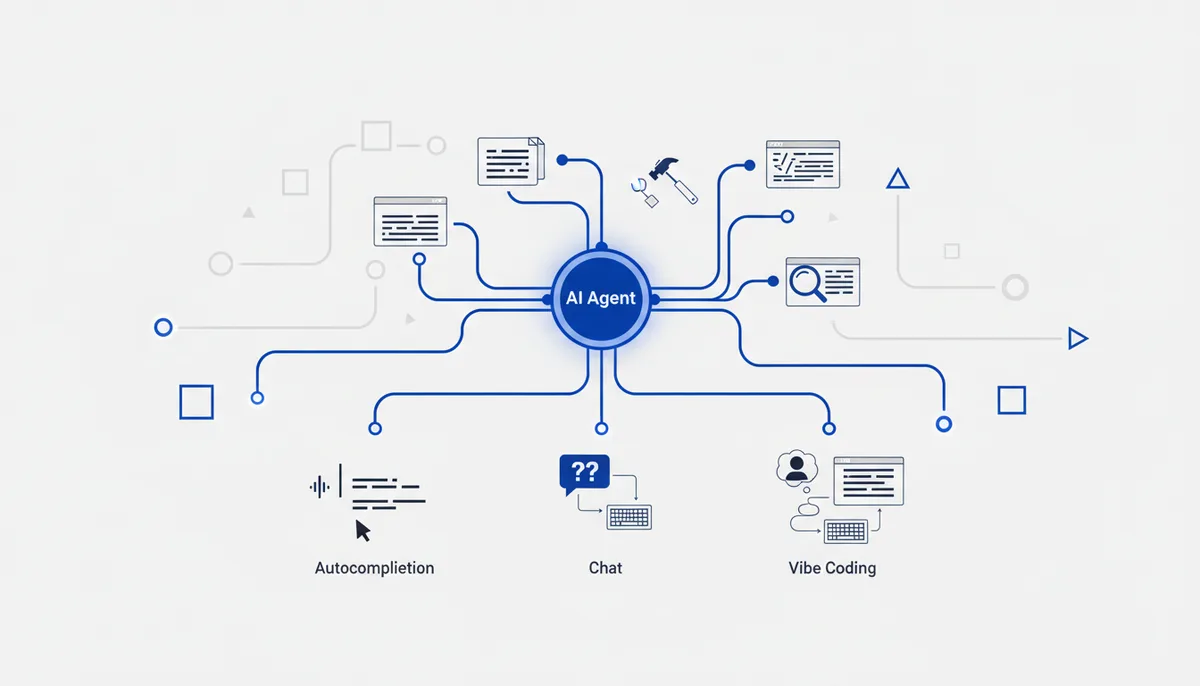
AI help in programming has gone through three stages, and all three live side by side — this isn't "old versus new" but different modes for different jobs.
Autocomplete suggests the next lines based on the context of the current file: you write the code by hand, the AI speeds up typing. Chat is a dialogue: you paste a fragment, get an answer, copy it back; applying the code is still on you. An agent is a doer: it sees the whole project and drives a change to a working state itself.
| Criterion | Autocomplete | AI chat | Agent |
|---|---|---|---|
| Unit of work | a line, a fragment | question — answer | a whole task |
| Who makes the edits | the human | the human (copy-paste) | the agent, across files |
| Visibility of the project | current file | whatever you pasted into chat | the entire codebase |
| Running code and tests | no | no | yes, by itself |
| Fixing errors | manually | manually | iteratively, by itself |
| Human control | every line | every fragment | plan and result |
| Typical task | finish a function | explain, debug a chunk | feature, refactor, bugfix |
The practical consequence: the higher the autonomy, the more the checks matter. You control autocomplete with your eyes as you type, but an agent's output has to be accepted deliberately — through the diff, tests and clear done criteria.
Are agentic coding and vibe coding the same thing?
No — they're concepts from different planes, though in practice they almost always show up together.
Agentic coding is a method: a description of how the tool works (an autonomous loop with tools and checks). Vibe coding is a style of framing tasks: the human describes the desired outcome in natural language and doesn't dig into every line, trusting the AI with the implementation. The term itself is unpacked in what vibe coding is.
The relationship is simple:
- You can vibe code through an agent — the most common scenario: "build me a login form", the agent does it, you look at the result in the browser.
- You can use an agent in strictly engineering mode: with a spec, review of every diff, tests. That's agentic coding but no longer vibe coding.
- Vibe coding without an agent, though, is nearly impossible: chat plus blind copy-paste won't take you far.
Experienced developers move along this scale deliberately: prototype closer to the vibe end, production closer to the strict method.
What is an agentic system made of?
Every coding agent, whatever the brand, is assembled from four layers.
The model is the brain: it understands the task, writes the plan and the code. The tools are the hands: reading and writing files, running terminal commands, searching the code, working with git, and — through the MCP protocol — external services such as a browser or a database. The loop (the agent loop) is the mechanics: plan → act → observe the result → correct, and so on until the task is done. The context is memory and rules: system instructions and project files such as CLAUDE.md or AGENTS.md, which record how work is done in this repository.
A fifth layer appears in mature systems — checks: tests, linters, type checking, human review. Without them the agent's loop closes on itself: the agent judges its own work through its own eyes.
Advanced setups run several agents at once: one plans, another writes, a third reviews. In Claude Code that's done through subagents, and how to assign agents the roles of a whole team — analyst, developer, tester — is covered in our article on agents and roles.
Which agentic tools are popular in 2026?
As of July 2026 the market has settled around three formats: terminal agents, editors' agent modes and cloud agents.
- Claude Code — Anthropic's terminal agent; runs in the console, IDE and cloud, strong on complex multi-file tasks. The easiest way in is our Claude Code guide.
- OpenAI Codex — OpenAI's agent: a CLI plus cloud sandboxes where several tasks run in parallel.
- Cursor Agent — the agent mode of the Cursor editor: it edits code and runs commands autonomously right inside the familiar IDE.
Alongside them sit the agent modes of GitHub Copilot, Windsurf, Replit Agent and others. A detailed comparison of the two leading tools is in Claude Code vs Cursor.
An important shift in 2026: the tools are converging in capability, and configurations are becoming portable — most agents read the AGENTS.md format. So there's no need to choose "forever": the method and the settings matter more than the brand.
Why does an agent need rules and checks?
The weak spot of agentic coding isn't code quality — it's the gap between what you meant and what the agent understood. An autonomous system given a vague task will confidently do the wrong thing: rewrite more than needed, pick a poor architecture, "fix" a failing test by deleting the assertion.
The cure is discipline, not abandoning agents:
- Project rules — an instruction file (CLAUDE.md, AGENTS.md, cursor rules) that records the stack, conventions and prohibitions.
- Decomposition — a large task broken into steps, each with a checkable result.
- Roles and stages — plan and approval first, then code, then review.
- External checks — tests and linters the agent is required to run, plus your own read of the diff before committing.
That layer is exactly what we packaged into the Quest engine: a ready system of roles, stages and checklists on top of any agent. The engine exports to Claude Code, Cursor and universal AGENTS.md, so the discipline stays with you when you switch tools.
How do you get started with agentic coding?
The barrier is lower than it looks. A working plan for the first week looks like this.
- Take one tool (Claude Code or Cursor is easier for a beginner) and one small project.
- Work only in git: a commit before every agent task is your insurance against any surprise.
- Set small tasks with a checkable result: "add email validation to the form", not "improve the project".
- Read the diff and ask the agent to explain its decisions — that way you learn from it instead of just clicking accept.
A step-by-step route from zero is in vibe coding: where to start.
FAQ
Will agentic coding replace programmers?
No — it changes what the work consists of. Writing lines gets cheaper; framing tasks, decomposition, review and accountability for the result get more expensive. The programmer shifts toward the position of architect and editor, and the ability to manage agents has become a distinct in-demand skill in 2026.
Can you use an agent with no programming experience?
Yes — for prototypes, personal tools and automations; that's vibe coding. But the closer the product gets to real users and money, the more the fundamentals matter: understanding the project structure, reading code well enough to say "what's happening here", checking security. An agent amplifies both what you know and what you don't.
If the model is the same, how is an agent different from an AI chat?
Tools and the loop. Chat generates text once and waits for you; an agent performs actions — edits files, runs commands — and reacts to the result itself. The same model in chat will explain how to fix a bug; inside an agent it will find it, fix it and run the tests.
Is it safe to give an agent access to your project?
With basic hygiene, yes: work in git, don't give the agent production access or secrets unless necessary, review changes before committing. Modern agents ask for confirmation on dangerous actions, but responsibility for what ships to production stays with the human.