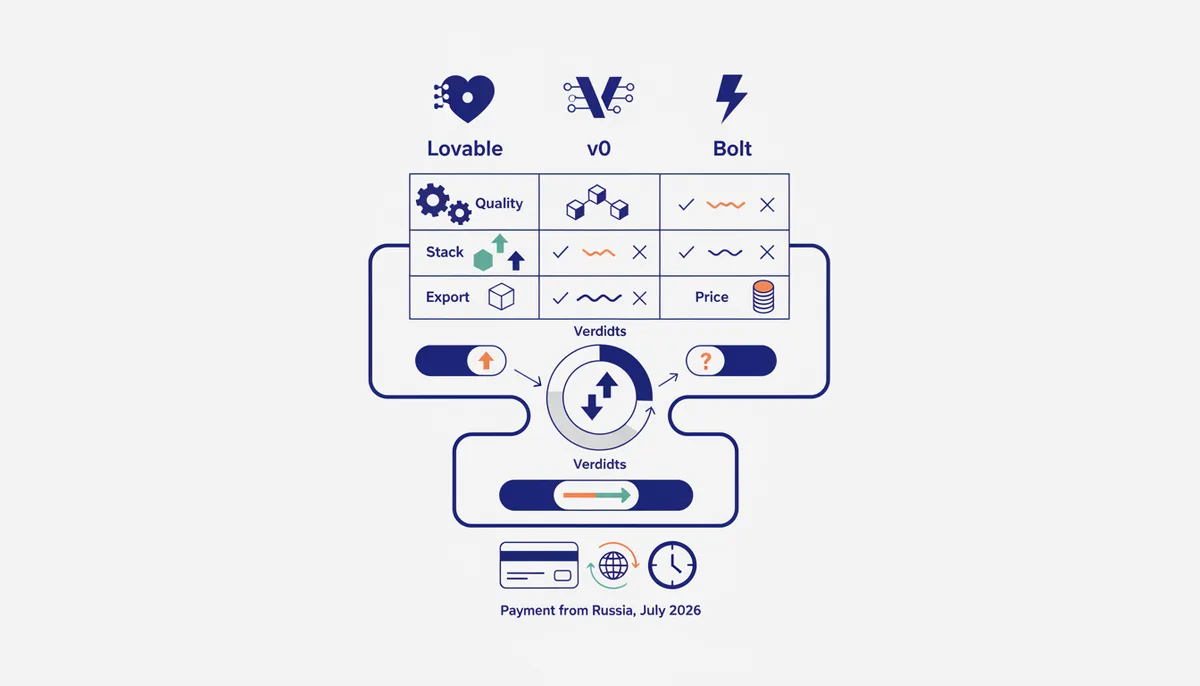
Lovable vs v0 vs Bolt: Which to Choose in 2026
In short
Lovable, v0 and Bolt.new are three AI generators that turn a text prompt into a working app or site, but they aim at different jobs. The short version: v0 (by Vercel) produces the cleanest, most presentable React interface — pick it for landing pages, dashboards and UI. Lovable assembles a full-stack MVP with a database and auth in one evening — pick it if you don't write code. Bolt.new is an IDE right in the browser with direct access to the code — pick it if you're technical and want control plus a mobile app.
All three are foreign services: the sites open from Russia, but paying requires a foreign card or an intermediary (as of July 2026). All three have free tiers, which makes testing without payment easy. And every generator shares one core limitation: it builds an excellent prototype, but on a complex project you run into variable code quality and lock-in to someone else's hosting. Past that point you need control — Claude Code or Cursor plus a methodology.
Lovable, v0 and Bolt.new: who's who
Lovable is a full-stack AI builder: from a description it assembles frontend and backend on React + Supabase, wires up auth and payments (Stripe), and deploys the app in one click. It grew out of the GPT Engineer project and is aimed at people who don't program.
v0 is Vercel's interface generator: it turns a prompt into clean React components on Tailwind CSS, optimized for Next.js. Historically a frontend tool, but in 2026 it gained a full-stack sandbox environment, a Git panel with branches and PRs straight from the chat, and database integrations.
Bolt.new is StackBlitz's in-browser development environment: it builds and runs the app right in the tab via WebContainer technology, with no local install. Backend and database come through Supabase under the hood, mobile apps through Expo. You stay closest to the live code.
If you're only starting to look into this, begin with the overviews: how to build an app with AI and how to build a website with AI. The full market map is in our guide to the best vibe coding tools of 2026.
Head-to-head comparison
| Criterion | Lovable | v0 (Vercel) | Bolt.new |
|---|---|---|---|
| Focus | Full stack, MVPs for non-coders | UI and frontend, design | In-browser IDE, code control |
| Stack | React + Supabase | React + Tailwind, Next.js | React/Vite, Supabase, mobile via Expo |
| Code quality | Standard React, readable | Cleanest React in its class | Varies from project to project |
| Backend and DB | Built in (Supabase), auth, Stripe | Historically none; in 2026, sandbox and DB integrations | Yes (Supabase under the hood) |
| Code export | GitHub on paid plans | Native GitHub with branches and PRs | Auto-sync with GitHub |
| Free tier | 5 credits per day (up to 30/mo) | $5 in credits per month | 1M tokens/mo (300K daily cap) |
| Paid entry point | $25/mo (Pro) | $20/mo (Premium) | $25/mo (Pro) |
| Paying from Russia | Foreign card or intermediary | Foreign card or intermediary | Foreign card or intermediary |
Which generator suits whom: the verdicts
Take v0 if you live in the Next.js and Vercel ecosystem and need the cleanest, most presentable React interface. On markup quality it's ahead of the competition — noticeably so when the result has to be shown to a client. Ideal for a landing page built with AI, for dashboards and for individual components. Its weak spot: full backend logic still isn't its strength and usually gets built separately.
Take Lovable if you don't program and want a working full-stack app in a single evening — database, auth and payments out of the box. It's the fastest start for validating an idea and building an MVP over a weekend. The price: hard coupling to Supabase (you can't plug in a different database) and unpredictable credit burn — simple edits are cheap, but a long debugging session eats the budget.
Take Bolt.new if you're technical, want an IDE in the browser and direct control over code, builds and debugging, and also want a mobile app through Expo. The cost of that flexibility is variable code quality and fast token burn on complex projects.
What it costs and how to pay from Russia (as of July 2026)
Current pricing as of July 2026:
- Lovable: free — 5 credits per day (up to 30 a month); Pro — $25/mo; Business — $50/mo; Enterprise — on request. Students and teachers get 50% off.
- v0: free — $5 in credits per month; Premium — $20/mo; Team — $30 per user; Business — $100 per user. In 2026 the service moved to token-based billing, so complex generations burn the limit faster than simple ones.
- Bolt.new: free — 1M tokens per month (300K daily cap); Pro — $25/mo (10M+ tokens with rollover); Teams — $30 per member. Annual billing takes 10% off.
Now about paying from Russia. All three are foreign services billing in US dollars. Russian cards haven't worked abroad since 2022, so subscribing directly isn't possible. The legal options as of July 2026: a card from a foreign bank with 3-D Secure support, or paying in rubles through an intermediary service that makes the payment on its own behalf. Everyone weighs the terms and risks for themselves — there's no single "right" method. The upside: the free tiers let you try each tool properly without paying anything, so the subscription decision can be an informed one.
Where generators end and control begins
All three share a ceiling. First, "soft" vendor lock-in: you can export the code, but managed hosting (Lovable Cloud, v0 paired with Vercel) takes the history and environment with it. Second, an exported repository you don't understand is a liability, not an asset: fixing someone else's generated code is harder than writing your own from scratch. Third, the generator makes architectural decisions for you — convenient in a prototype, a drag on a growing product.
Hence the healthy route: use a generator for the prototype and quick hypothesis testing, and once the project outgrows MVP, move the work onto your machine, into your repository, on any stack. That's Claude Code and Cursor territory — and to keep the agent from drifting, it needs structure: a clear brief, decomposition into steps, and control over each one.
That's exactly what the Quest vibe coding engine provides: a methodology and ready-made workflows for Claude Code/Cursor that turn chaotic "chatting with AI" into managed development, with no dependence on someone else's hosting. Free learning tracks help you pick up the approach from zero, and our breakdown of vibe coding techniques helps you build a personal practice. Generators and the engine aren't competitors: the first is handy for finding the idea, the second for taking it to a product you fully control.
FAQ
What should a beginner with no coding experience choose?
Lovable: it makes more decisions for you and gets you to a working full-stack app with a database and auth faster than the others. If all you need is a good-looking interface or a landing page, take v0 — its markup is the best of the three.
Can I move the project into my own repository?
Yes, all three export to GitHub (Lovable only on paid plans). There's no hard lock-in at the code level. But remember: moving a repository is easy, while maintaining generated code you don't understand is hard. That's precisely the reason to learn to work in your own environment early.
Do Lovable, v0 and Bolt work from Russia?
The sites themselves open, but payment only works with a foreign card or through a ruble intermediary (as of July 2026); Russian cards are declined. The free tiers are available for testing without any payment.
Which is better for a landing page or dashboard?
v0 — it has the cleanest React and the best markup in its class. For a full application with a backend, Lovable or Bolt.new makes more sense.
When should I move to Claude Code and the engine?
When the project outgrows the prototype: the logic gets complex, the team grows, and code quality and predictability become the priority. At that point control matters more than generation speed — and development should move into Claude Code or Cursor with the Quest engine.