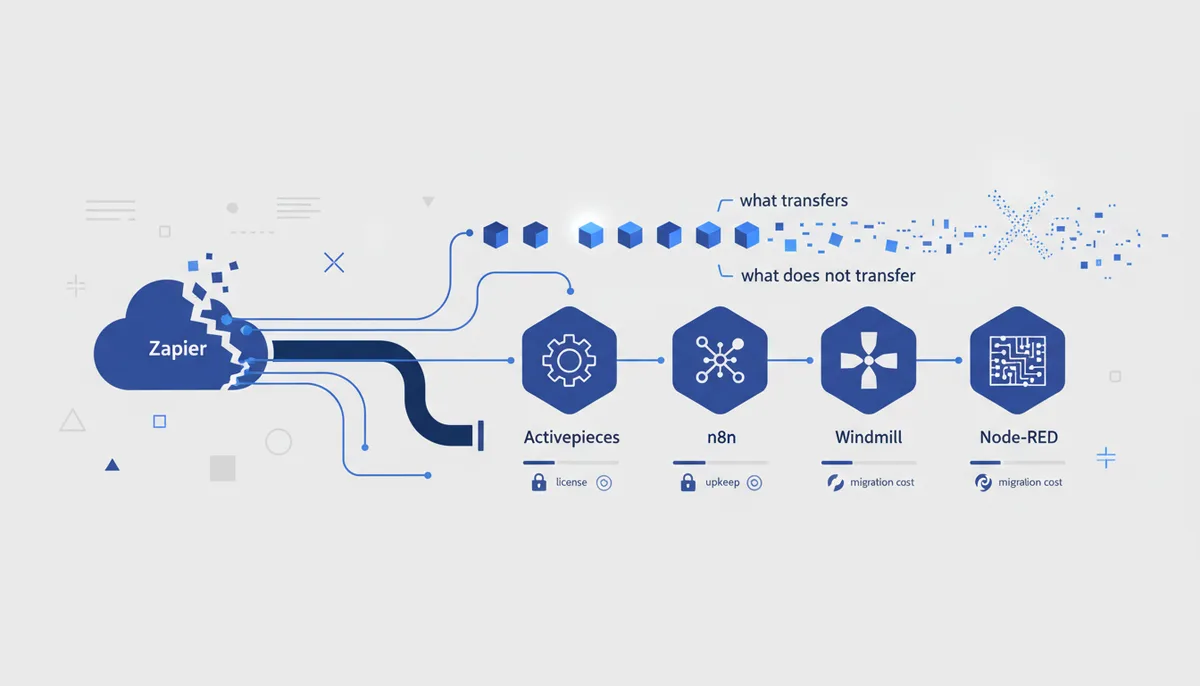
Self-Hosted Zapier Alternatives, Compared
In short
If you want Zapier's job done on your own server, the realistic shortlist is short: Activepieces if you want the closest thing to Zapier's UX with an MIT-licensed core, n8n if you want the widest connector library and are fine with a non-OSI licence, Windmill if your "workflows" are really scripts that deserve to be code, and Node-RED if you are wiring events and devices rather than SaaS accounts. Huginn still works but has had no tagged release since 2022. Automatisch looks the part but its main branch has been quiet since January 2026. Nothing imports your Zaps — every option is a manual rebuild, and the expensive part is not the logic, it is re-registering OAuth apps with every SaaS provider you touch. Self-hosting removes the per-task bill and replaces it with an upgrade cadence, a webhook endpoint you have to keep reachable, and credentials you now own. All figures verified as of July 2026.
Why teams leave Zapier
Three reasons, and they are not equally good ones.
The billing model. Zapier bills tasks, and a task is any successful action step that runs. Triggers, filters, Paths, Formatter and Delay are free — but every real action counts, so a five-action Zap firing 1,000 times a month is 5,000 tasks, not 1,000. Some steps cost more than one: Zapier MCP counts 2 per successful tool call, Lead Router counts 5. Past your allowance you either pay per extra task or your runs get held until the cycle resets.
Data residency. Every payload you route through Zapier passes through Zapier. For teams handling anything a DPA does not comfortably cover, that is a hard blocker rather than a preference.
Availability. Zapier is not available in every jurisdiction. If its pricing page returns a sanctions notice rather than plans — which it does from some locations as of July 2026 — the comparison is not "cheaper or not", it is "works or doesn't".
Notice what is not on that list: capability. Zapier's connector catalogue is larger than any self-hosted alternative and it handles OAuth for you. If none of the three reasons applies, self-hosting is a lateral move that costs you a server and a maintenance window.
The self-hosted options
Snapshot taken 28 July 2026 from the GitHub API. Stars are a popularity signal, not a quality one; the "last commit" column is the one worth reading.
| Tool | Licence | Stars | Last commit | Runtime | Best fit |
|---|---|---|---|---|---|
| Activepieces | MIT, except packages/ee/ |
23.5k | 2026-07-28 | Node + Postgres + Redis; embedded PGLite for small installs | Closest Zapier replacement for non-developers |
| n8n | Sustainable Use License (not OSI) | 198k | 2026-07-28 | One container, SQLite by default | Widest connector library, technical teams |
| Windmill | AGPLv3 / Apache 2.0 CE, proprietary EE | 17.3k | 2026-07-28 | Postgres + workers, ~1 worker per vCPU | Workflows that are really scripts |
| Node-RED | Apache-2.0 | 23.5k | 2026-07-13 | One Node.js process, flows as JSON | Event and device wiring, MQTT |
| Kestra | Apache-2.0 core, separate EE | 27.5k | 2026-07-28 | JVM + Postgres, YAML flows | Data pipelines, scheduled orchestration |
| Huginn | MIT | 49.7k | 2026-07-28 | Rails + database + workers | Scraping, monitoring, RSS-shaped agents |
| Automatisch | AGPL-3.0, except .ee. files |
13.9k | 2026-01-15 | Compose, Postgres + Redis | Hard to recommend — see below |
Two rows need footnotes, because star counts flatter both.
Huginn has 49.7k stars — more than Activepieces and Node-RED combined — and commits still land weekly. But its most recent tagged release is v2022.08.18. Self-hosting Huginn means running master and deciding for yourself when the tree is stable. Fine if you are comfortable with Ruby and Docker; a bad idea if you wanted a product.
Automatisch is marketed as "the open source Zapier alternative" and appears on most listicles. Its last commit to the default branch was 15 January 2026 — over six months of silence. Not abandonment, but not a base for a business process either.
Licence traps. n8n's Sustainable Use License permits use "only for your own internal business purposes or for non-commercial or personal use". Running client automations internally is fine; selling an n8n-powered automation service is the case to get advice on. Activepieces splits its tree: everything is MIT except packages/ee/, which carries a commercial licence — so SSO, RBAC and audit logs are the paid part. Node-RED and Kestra's core are the only plain Apache-2.0 options here.
What each one costs to run
Licence cost is zero for every option in the table. Your bill is a server plus your time.
A single-tenant instance handling a few thousand runs a month is not demanding. The realistic floor is a 2 vCPU / 4 GB VPS — enough for n8n or Activepieces with Postgres alongside. Windmill wants more headroom, because each worker is a process that actually executes your code, so plan by concurrency rather than run count. The sizing exercise in self-hosting an AI stack on one server applies if this box will also run other things.
If you would rather pay for hosting: Activepieces Cloud gives 10 active flows with unlimited runs free, then charges $5 per active flow per month (Activepieces pricing page, July 2026). n8n Cloud starts at €20/mo billed annually for 2,500 executions. Activepieces bills per active flow; n8n bills per execution, counting a whole workflow run as one regardless of node count. Both are kinder than per-action-step billing at volume, which is the single biggest reason a Zapier bill grows faster than the work does.
The honest caveat on n8n: the free self-hosted Community Edition omits SSO, Projects, Git version control, environments, external secrets and workflow sharing. Those unlock at Business, €667/mo billed annually. If your reason for leaving Zapier was cost, and your team needs shared workflows and SSO, check that number before you standardise.
Migration: what actually transfers
Nothing transfers automatically. No Zapier export imports into any of these tools, and none of them ships a converter. Third-party services advertise Zap-to-n8n conversion; treat their output as a draft you review node by node.
What the rebuild actually consists of, in rough order of pain:
- OAuth apps — the real cost. Zapier registers and maintains OAuth applications with every service it connects to. You do not. Self-host anything and you become the OAuth client: for Google alone that means a Google Cloud project, enabled APIs, a configured consent screen and your own client credentials, per n8n's own credential documentation. Multiply by every provider. For a workflow touching Google, Slack, HubSpot and Stripe, the credential work outlasts the logic work.
- Trigger semantics. Zapier polls a lot of things on a schedule and hides that from you. Rebuilding as a webhook changes timing, ordering and failure mode. Rebuilding as a poll means you own the cursor and the dedupe.
- The logic. Usually the easy part — filters, branches and field mapping port over conceptually.
- Error handling. Zapier's autoreplay and error emails are a feature you were using without noticing. Self-hosted, you configure your own error workflow and alerting, or you hear about failures from a customer.
A sequence that works: stand the new instance up empty for a week, rebuild one non-critical workflow, run both platforms in parallel on real traffic and diff the outputs, then move the rest in batches with the highest-volume ones last.
Where self-hosting bites back
You are now the uptime. A webhook endpoint that is unreachable does not queue — the sending service retries a few times and gives up. That means TLS, a public hostname, and monitoring that tells you the instance is down before a partner does.
Upgrade cadence is real work. n8n ships a new minor version most weeks; Activepieces commits daily. Every upgrade can shift a node's behaviour under a workflow you have not looked at in months. Pin versions and read release notes.
Credentials are now your problem. You store OAuth refresh tokens and API keys for every connected service in a database you administer. Encryption keys, backups and admin-UI access all become security decisions you own.
Connector coverage will disappoint you somewhere. Activepieces ships 724 community piece directories as of 28 July 2026, and n8n's catalogue is larger still, but Zapier's is larger than both. You will hit a service with no node, and the answer will be an HTTP request node plus a morning with someone's API docs.
The AI-workflow question is separate. If half your motivation is putting an LLM in the loop, see Dify vs n8n for where the boundary sits between an automation tool with an LLM node and a platform built for LLM apps.
Card-level notes and install commands live in the arsenal for Activepieces and n8n.
FAQ
What is the best free self-hosted Zapier alternative?
For most teams, Activepieces. Its Community Edition is MIT-licensed, the builder is closest to Zapier's step-by-step model so non-developers pick it up quickly, and the repository is actively developed. Pick n8n instead if you need the broadest connector catalogue or want code nodes with few restrictions, and accept that its licence is fair-code rather than OSI open source.
Can I import my Zaps into n8n or Activepieces?
No. Neither project ships a Zapier importer, and Zapier's step-based model does not map cleanly onto a node graph anyway. Migration is a manual rebuild. Third-party converters exist and can save you typing, but every converted workflow needs a full review and fresh credentials before it runs on real traffic.
Is n8n actually open source?
Not by the OSI definition. n8n uses the Sustainable Use License: free for internal business, personal and non-commercial use, with enterprise-only source files carved out. It is usually described as "fair-code". For an internal ops team this changes nothing; for anyone reselling automation as a service on top of n8n, it changes everything.
How much server do I need to self-host an automation platform?
A 2 vCPU / 4 GB VPS runs n8n or Activepieces at small-team volume with Postgres on the same box. Scale by concurrency, not by run count: what breaks first is several long workflows executing at once, not the monthly total.
Is self-hosting cheaper than Zapier?
At the licence line, always. In total, it depends on what your time costs. You trade a per-task bill for a VPS, an upgrade cadence, your own OAuth registrations and your own on-call. If your Zapier bill is under roughly one hour of engineering time per month, the switch will not pay for itself on cost alone — do it for data control or availability instead.