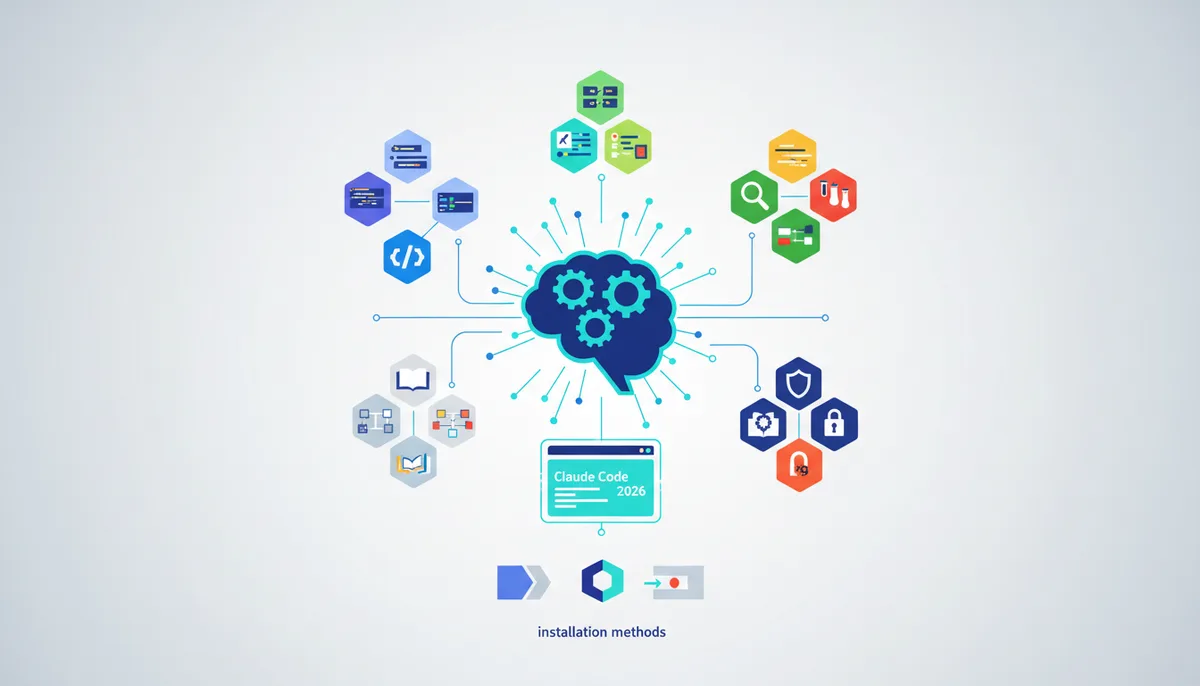
Best Claude Code Skills in 2026: A Curated List
In short
A skill (Agent Skill) is a folder with a SKILL.md file that Claude loads on its own when a task matches the description. In Claude Code, skills give the agent procedural knowledge on demand: how to review a diff, run tests, assemble documents, build MCP servers. Below is a curated list as of July 2026 by category (code, review, tests, docs, security), a table with each skill's status, three ways to install them, and an honest breakdown of which viral hype skills actually exist. Half of the best skills are official and free; you don't have to assemble a coherent set by hand.
What are skills and why are they better than prompts?
Anthropic introduced Agent Skills in October 2025, and by mid-2026 the format had become the standard way to extend agents: the same skill works in Claude Code, in the Claude apps and through the API.
Let's separate three concepts:
- A prompt is a one-off message to the agent: it lives for one task, after which you type it again.
- A skill is an on-demand procedure: a detailed instruction that occupies context only when it activates.
- An MCP server is the "hands": access to external systems (databases, browser, APIs). A skill is the "head": knowing how to act. The difference is covered in our roundup of MCP servers.
This works through progressive disclosure: at the start of a session Claude sees only each skill's name and description (a few dozen bytes), reads the full SKILL.md only when a task matches, and pulls in reference files and scripts as it goes. That's why you can keep dozens of skills and pay almost nothing in context while they stay quiet. A full breakdown of the format is in the guide Claude Skills: what they are and how to build your own.
Top skills by category, July 2026
Straight talk first: half the "skills" from viral reels ("Auto Refactor Pro", "10x Debugger") return nothing on Google — they don't exist. The real, useful skills are either official (the anthropics/skills repository) or large open-source community collections. Don't trust GitHub stars at face value: the count is easy to inflate and proves little on its own — look at evidence, recent commits and whether the project is alive.
| Category | Skill | What it does | Status |
|---|---|---|---|
| Review, security | /code-review, /security-review |
analyzes the current diff for bugs and vulnerabilities | free, built in |
| Tests | webapp-testing | drives a local web app through Playwright: clicks, screenshots, console, DOM | official, open-source |
| Process, TDD | superpowers (obra) | workflow: brainstorm → plan → tests → two-stage review | open-source, in the official marketplace |
| Frontend | frontend-design | UI without the "AI look": design tokens and component conventions | official Anthropic |
| Documents | docx · pdf · pptx · xlsx | generating and editing office files | official Anthropic |
| Documentation | doc-coauthoring | co-authoring a document via a structured workflow | official Anthropic |
| Integrations | mcp-builder | builds MCP servers: tool schemas, tests, evals | official Anthropic |
| Your own skills | skill-creator | helps you assemble and validate your own skill | official Anthropic |
| SEO | claude-seo | full site audit with a single /seo audit command, MIT |
open-source |
| Cybersecurity | Anthropic Cybersecurity Skills | hundreds of cybersecurity skills (community, not Anthropic) | Apache 2.0 |
Notes on the contentious rows. superpowers by Jesse Vincent (obra) is one of the most popular community collections; in early 2026 it joined the official Claude Code marketplace. It isn't a single skill but a bundle covering the whole development cycle: brainstorm, plan, tests, two-stage review. Anthropic Cybersecurity Skills has a misleading name: it's a community project, not an Anthropic release; several hundred cybersecurity skills under Apache 2.0. claude-seo is a toolkit of dozens of skills and agents that runs an SEO audit with one command.
More verified cards with evidence and check dates are in Arsenal → Skills.
What's already there out of the box?
A bundled skill is a built-in Claude Code capability available in any session through a slash command — nothing to install (you do need a recent CLI version).
/code-review— reviews the diff for bugs and simplifications; effort levels and the flags--comment(inline PR comments) and--fix(apply the fixes)./security-review— a security audit of your changes./review— pull request review;/init— project initialization./run,/verify— launch the app and confirm the change works in the live app, not just in tests (available in recent CLI versions).
In practice: before committing, run /code-review --fix, then /security-review on the diff — a minimal safety net that costs nothing.
How do you install a skill in Claude Code?
Three ways:
- Marketplace.
/plugin marketplace add owner/repo, then/plugin install skill-name@marketplace. The official package installs with/plugin installfromanthropics/skills. - Manually. Put the skill folder in
~/.claude/skills/<name>/SKILL.md(for all projects) or in.claude/skills/inside the repository (current project only). Important: SKILL.md sits directly in the skill folder with no extra nesting, andnamein the YAML front matter must be lowercase letters, digits and hyphens only. - As a plugin — a bundle of skills, one command from the marketplace.
After installing, restart Claude Code and verify loading with /doctor.
Honestly about access and money: the skills themselves are free and live locally — you only pay for Claude Code or the API. As of July 2026 there is no direct access to Anthropic from Russia; the legal options (aggregators, foreign cards — with caveats) are covered in Claude Code pricing and payment and Claude API from Russia. There are no instructions here for circumventing blocks — that's outside the law and outside the topic.
How to choose skills without building a zoo
Skills easily turn into a junk drawer: 40 skills with overlapping descriptions start conflicting, and the model activates the wrong one. Working rules:
- Official first.
frontend-design,webapp-testing,skill-creator,mcp-builderand the document skills cover most tasks. - One skill, one procedure. If the
descriptionis vague ("helps with code"), the skill will fire at the wrong moments. - Heavy work goes to a subagent, not a skill. A large refactor or a codebase investigation is better delegated to a separate executor with its own context — how to set that up is in the article on Claude Code subagents.
- Turn your own repeatable workflow into a skill via
skill-creator. The third time you type the same long prompt, it's already a skill.
How does this relate to the qvib engine?
Assembling a coherent set of skills, CLAUDE.md and subagents for a specific stack by hand is work. The Quest vibe-coding engine does it from a spec: given a project description, it compiles a consistent kit of skills, rules and roles for your framework, so the agent works to shared conventions from day one instead of a random zoo pulled off the internet. What's in the build is on the engine page; to start from the basics, see the learning hub.
FAQ
How is a skill different from a subagent?
A skill loads knowledge into the current context and activates on its own based on its description. A subagent is a separate executor with its own context window, to which you delegate a large subtask. A skill is "how to do it", a subagent is "who to hand it to". More detail in the subagents guide.
How many skills can you keep without hurting context?
Thanks to progressive disclosure, dormant skills cost a few dozen bytes each, so technically you can have dozens. The problem isn't context but overlapping descriptions: the more similar skills you keep, the more often the wrong one fires. Keep the set meaningful, not maximal.
Do skills only work in Claude Code?
The Agent Skills format is portable: one SKILL.md works in Claude Code, the Claude apps and through the API, and compatible harnesses (Cursor, several CLIs) can pick up the same skills. There's no lock-in to a single tool.
Do I need a VPN to use skills?
The skills themselves are local files and need nothing. The only question is access to Claude Code or the API. Legal payment and connection options from Russia as of July 2026 are collected in pricing and API from Russia; we don't publish instructions for circumventing blocks.