When to use it
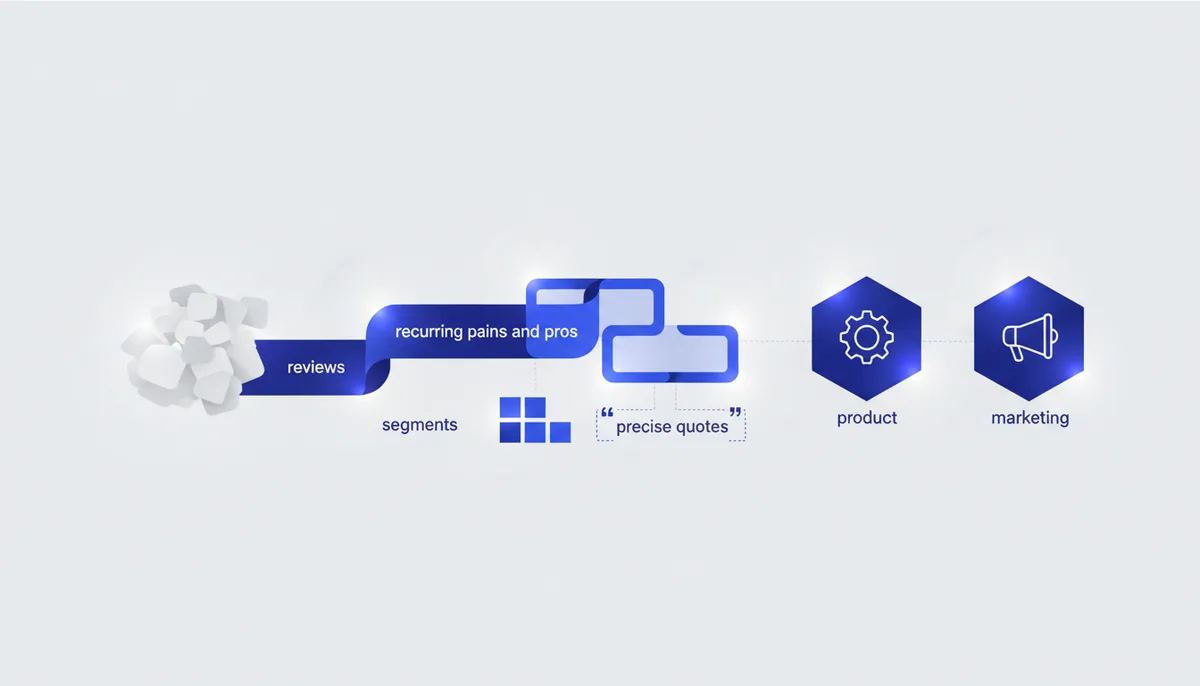
When reviews have piled up (marketplace, app stores, surveys, support) and you need to see the pattern: what gets praised most, what gets slammed, which segments exist, what to fix and what to put in the ads. The role is a Voice of Customer analyst. Output: themes with frequency and sentiment, exact quotes, priorities.
The prompt (copy and paste)
You are a Voice of Customer analyst. Analyze the reviews below. Work ONLY from the text, don't fill in blanks.
REVIEWS (one per line/block): "<PASTE>". PRODUCT: <what it is>. GOAL OF THE ANALYSIS: <improve the product / gather arguments for marketing / understand churn>.

Give me:
1. The main PAIN themes — group similar ones, and for each: frequency (roughly how many reviews), sentiment, 1-2 verbatim quotes.
2. The main PRAISE themes — what people love, also with frequency and quotes (this is marketing material).
3. Segments — if it's visible that different customer types complain about different things.
4. Top 3 "fix in the product" (frequency × pain) and top 3 "put in the ads" (strengths in customers' own words).
5. Red flags — one-off but critical (safety, lost money/data, legal).

Take quotes verbatim. If there isn't enough data for a conclusion, say so instead of generalizing from nothing.
Filled-in example
In <PASTE> — 80 reviews of a food delivery app. Goal: improve the product and gather arguments for marketing.
What the AI should come back with: pains — "slow delivery" (30 reviews, negative, quote "waited 2 hours instead of 40 minutes"), "the app lags" (15), "items I want are missing" (~10); praise — "polite couriers", "easy ordering flow", "fast support" with quotes; segments — people in outlying districts complain about timing more than those downtown; top 3 to fix (delivery times, performance, assortment); top 3 for the ads (couriers, convenience, support — in customers' words); red flags — 2 reviews about being charged without an order (escalate).
Variations
- Trend over time. "Compare reviews before and after the update — what changed in the complaints."
- Competitor. "Analyze a competitor's reviews — what gets praised and slammed, and where our opening is."
- Ready-made copy. "Turn the praise themes into 5 benefit bullets for the landing page, in customers' words."
Pro tips
- Verbatim quotes are gold: the customer's language converts better in ads than the marketer's. Insist on quotes, not paraphrase.
- Keep "red flags" as its own block — so that a single but critical review (money taken, data leaked) doesn't drown in the frequency stats and actually gets escalated.
- Frequencies from an AI are approximate, not statistics: for decisions on large volumes, re-check against the full dataset. And don't dump reviews containing authors' personal data into a public AI — anonymize first.