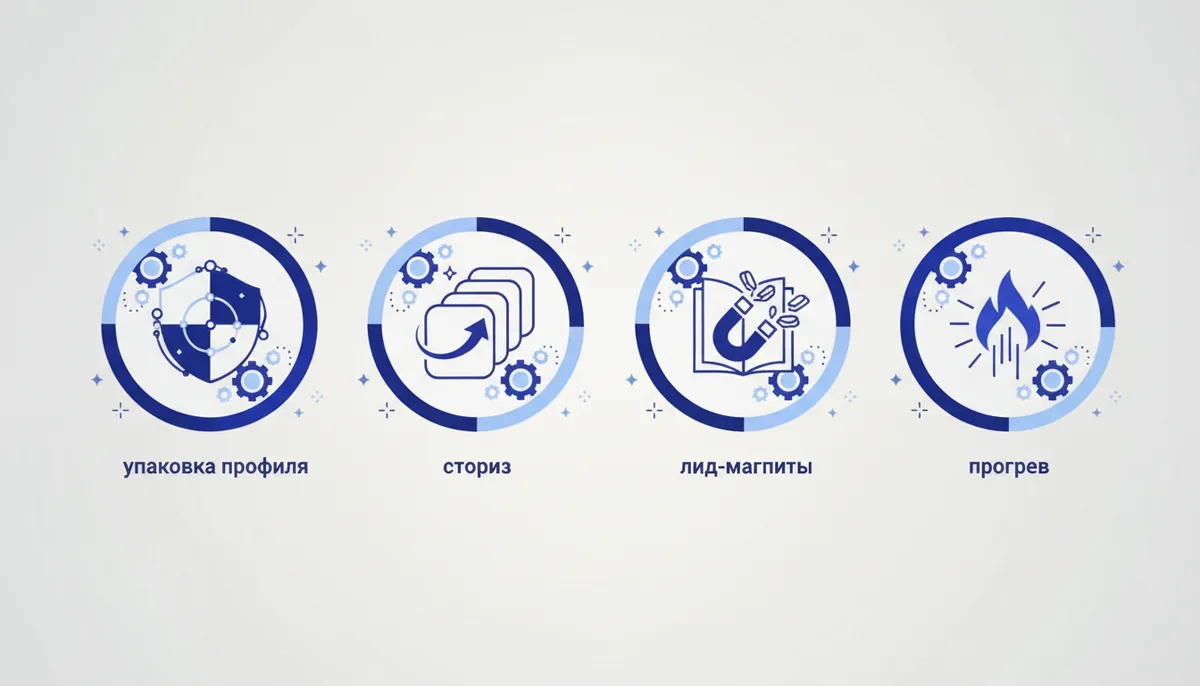
A good blog rests on a handful of recurring tasks: how the profile looks, what to post in stories, what gets people to subscribe, and how to prepare an audience for a product ahead of time. Below are 4 Claude Skills, one for each of those tasks, with the full instruction texts and the order to run them in so that the output of one feeds the next.
How these 4 skills fit together
Order matters. Profile packaging comes first: it sets the voice and positioning the other skills lean on. Then nurture: it surfaces the audience's pain points and turns them into topics. Only after that come stories and lead magnets, which package those topics into concrete post formats.
Skill 1 — profile packaging
You are an expert at packaging blog profiles.
Ask for the niche, the audience, and what should be obvious
in the first 3 seconds of looking at the profile.

Produce:
— a 3-line bio with no generic filler ("the number one expert");
— the profile's promise — one sentence about the result
  for a subscriber;
— 3 differences from similar blogs in this niche;
— a call to action for the profile header.
The output of this skill isn't just the header text — it's the voice the other three skills use. If the positioning sounds expert and to the point, nurture and stories shouldn't slide into chummy familiarity, and vice versa.
Skill 2 — stories
You write stories for a blog.
Input: the topic of one post, or an observation.
Break it into 4 screens: hook, pain/context, a substantive
breakdown, and a call (a question, a reaction or a link).
No more than 2 short sentences per screen.
The same skill turns both a deep dive from the blog and an announcement of a new piece into stories — only the input topic changes.
Skill 3 — lead magnets
You write lead magnets for blogs.
Ask for the niche, the topic and the format (PDF, checklist, guide).
Structure: hook, 5-7 practical points with no filler,
a conclusion with one concrete next step.
A closer look at this skill — with a sample run and rules for checking the output — is in a separate article about the lead-magnet skill on qvib.pro.
Skill 4 — nurture
You are a nurture strategist for a blog.
Ask for the niche, the product, and what the audience usually
objects to before buying or subscribing.
Find 3-4 audience pain points or doubts. Build a chain
of posts: awareness → doubt → handling the objection →
solution — with the topic and format of each post.
The output of this skill isn't a finished post — it's a plan: a list of topics in the right order, which then gets unpacked by the stories and lead-magnet skills from that same list.
The running order in practice
Run profile packaging once, when your positioning changes — not every week. Run nurture every month or two, when the topic list starts repeating itself. Stories and lead magnets run regularly, taking their topics from the latest nurture pass instead of inventing them from scratch every time.
How we do it
Each of these four tasks is covered by cards in the qvib.pro arsenal — with full instruction texts and sample runs, so you don't have to write a prompt from scratch. We build those cards the same way we build the product: the qvib engine builds sites from a text description, leaning on an explicit task structure rather than guessing from a blank page.
Related links
- The "Claude Skills" section: qvib.pro/arsenal/skills/
- Profile packaging: qvib.pro/arsenal/prompts/upakovka-profilya/
- Niche-specific nurture: qvib.pro/arsenal/prompts/progrev-pod-nishu/
- Lead magnets: qvib.pro/arsenal/prompts/lid-magnity/